I am not certain if I read too broadly or not concisely enough. In thinking about the Argonauts, I recall the Golden Fleece, a ram’s skin of radiant gold, and immediately think of the golden calf that Moses cast down, and then to scapegoats, Jesus as the lamb. The narratives form a skein that demands untangling.
My return to the Greek myths owes much to Roberto Calasso. When I first read The Marriage of Cadmus and Harmony, I was devastated, recognizing that the book I had long wanted to write had just been written, and in a form more brilliant than I could have managed. I felt like Athena before Arachne’s tapestry: not angry, but confronted with perfection. Three decades later, I am content to be derivative; to work in that spirit: condensing the myths into aphoristic fragments, seeking a clarity that gestures toward Wittgenstein and Nietzsche.
The voyage of the Argo is ancient, but the fullest surviving account is a Hellenistic retrospective, a prequel, written in an age eager to imagine a Greek unity that had never existed before Alexander. Apollonius comes late. His poem lacks the tragic compression of Aeschylus or Sophocles, the archaic authority of Hesiod, the breadth of Homer. It is reflective, literary, already conscious of standing at the end.
Jason calls the heroes. They come from every corner of the Greek world, the generation before Troy, and all of them greater than he. Why do they heed him? Why do better men follow? Great men do not always follow great leaders; they follow occasions worthy of greatness. The heroes seek kleos.
Kleos, the enlargement of name, is glory gained in the act. Reputation alone is inert. Kleos requires a stage, a sanctioned risk, a horizon against which excellence can be measured. The voyage of the Argo provides precisely this: a lawful pretext to leave the familiar world, to test oneself at its edges, to return (nostos) with story increased.
The heroes who show up number more than fifty, but the main participants are here as a reprise; they gathered before to slay the Calydon boar. This time they seek a hide already skinned. It is not merely an object but a proposition: that there remain deeds worthy of men already sung. So the heroes assemble, each carrying a different necessity.
Heracles comes because his strength must find release or turn inward destructively. For him the expedition is another channel through which compulsion may flow. He does not subordinate himself to Jason so much as move alongside the venture until fate diverts him. His presence is gravitational and temporary. Proof that the greatest intersect only briefly with collective undertakings.
Orpheus comes as witness. The voyage passes through thresholds where speech fails, clashing rocks, foreign rites, the ambiguous hospitality of distant shores, and a singer is required to render passage intelligible. His music orders what force alone cannot. He joins because the world at its margins must be serenated not just traversed.
Atalanta comes as a quiet provocation. She, not yet vanquished by convention, is drawn by contest and by a refusal to accept the narrowing definitions offered to her. The expedition becomes an arena in which excellence outruns convention, where skill justifies presence more than precedent.
The Dioscuri come as embodiments of fraternity extended outward. Their twinship models a broader solidarity among houses, a mutual recognition that glory compounds when shared. They bring seamanship, steadiness, and the assurance that the voyage participates in a larger network of reciprocal honor. Their motive is neither desperation nor vanity, but the maintenance of a world in which noble companionship still binds.
Peleus is not yet the father of a legend, but a man in formation. The expedition offers apprenticeship among the eminent, a chance to move within the circuits where reputation is won and alliances earned. For him, the journey is the defining preparation for fathering Achilles.
And Theseus? He sits in Tartarus, detained by the consequences of an earlier overreach: a reminder that heroic lives accumulate obligations and entanglements that cannot be set aside at will. His absence is not incidental; it marks the cost of ambition carried too far, and the fact that even the greatest cannot answer every call.
Seen together, the company reveals that each arrives with his or her own trajectory already in motion, intersecting Jason’s quest because it offers a legitimate convergence. They gather because this is a venture proportionate to their nature.
Jason stands at the center as a middle manager. He is a figure around whom rivalries need not ignite, a claimant whose need creates space for better men to act. His very insufficiency becomes a kind of social catalyst, allowing greatness to assemble without collapsing into contest.
So the Argo departs not as a procession behind a commanding hero, but as a temporary alignment of forces. The quest binds them briefly, like stars appearing in a constellation that exists only so long as the observer traces the lines.
But why a quest and why Jason?
Pelias rules in Iolcus with the nervous vigilance of a man who knows his authority rests on displacement. An oracle has warned him: beware the man who comes wearing one sandal.
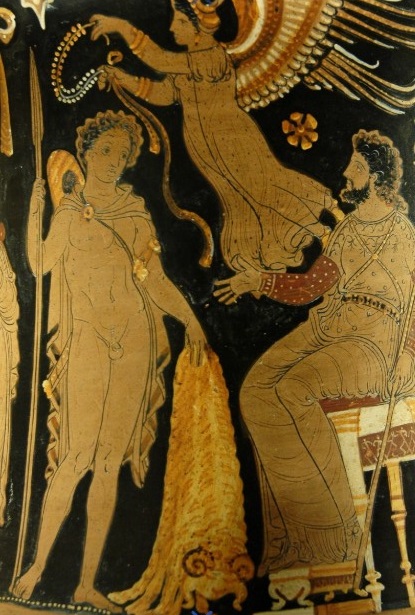
Jason arrives single shodded almost accidentally. On the road he encounters an old woman at a river swollen with current. She asks to be carried across. He lifts her and in the crossing loses one sandal to the water. The woman is Hera, concealed in age, testing recognition. In helping her, Jason binds himself to a power that will accompany him thereafter.
Why a sandal? Because kingship in the Greek imagination is often revealed through tokens rather than proclamations. A shoe marks the boundary between wild ground and ordered space; it is the sign of one who walks where others cannot. Like the sword and sandals hidden for Theseus beneath the rock at Troezen, the missing sandal announces a transition. Something has crossed over. A limen. The rightful presence appears in a small asymmetry that only the attentive recognize.
Pelias sees and understands. To kill Jason outright would stain the fragile legitimacy he has constructed. So he asks what should be done with a rival. Jason, still speaking in the plain grammar of heroic expectation, answers that such a man should be sent to retrieve a distant prize. Pelias agrees and names the prize: the fleece of gold, hanging in Colchis at the far edge of the world.
Thus the quest begins as an assignment designed to remove a claimant under the guise of honor. Yet in the logic of myth, what is meant as elimination becomes ordeal; what is meant as postponement becomes proof.
Hera watches. Hera’s sponsorship is striking precisely because it is rare. More often she opposes, corrects, restrains. Here she steadies succession. Jason carries her across the river; she carries him through the world.
So he seeks the fleece not because gold attracts him, nor because glory alone compels him, but because the path to kingship has been translated into a journey. To retrieve it is to transform prophecy into fact.
But what is the Golden Fleece?
Before it hung in Colchis, before Jason stood beneath the oak calculating how to approach the sleepless serpent, the Golden Fleece had already passed through air. It is the remnant of rescue, a skin that remembered flight.
It begins, as Greek stories so often do, with a household divided.
Athamas, king in Boeotia, had taken the cloud Nephele and from that union were born two children, Phrixus and Helle, beings already marked by transience, as though their mother’s substance could never fully settle into the solidity of earth. Nephele was presence and passing at once, a figure who could shelter but not remain. And like clouds, she thinned.
Athamas turned, as men often do, toward the more tangible. He took Ino, daughter of Cadmus, whose lineage already carried the dense gravity of Thebes.
For a time, nothing appeared altered. The rhythms of field and altar continued; children grew; sacrifices smoked upward. Then the grain failed.
Whether the failure came from blight, from weather, or from human design (the stories allow all possibilities) the result was the same. Seed cast into furrows did not return in green. Fields that had long answered with abundance lay silent. Hunger spreads first as uncertainty, then as accusation. In such moments the question is not only how to survive, but why the order of things has shifted.
Ino, who understood the currents of belief, is said to have intervened. Some tell that she secretly roasted the seed before planting, ensuring that nothing would sprout. Others say she persuaded those who carried messages from Delphi to alter the god’s words. However it was done, the oracle spoke with terrible clarity: The land will recover only when Phrixus is given.
The announcement transforms private rivalry into public necessity. What might have remained a domestic tension becomes a matter of survival. The community now shares in the logic. A sacrifice is an act of restoration: the removal of a blockage so that fertility may return.
Athamas hesitates. Kingship binds a man to the well-being of his people, and famine narrows the field of choices until even the unthinkable begins to appear as duty. The boy is brought toward the altar as an offering demanded by circumstance. One thinks of Abraham, asked by God for what cannot be asked.
At the altar intervention arrives in animal form. A ram descends. Not merely golden, but radiant with a brightness of condensed sunlight. This is Chrysomallos, sent by Nephele, the cloud that cannot remain but still protects. The children climb upon its back, and the creature rises, carrying them eastward, away from the geometry of plots and accusations.
They cross the narrow strait that divides continents. It is there that Helle loosens her hold. Whether seized by vertigo, terror, or simply the fatigue, she falls. The sea receives her, and from that moment the waters bear her name: the Hellespont, the sea of Helle. Geography as memorial, a crossing marked by loss.
Phrixus continues alone, arriving in Colchis at the world’s margin. There he sacrifices the ram and hangs its fleece in a sacred grove of Ares. A serpent coils nearby, tireless, unblinking. The skin remains, retaining its impossible sheen, as though the passage between danger and deliverance had been preserved in matter.
What, then, is the Golden Fleece?
It is not simply treasure. It is the residue of a crossing: the visible sign that passage from peril to legitimacy has occurred once and might occur again. A token of survival transformed into a test for those who come later. Kingship, like flight, must be proven at the boundary between worlds.
The Greeks would later call themselves Hellenes, and though the name descends properly from Hellen, the son of Deucalion and Pyrrha, the echo with Helle lingers suggestively, like a resonance not entirely intended but impossible to ignore. A people of crossings, of narrow straits and remembered losses, of those who fall and those who continue.
Yet we hear this most fully through Apollonius of Rhodes who set down the voyage in the third century BCE, when the Greek world had already been stretched across continents by the campaigns of Alexander the Great. What had once been a mosaic of fiercely local identities was being consolidated (administratively, linguistically, narratively) into something broader and thinner at once. His poem belongs to that moment: a work of recollection shaped in the libraries of Alexandria, where scholars assembled fragments of an earlier severity into a narrative suitable for a cosmopolitan age.
In that sense the story is not only remembered but curated. The Argonauts become a retroactive fellowship, a mythic prefiguration of unity: heroes drawn from every corner of the Greek world, sailing together long before such cohesion had any political reality. It is consolidation literature: an attempt to recover a center even as the old boundaries dissolve.
The timing matters. By the age of Apollonius, authority increasingly took administrative form. The old heroic violence, immediate and personal, gave way to treaties, appointments, bureaucratic hierarchies. Jason stands comfortably in such a world. He is neither the strongest, nor the most cunning. He is the one who convenes, legitimizes, and proceeds through process. Jason succeeds almost entirely through the capacities of others.
When the Argo must move, it is Argus who builds her, guided by Athena. When danger threatens morale, it is Orpheus who steadies the company with song. When brute force is required, Heracles supplies it; until he departs, and the expedition must continue without overwhelming strength. When seamanship and mutual defense matter, the Dioscuri stand ready. Jason watches.
The decisive reveal is at Colchis where Jason’s insufficiency becomes unmistakable. The tasks set by King Aeëtes are impossible by ordinary means: to yoke fire-breathing bulls, to plow a field, to sow dragon’s teeth and survive the warriors who spring forth. Jason cannot succeed without Medea.
Medea gives him the pharmakon, the ointment that renders him resistant to flame and iron. She instructs him in the stratagem of casting the stone among the earth-born warriors so that they destroy one another. She guides him through the labyrinth of conditions that guard the fleece. Without her, there is no success.
And yet once the fleece is secured, Jason turns toward calculation. In Corinth he seeks a marriage that will consolidate his position; an alliance more advantageous than loyalty to the foreign woman whose knowledge made his triumph possible. He abandons Medea for the daughter of King Creon, exchanging obligation for advancement.
The pattern is unmistakable. Jason excels not in conquest but through political navigation; of systems, of relationships, of opportunities. He is a figure of procedural ascent.
And Medea abandoned for political gain? Jason departs, and Medea enters a different kind of story.
Unlike the earlier telling by Euripides, Medea does not erupt into final catastrophe. She continues. She has already done what cannot be undone: she enabled Jason’s success. She gave him the ointment that allowed him to withstand the breath of the bulls, taught him how to turn the earthborn warriors against one another, guided him through the sacred grove to the fleece. She fled her father’s house and crossed the seas, carrying with her knowledge that unsettles every place she enters.
In Iolcus she persuades the daughters of Pelias that they can renew their father’s youth; a demonstration that ends in his death. Power here operates through ritual cunning, not open violence. When this renders the couple unwelcome, they move on.
In Corinth she lives as Jason’s consort. Later strands send her to Athens, where she becomes wife to Aegeus, attempting once more to secure position within a new order before departing again into the margins of myth.
She moves from Colchis to the Adriatic routes, from Iolcus to Corinth, from Corinth to Athens. She is a figure whose potency is acknowledged but accommodated. Medea becomes part of the larger circulation of stories, dangerous yet intelligible.
For Euripides the action fixes itself in Corinth, and what had been episodes becomes a reckoning. Jason’s abandonment is no longer one turn among many but a fracture that demands response.
Medea acts with relentless clarity. She sends wedding gifts, a robe and crown, that consume the new bride and Creon in consuming fire. And then she performs the act that seals the rupture: she kills the children she bore Jason, denying him the future he sought to secure.
When Jason confronts her, she is already beyond his reach. A chariot sent by Helios bears her away, lifting her above the human sphere, neither reconciled nor punished, but withdrawn into a domain where ordinary judgments cannot follow.
Euripides warns a polis of the dangers of excess, and Apollonius shows the acceptance of politics. Very different eras, each with their own demands.
But what of the resonance of the fleece, of golden rams and scapegoats?
The Golden Fleece is first of all the skin of a rescue. A child is spared; an animal is given. The skin glows because it remembers an exchange: life for life.
Why a ram? Because in Mediterranean sacrificial logic the ram occupies a liminal position: powerful yet domesticated, a leader of flocks yet destined for offering. It is neither wild threat nor passive victim. Its horns suggest potency; its submission suggests transfer. In ritual language, it is a suitable bearer.
Across the Near Eastern world, rams mark thresholds: of seasons, of covenants, of kingship. The horn itself becomes a sign of authority. One hears echoes in the Hebrew shofar, the ram’s horn sounded to gather memory and summon attention.
When Moses descends from Sinai he finds his people gathered around the golden calf, not a ram, but another bovine image of potency. To the Homeric poets the goddesses are cow-eyed (βοῶπις); bovine divinity is not foreign to Greek imagination. A people attempts to make visible the power that guides them. The calf is a condensation of divine presence into metal; the fleece is a condensation into skin. Both are dangerous attempts to hold what should remain diaphanous.
Scholars have long noticed these patterns. Frazer saw survivals of sacred kingship; Burkert traced ritual to the domestication of violence; Girard saw sacrifice as the displacement of communal tension.
The scapegoat makes this explicit. In Leviticus, the goat bears the sins of the people into the wilderness: guilt transferred, order restored through symbolic expulsion. The Greeks possess analogous rituals, though less doctrinally articulated. The pharmakos, a marginal figure expelled or sacrificed during crisis, carries away pollution. During festivals in some cities, a human or symbolic substitute would be driven out to cleanse the community. The logic is unmistakable: disorder must be relocated.
Greek tragedy remembers this structure. Oedipus becomes the bearer of Thebes’ pollution; his exile restores balance. The community survives by transferring burden onto a figure who embodies its contradictions.
Much like the substitution for Abraham, Chrysomallos marks the successful substitution of animal for child, and its later retrieval becomes a test of worthiness. The dragon guarding it is vigilance incarnate, as if reminding that such exchanges are never fully settled.
There is also a celestial echo. The ram appears in the sky as Aries, marking the spring: the renewal of cycles, the reopening of the year. Ancient observers linked myth and constellation not as decoration but as confirmation: the story is written above as well as below. The ram that carries, the ram that is sacrificed, the ram that rises. These are not separate images but different faces of recurrence.
Greek myth operates through such networks of association. Not systematic theology, but a web in which meanings reverberate across ritual, story, and observation. The fleece shines because it sits at a crossing of these threads.
Why gold? Because gold does not decay. It is the metal that resists time, and therefore an apt material for memory. A golden fleece is a paradox. Flayed skin imagined as incorruptible. It suggests that the act it commemorates cannot be forgotten.
Jason’s quest thus becomes something more than acquisition. He seeks an object already saturated with prior exchanges: rescue, sacrifice, legitimacy. And yet, once achieved, the Golden Fleece largely disappears from myth.
The fleece confers recognition but not resolution. The pattern continues: what is gained through substitution demands further reckoning. Medea will later remind Jason of the cost embedded in his success.
But how the story ends depends on who is telling it.
Apollonius’ Argonautica does not follow Jason into ruin. The poem concludes with return: the heroes sail home, reconciliations are achieved, dangers subside. Medea is still beside Jason, not yet the avenger of Corinth. The tone is one of completion, even restoration, as though the narrative wishes to gather its threads without tearing them. The voyage has been arduous but intelligible; the world remains coherent.
Apollonius stops before the fracture. His ending reflects a Hellenistic sensibility. Jason stands validated, his legitimacy secured by ordeal. The fleece has done its work; the poem closes.
Other traditions are less gentle.
Later mythographers, Apollodorus, Pausanias, Diodorus Siculus, Hyginus, carry Jason beyond the horizon Apollonius refuses to cross. They remember Medea’s revenge, Jason’s exile, the slow erosion of fortune that follows triumph. What remains is consequence.
They tell that Jason, outliving his moment, sat beside the timber-weathered Argo and that a fragment fell and ended him, as if the voyage reclaimed what it had once conferred.
The image is almost tender in its severity. No battlefield, no final speech, just the slow recognition that what carried a man to greatness cannot carry him indefinitely. The instrument of ascent becomes the instrument of closure.
Apollonius leaves Jason at the moment when achievement still feels whole. The later tradition insists on completion of the pattern. And so the story resolves along two lines. One preserves the memory of success; the other remembers its cost.
In the end, the Argo itself speaks the final word. Wood yielding to time, reminding us that even the vessels of glory are mortal.
 Protective Arts