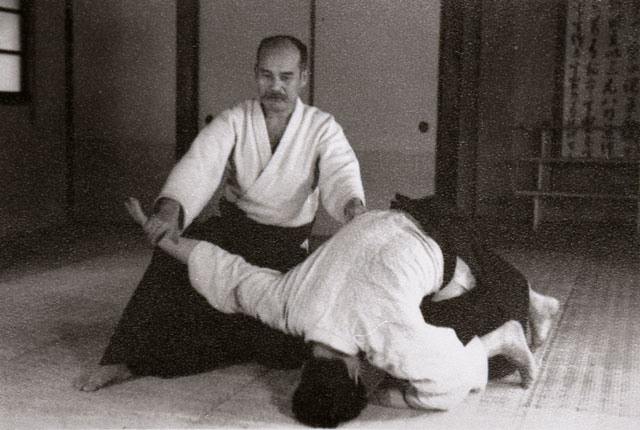
In the last several classes we have explored ikkyo-omote from static, tsuki and shomen. These are often misleadingly taught as if they are three separate techniques, but really it is all only one expression of a single line of the 8 basic angles of attack.
The eight basic lines of attack – if you are not familiar with these lines and how to traverse them, please study them – they are both foundational and universal:
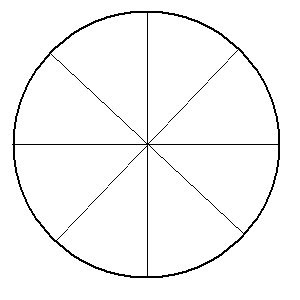
These are universal planes of engagement found in every martial blade culture. For example, in Europe the diagram was often referred to as the “cutting rose”
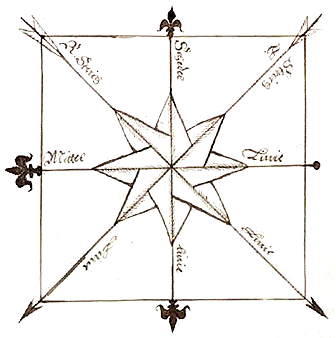
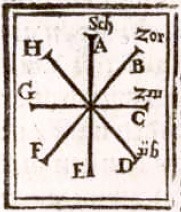
And while the cutting rose is most often shown superimposed on the body as a whole, remember that these planes can – and should be – a generalization you carry with you and are ready to place over any given target.
Once we fully appreciate that the lines are directional cuts that can be superimposed over specific targets, the next level of understanding is to fully appreciate that every line can become a point – which is to say a thrust.
As shown in the etching above, and as taught in Aiki-ken, the primary thrust is the 9th movement of the sword – tsuki. (A later article on the “thrusting triangle” will explore that in greater depth.) The foundational lesson, however, is to understand that the center point where all lines converge is chudan tsuki, which is taught as ai-hanmi-katate dori for pedagogical convenience.
Phrased differently: all three attacks can be “countered” with the same “technique” or basic movement pattern. In class it is easier to demonstrate, but to expand on this “universal” response: ai-hanmi-katate-dori is a training convenience in order to show and allow us all to train from a static origin. A static starting point eliminates all but one variable in the encounter: the contact – we have eliminated the other variables of distance, and tempo. With contact established and a static encounter nage is allowed to focus on learning correct movement – that is to allow uke to control the one point of contact, the one variable. Nage must learn to allow uke that point because it will be used to define the “axis” of the encounter, the fixed point around which all other movement rotates. Leaving the wrist in uke’s control, nage must move to the interior to a 45-degree relationship to the fixed point. Now we see how the basic 8 cut diagram translates to the horizontal plane and informs footwork.

The diagram remains a very fruitful teaching device because the universal planes of engagement when transposed to the horizontal plane become the walking lines – teaching the ashi-sabaki.
Since nage is now on uke’s interior, uke’s rear hand is a threat that must be neutralized. How? Nage must raise the hand being grasped by lowering his center while elevating the grasped hand on the vertical line defined by point of contact – i.e. without trying to move uke. At the top of the line, nage’s hand now should rotate shyuto (blade edge) toward uke’s head and then start to cut. It is the act of cutting that “takes” uke’s center.
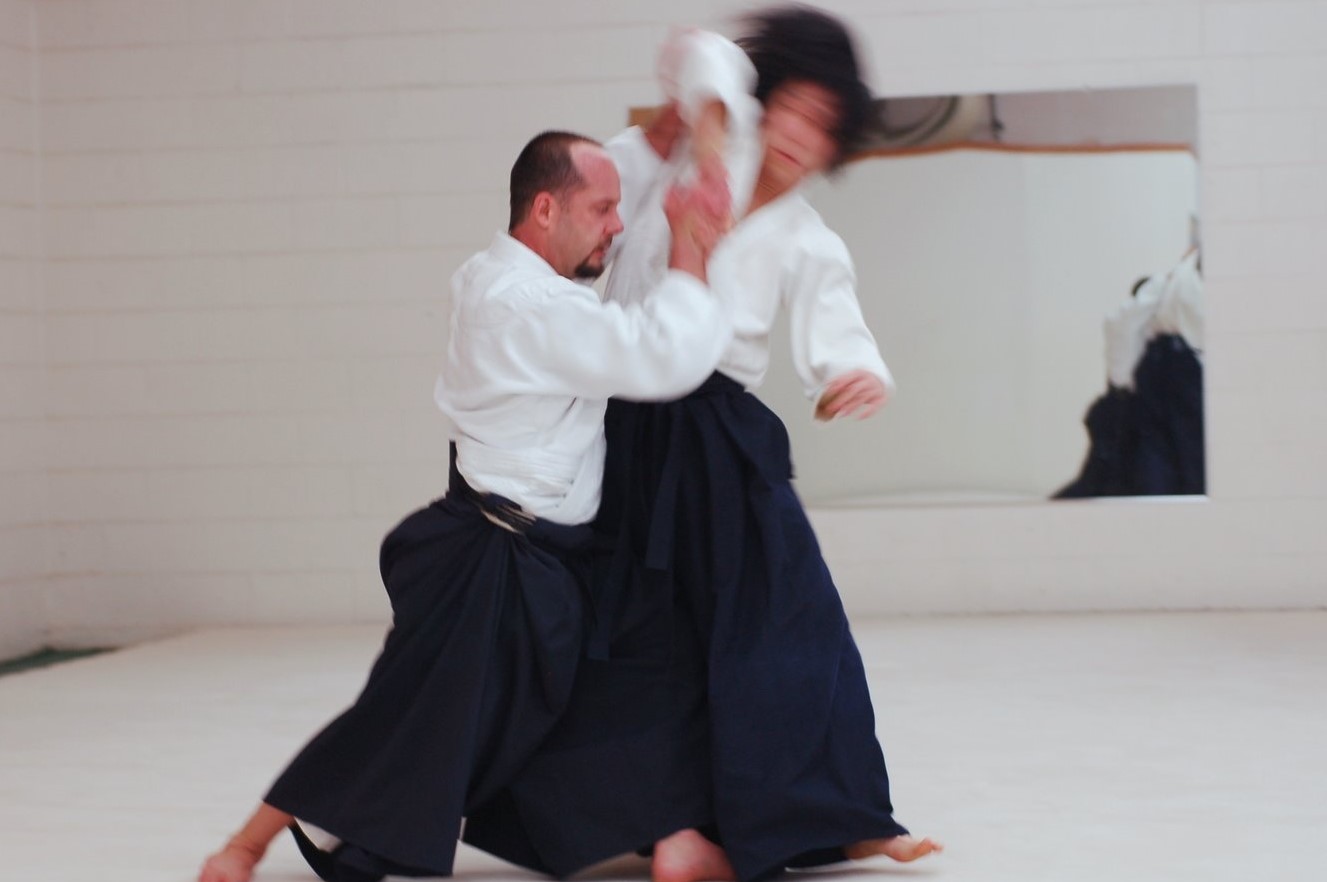
Uke should be motivated to move his head out of the path of the cut and to do it properly (and for that one needs train in class). But it is the atemi, the cut to the head, which takes uke’s center and simultaneously nullifies the threat of the back hand. Now that uke is in motion, the focus for nage’s striking hand (which uke is still grasping) is to take the humerus with the free hand and drive straight down – not out – which will further displace uke’s center and take him to the ground.
Nuances are legion and can only really be experienced through repetition and good training, however that is the basic mechanism, or “technique.” Understanding that, then moving to chu-dan tsuki is to merely introduce distance as a variable. A grab is merely the terminal limit of what could have been a punch. Nage’s response can and should be exactly the same set of motions performed from being grabbed. It is as simple as picking up the same point, but now in motion – i.e. we have introduced space as a variable.
The next variable is to change from static point (grab) to the dynamic point (punch) and transform the point to a line – the shomen uchi attack. Shomen merely requires closing the distance but now in true time – i.e. ki-musubi – so now nage determines when and where the point is intercepted.
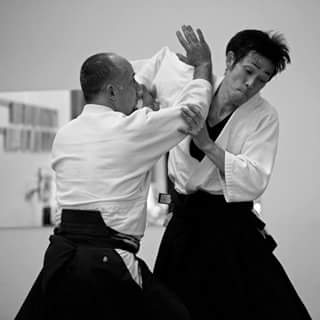
All the variables are now determined by nage whereas previously uke controlled some of the encounter.
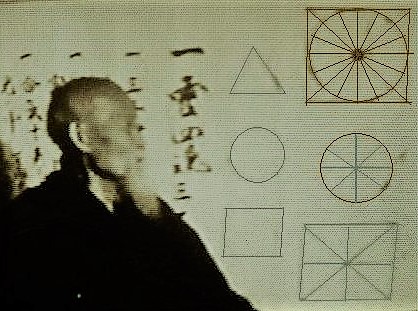
(Keep looking for these geometric symbols they represent keys to understanding.)
 Protective Arts
6 thoughts on “IKKYO (OMOTE)”