“There are no primary attacks in a knife fight.” This is an important reminder for Aikidoka who are habituated to the one-hit one-kill training mentality. In a knife fight attacks can be gambits, ploys, set-ups to elicit responses. Boxers must contend with similar complex encounters. Stratagems of deception and non-linear methods of attack are not Aikido’s forte. Aikido’s premise narrows the focus to one instant – that of the kill stroke. To replicate this intent with any sincerity means uke should be fully committed to the action – a unification of spirit, body, and action.
I have mentioned in other posts that this training can lead to dangerous artifacts of training, but the most obvious problem with a one-strike one-kill training method is that it fails to teach tactics. The best definition of tactics that I was taught is simple: good tactics are whatever increases your advantage while decreasing your opponent’s.
In a standard classroom setting, Aikido doesn’t afford an opportunity to develop tactical awareness. Rondori inculcates a crude response to group encounters, but does little to build the awareness in a continuous stream of action.
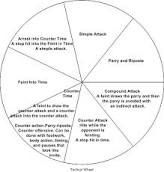
As a partial antidote, I suggest that western fencing offers an opportunity to learn the complexities of monomachy and more importantly provides a method of categorizing the responses. And to expand on the value of a fencer’s approach consider the Sarbo Tactical Wheel:
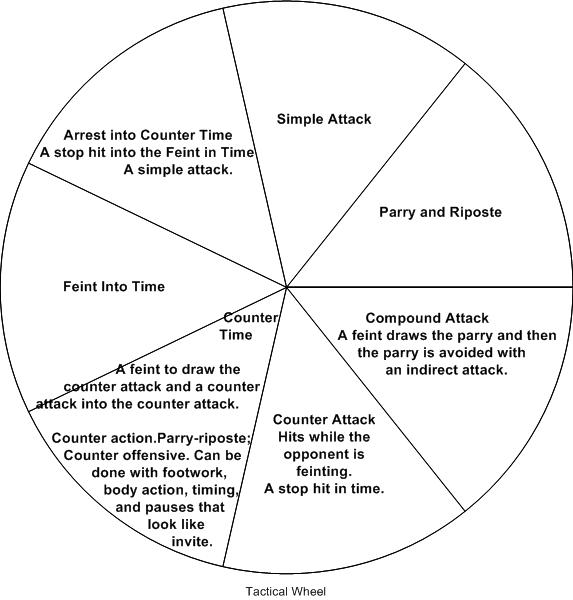
The Tactical Wheel defines how to defeat particular actions, beginning with the simple attack. Do not be confused by the label – in our art, a “simple” attack would be shomen, yokomen, tskui, etc. It is simple because straight forward – one hit kill. And as shown above, the direct attack is defeated by a parry-riposte – so to translate, shomen uchi is defeated by ikkyo omote (the parry is the intercepting front hand followed by the riposte of the back hand on the triceps). And here is where Aikido traditionally stops – with the parry-riposte. At the higher levels, we begin to play with defeating the riposte with the next step – a feint-attack, which is defeated by a counterattack, which is defeated by an attack, which is defeated by a parry-riposte, etc. Of course, in reality, nothing is this simple in its sequencing, but the wheel does provide a good reminder of what I have labeled the “Ouroboros” loop and ways to conceptually segment it.
 Protective Arts
4 thoughts on “TACTICS – BEYOND THE ONE HIT KILL”