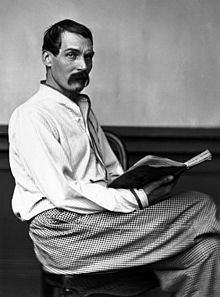
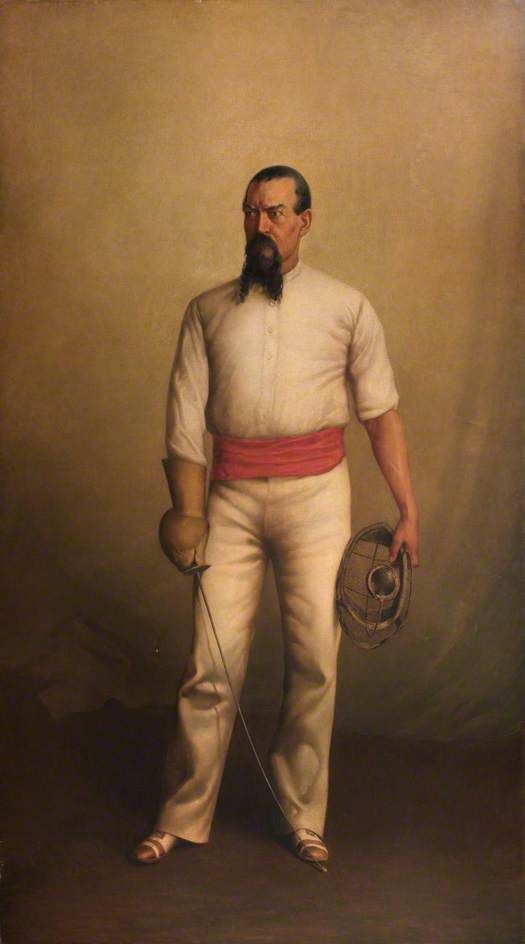
Sir Richard Francis Burton – polyglot, explorer, writer, swordsman – perhaps the quintessential warrior-scholar. His life and works are impressive and deserve study.
While written in Victorian prose, his work remains accessible and is deeply informed with the experience of a man who has been there, seen it, and done it all. A link to digitized versions of his oeuvre is found >here< but the works of specific interest to the martial artist are: New System of Sword Exercise for Infantry (1876), Book of the Sword (1884), and Sentiments of the Sword (1911) [also found here, and Burton-1911-sentiment-sword]. Texts are copied to this post for ease of reference.
Burton’s Sword Exercise – Notes on the Development of Victorian Saber Fencing – Part III
A New System of Sword Exercise for Infantry by Richard F. Burton (1821-1890)
Journal of Non-lethal Combatives, February 2000 published Burton’s New System in full with footnotes.
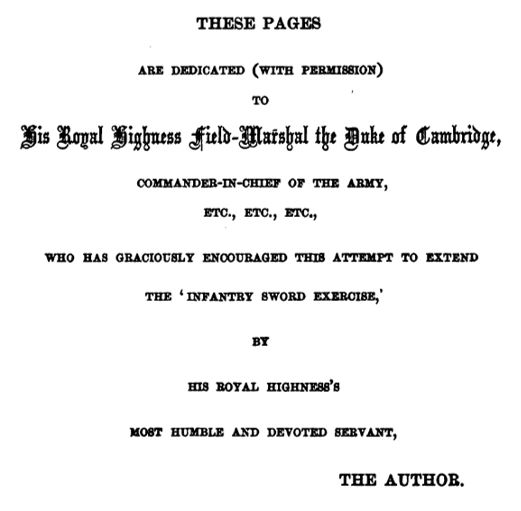
An excellent review of the New System is taken from the Victorian Fencing Society so that excellent material will be readily accessible:
 |
 |
 |
Burton provides an interesting perspective on the nineteenth century sword manuals intended for military training. It is often said that the character of a person can be learned in just 5 minutes of fencing with them. This may also be true of 5 minutes of reading a fencing manual. All of Burton’s fortes and foibles are on display – his knowledge, bluster, faultfinding, and sense of humor.
Sir Richard Francis Burton was an extraordinary Victorian. He was an explorer and anthropologist, who may be most famous for not finding the source of the Nile River. His many accomplishments include a journey to Mecca disguised as a native, explorations in Africa, Asia and the Americas, and learning a vast number of languages – 29 according to Burton himself. He was also a prolific author.
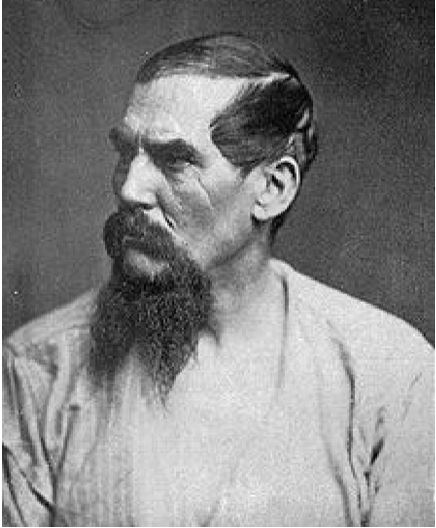
Burton would write about anything, but the sword was a favorite subject. Besides A New System of Sword Exercise for Infantry, he wrote a treatise on bayonet fencing in 1853. The Book of the Sword (1884) is an unfinished history of the sword, and the Sentiment of the Sword: A Country House Dialogue, was published in 1911 after his death. Burton said of the sword, “The History of the sword is the history of humanity.”
He was an accredited fencing master, and his ability to compare fencing with other national systems such as German and Italian is one of the things that make this manual an interesting item. His unique contribution is the use of manchettes, a system of cuts at the arm used to disable an opponent.
 |
In his introductory remarks, he lambasts contemporary English and French manuals. He states that there has been no advancement in the use of the sword.
“Whilst the last half century has witnessed an immense improvement in the projectile weapons of the civilized world, the theory and practice of the sabre or cutting arm have remained in statu quo ante; indeed, if there has been any change it is for the worse.”
He then goes on to criticize the current British military manuals as obsolete, and “nought but a snare and a delusion.” He notes that the only updates in the manuals are the uniforms in the picture plates.
Of the Infantry Sword Exercise he says “I am opposed to almost every page of this unhappy brochure” objecting to the shape of the target, the grip of the sword, the position of the guard and the parries.
 |
For example, and many of his contemporaries agree, he insists that one should “sit on guard” with the weight equally distributed on both legs. He describes the reason for the old style of keeping the bodyweight on the left leg:
“The person is not so much exposed; moreover, that the centre of gravity being thrown back adds spring and impetus to the Lunge.”
But this risks cramps in the overworked rear leg, which for Burton is enough to discard its use.
He criticizes the Guards. Of the Hanging Guard he says it is a “painful spectacle” and a “Lesson of what to avoid”. It exposes the right forearm and is fatiguing.
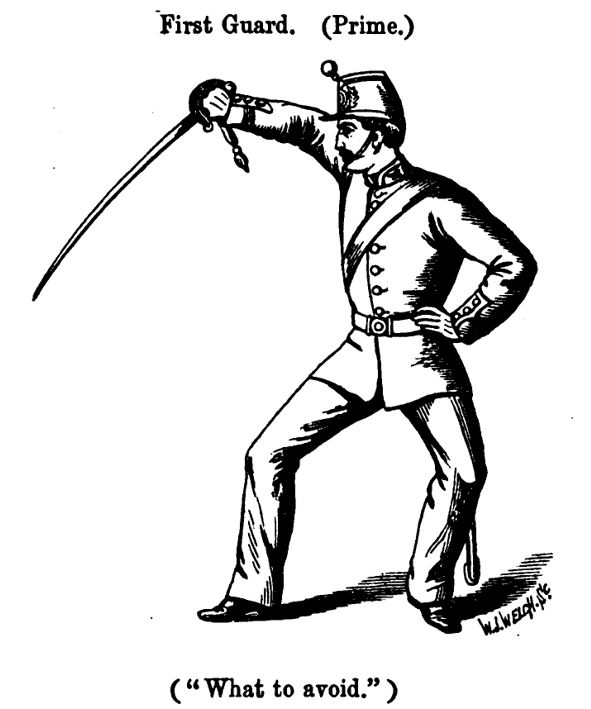
The inside engaging guard (carte) also endangers the forearm, and outside engaging guard (tierce) holds the hand too low and endangers the arm.


Burton calls the “loose practice” with the singlestick a mistake for learning saber. The lack of edges on the stick (which he says is simply a different weapon) lends to every blow representing a cut.
He also criticizes the simplification of terms, such as right and left for tierce and carte “as if such mysteries were too high or too deep for our national intelligence.”
Burton was not shy about criticizing the practices of the British government and military, and he developed a world view that could eschew British superiority.
He suggests that the British soldier will be equal in intelligence with the rest of Europe “When we enlist the right kind of recruit either by improving his condition and his prospects, not his pay, or better, far better, by securing a superior man through the conscription of modern Europe. We Britons are no longer physically divided from the total orb; nor can we afford to remain morally insulated and isolated. The logical effect of union with the outer world will be to make us do as the world does, and all our exceptional institutions, such as the system of volunteer recruiting, must sooner or later go by the board.”
Finished with his critical introduction, and asking that his own work be similarly scrutinized, Burton emphasizes the importance of his treatise.
“I have now finished with the ungrateful task of criticizing, and I proceed to propose a system which it is hoped will be as severely criticized by others. It is only candid to state that its pretensions are high, that it contains two distinct novelties, the Manchette System and the Reverse or Backcut; and, finally, that it aspires to be the first Treatise in which the broadsword is scientifically taken in hand.”
Section I. PREPARATORY INSTRUCTION WITHOUT THE SWORD.
Preliminary
Burton refers to the preparatory squad drills of Balance and Extension motion training as the “goose step of the sword”. Squad drill, he notes, will not likely make a good swordsman, but economy of time renders it a necessity.
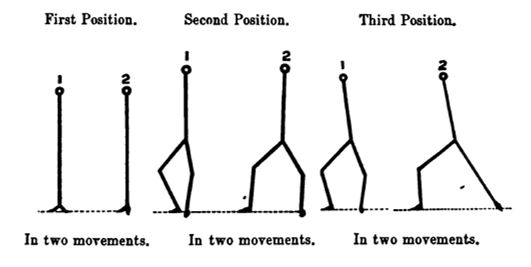
First Position in Two Motions
He goes through First Position, Second Positon (the Guard), and Third Position (from Guard to Lunge). To avoid fatigue and give additional balance to the body, Burton suggests they also practice the actions standing as a left handed fencer would do.
Attacking, Advancing and Retiring
The attack Burton refers to is a beat on the ground with the right foot. He apparently is describing the appel.
Section II. PREPARATORY INSTRUCTION WITH THE SWORD
Explanation and use of the target
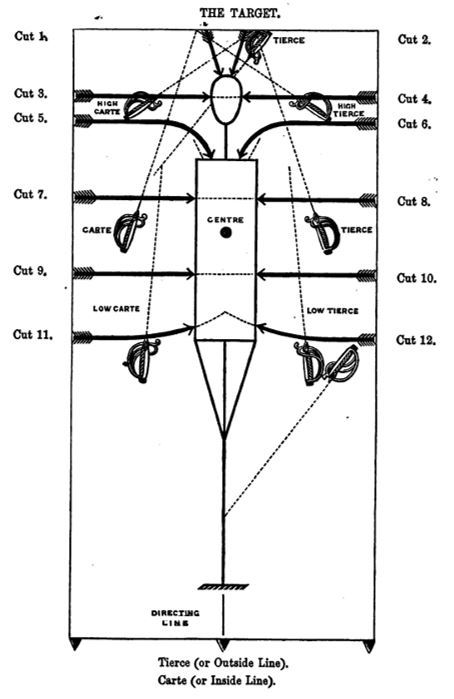
One of Burton’s criticisms is the depiction of the target in most saber manuals. With his typical caustic humor he notes: “to the shape of the target—I never yet saw a man absolutely circular;” This is a reference to most cutting targets depicted in saber manuals that are circular in shape, showing the directions of the cuts along the radius.
Burton’s target is oblong and the figure is five foot 8 inches tall. Showing the lines of the 12 cuts and the angle of the saber. He notes that the target “directs the recruit on how to make the cuts, but not exactly where; this must depend upon how the opponent acts during the attack and the defense.”
The Moulinet
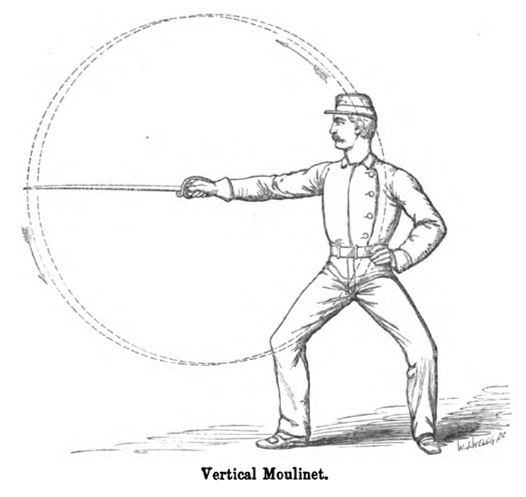
Burton requires that this rotation movement should be learnt before the recruit proceeds to the Cut.
This section is a good example of Burton’s urge to include detailed background on his subject matter. Before he gets in to the action of the moulinets, a lengthy footnote describes it as being a favorite movement of French sabrers. Most of the footnote is written in French. Burton often added quotes in Latin, French, Italian and other languages without translation. Readers had complained about his use of untranslated quotes, to which he responded that he could not help if they were not smart enough to read his books.
As for the moulinet, he says “There is nothing better for ” breaking,” as the French say, the recruit’s wrist than this sweep of the sword; and the style of a swordsman may always be known by his Moulinet.”
He divides it in three kinds: Horizontal, diagonal and vertical.

The Cuts
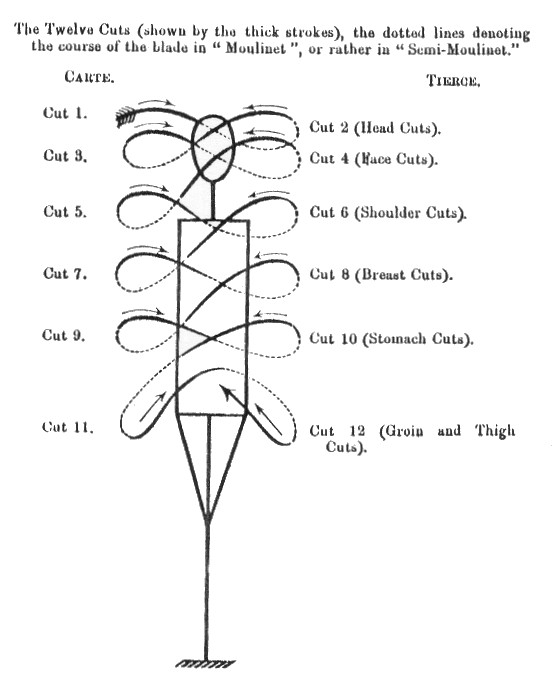
Of making cuts, Burton says that “The Cuts must, as a rule, be delivered within eight inches of the point and at the “centre of percussion,” so that the sword may clear itself and the arm escape a “jar.”
There are twelve cuts. 1 & 2 are at the head, 3 & 4 are horizontal face cuts, 5 & 6 are slanting shoulder cuts, 7 & 8 are horizontal breast cuts, 9& 10 are horizontal stomach cuts, and 11 & 12 are slanting groin or thigh cuts, going from downwards upwards, as in the reverse of the shoulder cuts.
He adds that “The two virtues of the Cut are its trueness and its velocity.”
Burton describes the various ways of making cuts, demonstrating his experience with foreign styles. His preference is what he calls the “whip cut”, which is made mostly from the wrist.
The following are the five principal ways of cutting according to Burton:—
- The Chopping or Downright Cut, from the shoulder and fore-arm. This appears to be the instinctive method preserved by Europe; most men who take up a sword for the first time use it in this way.
- The Sliding Cut, common throughout the East. In this movement the elbow and wrist are held stiff and the blow is given from the strong muscles of the back and shoulder, nearly ten times larger than the muscles of the arm, while the whole force and weight of the body are thrown in. Hence the people of India use small hilts with mere crutch-guards, which confine the hand and prevent the play of the wrist; the larger grip required for the Chopping Cut only lessens the cutting force. The terrible effect of these cuts is well known.
- The Thrust Cut, with the curved (” Damascus “) blade; a combination of point and edge, the latter being obliquely thrust forward and along the body aimed at. This movement is a favourite on horseback, when speed supplies the necessary forms, which can hardly be applied on foot. It must be carried like a Point.
- The Whip Cut; in which the arm and elbow are kept almost motionless, and the blow is delivered from the wrist. This is the principal Cut allowed in my system; it is capable of sufficient effect upon the opponent whilst it does not uncover the swordsman who uses it.
- The Drawing or Reverse Cut, which will be explained in the following pages; it is the reverse of the “Thrust Cut.”
The Engaging Guards, or Engagements.
The next section details the Engaging Guards, which Burton explains “As the ‘Infantry Sword Exercise’ has a deficiency of Cuts, so it has a superfluity of “Engaging Guards.”
Burton reduces the Engaging to Tierce and Quarte.
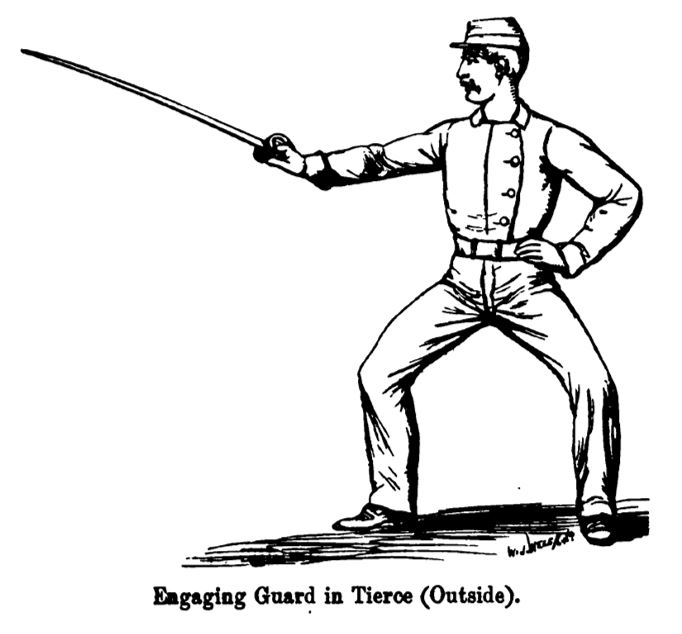
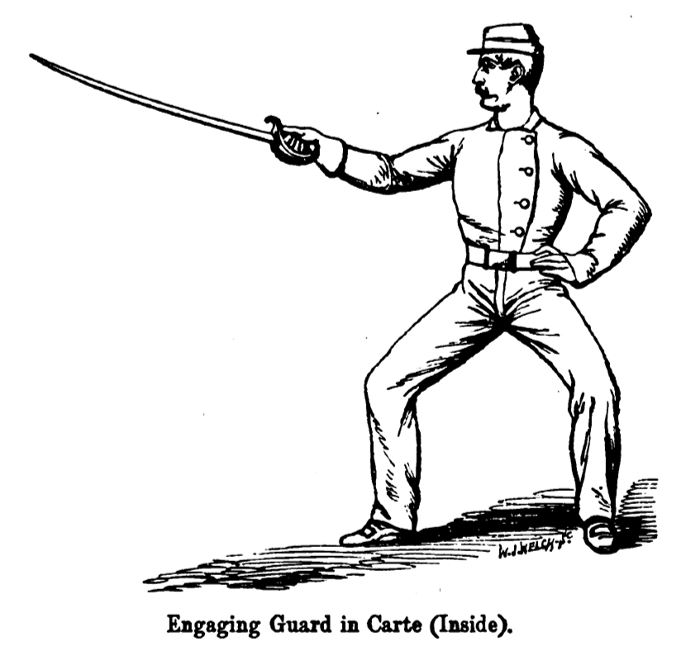
He says that “When engaging in guard (joining weapons), the swords should meet each other about eight inches from the points. If the distance is diminished the opponents are “out of measure” (or distance); if increased, they are “within measure.” The recruit must be taught slightly to press upon the opponent’s blade, but not to rest upon it; by this “opposition” his hand and wrist will be more ready to follow the weapon during the attack.”
He recommends that the right-handed recruit be taught the engaging guard of tierce, with the opponent’s blade in the outer line. The reverse position leaves the fore-arm unguarded, and tierce facilitates the defense of the low lines.
The Guards or Parries.
The ‘Infantry Sword Exercise’ proposes Seven Guards, but Burton says that in practice the advanced swordsman will confine himself to Tierce and Carte with their natural modifications.
Of guarding the head he suggests High Tierce or High Carte (rather than Prime). To guard the legs he prefers Low Tierce or the rassemblement (withdrawing the leg) to using seconde.
The Guards or Parries will be practised like the Cuts, first in the “Second Position” (Guard), and afterwards in the “Third Position” (Lunge).
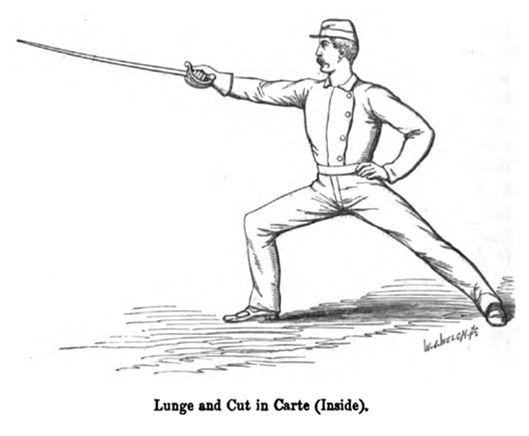
Section III. THE MANCHETTE OR FOREARM PLAY.
The manchette is cutting at the hand, wrist and forearm with the inner edge of the blade. This is Burton’s distinct addition to saber exercises of the time. Burton says that “A swordsman thoroughly trained in this section does not allow the opponent to deliver a cut.”
The manchette allows a swordsman to disable his opponent, rather than being forced to deliver a lethal blow. It also is a safer method of delivering a cut for the swordsman.
Burton explains “The natural man cuts as if he were using a stick or a club, and the preliminary movement lays open the whole of his body; indeed, exposure, I have said, is the main danger of every attack with the sabre, however closely and skilfully conducted. A cut through the muscles of the fore-arm, either inside or outside, causes the sword instantly to be relaxed and dropped; the man in fact is hamstrung in the upper works.”
And he adds “Finally I meditated upon the comparative humanity of ‘Manchette’, of disabling the opponent by an arm-cut, rather than laying open his flank or his head. During single rencontres in the field, especially at the end of Indian battles, it is so often necessary to put hors de combat some unfortunate, whose pluck or sense of honour induces him to prolong the hopeless attack.”
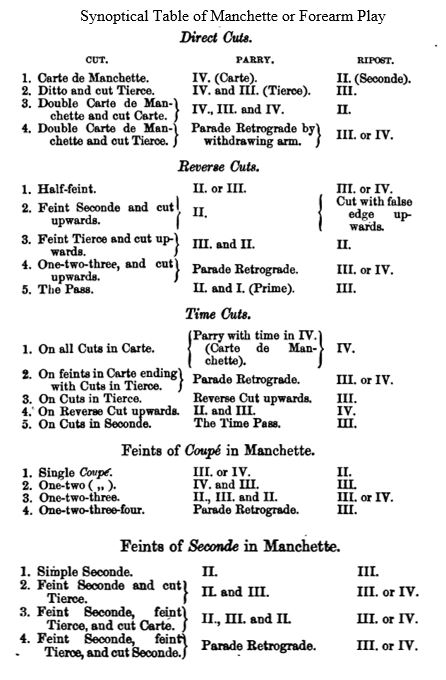
Burton lists his system of manchette as the Direct Cuts, The Parries and Feints, the Reverse or Back Cuts, and the Time Cuts.
The Time Cut (a cut delivered during an opponent’s attack, disabling the opponent before he can finish) is the flower of the Manchette system, as the Manchette is of the broadsword; and it is, perhaps, the part least capable of being taught in books.
Burton then gives what he refers to as a synoptical table of Manchette or Forearm play, showing the Cuts, the Guards (Parries) for the Cuts, and the Ripostes or replies that should follow each Parade.
In conclusion of the manchette play, Burton says “I will end this system of Manchette with the words of old Achille Marozzo, written some three centuries and a half ago: ‘I would that ye swear upon your sword-hilts never to use this knowledge against me, your master.’ But, in lieu of insisting that my readers never teach it without obtaining formal permission, I only hope that they will favour me by spreading it far and wide.”
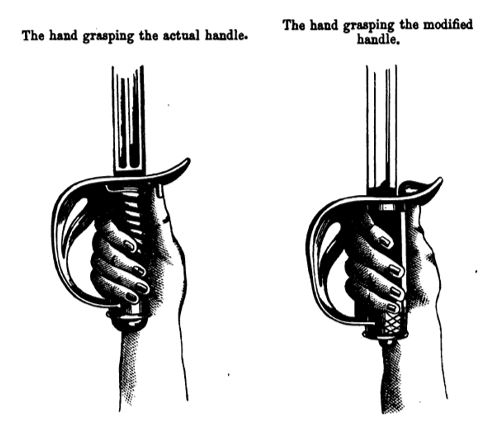
An Appendix to the Sword Exercises alludes to an improved form of sabre handle. Burton recommends a modified grip made by the Italian Captain Settimo del Frate. This is illustrated in the following diagrams
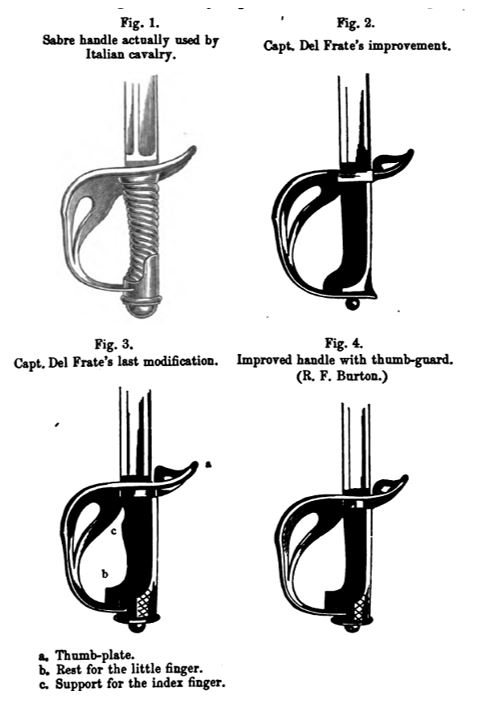 |
Burton suggests “I would further modify his Fig. 1, so as to give more fulcrum to the hand. The thumb-plate should be made weighty and the guard light, otherwise the blade will be over-balanced, that is, heavier on one side than on the other. It need hardly be said that the grip before going into battle should be whipped round with thin whipcord, or better still, with web-cloth.”
 |
Additional thoughts on and from Sir Burton from MAAJAK (search that chimerical website well and often!). This from Burton’s Sentiment of the Sword:
I have now made you as wise as myself upon the subject of moving the body and the limbs, which indeed is all the mechanism of swordsmanship. A few words before we separate. Why have these positions and these movements been chosen, been universally approved of by the civilised world? The reply is because they are intuitive and instinctive. See how the races that use the knife naturally seize it with the right hand, drape the cloak round the left arm, and, under cover of the body, prepare the weapon for a fatal thrust. ” I’m certain,” Shughtie said, ” that they are wrong. Have the cloak if you like, it may always be useful, but hold your bowie-point to the fore as if it were a sword. Why, man, you’ve quoted Achille Marozzo, and already you forget hie principles. There are two common ways of using the knife underhand and overhand. Underhand is rare, being easily stopped; overhand, if you treat it as I would, may be received upon the point. An acquaintance of mine had a third way, which was not without its merits. He rejoiced in the sobriquet of ‘ Flat-footed Jack,’ being, or rather having been, one of Her Gracious Majesty’s hard naval bargains. The Argentine gargotti’s not a bad place for knife practice. The Flat-footed in his cups would quarrel with hie own hat; hence many a difficulty. When cuchillos are drawn Senor Spaniard, old or new hemisphere, have a silly habit of showing off. The world must see the curved beauties of his deadly blade. It’s like the Tartar prince, who by herald informs the kings of the earth that they may dine, as he has finished his meal of mare’s milk. And it’s quite unlike the sensible Japanese, who, holding the scabbard in the left hand, draws hie sword with so little loss of time that he opens his man from belt to shoulder.” A very old manoeuvre of the Italian and German schools, I interposed. ” Well,” resumed Shughtie, ” while the particular Don was intent upon his gambado, Flat-footed Jack suddenly let fly at him a perfectly straight thrust with a common whittle some 6in. long, and worth when new 4d. He was only careful to put his thumb along the bone handle. Of course, every blow killed. I should be afraid to name the number of our countryman’s triumphs.” This was a long speech for Shughtie. I knew that he would not readily do it again, and resumed. Such, then, is the rule of the sword we will drop the knife – and it is based upon nature and truth, upon practice and experience.
Especially when preparing for actual combat, these few seconds of preamble allow you to settle your equilibrium, to draw upon your self-confidence, to face without emotion that sword point which threatens you, and to allay the first involuntary movement of anxiety which, in such cases, the strongest nature must endure for a moment. Moreover, you have been able to entrap your adversary in a comprehensive glance of observation, and to draw your own conclusions from his position, from his handling of the sword, and from the general way in which he offers battle.
This renders it worth your while to stand for a few minutes even out of pistol shot.
From Sentiments of the Sword by Sir Richard Burton
The sentiment du fer is that supreme art of digitation which is to the complete swordsman what the touch of the pulse is, or rather was, to the old physician who disclaims the newfangled thermometer. It begins to make itself felt as soon as the blades come into contact. Essential to the highest development of our art, it is the result of happy natural disposition, of long study, and of persevering attention. To the hand it gives lightness and that indescribable finesse which guide the cue of the billiard player; to the passes it communicates quickness directed by an appreciation of the case which can hardly be subjected to analysis. It is that mysterious résumé of delicate manipulation, of practised suppleness in wrist and forearm, and of precision in movement, which makes the adversary feel powerless before it, which startles at the same time that it commands him. No quality in a swordsman is more rarely found in any degree approaching perfection. To say that I have not the highest admiration of it would be to set myself down in the lowest ranks of materialism — as the world understands the word. But its very potency suggests the absolute necessity of providing against it when we find so rare a gift opposed to us.
Burton’s Sentiment of the Sword 3
Journal of Non-lethal Combatives, March 2000
The Sentiment of the Sword: A Country-House Dialogue, Part III
By Captain Sir Richard F. Burton, K.C.M.G., F.R.G.S., edited, with Notes, by A. Forbes Sieveking, F.S.A.; and a Preface by Theodore A. Cook
London: Horace Cox, “Field” Office, Bream’s Building, E.C., 1911
The Third Evening.
I.
During the day I had reflected upon the easiest and neatest way of explaining my method of simplification — my conviction that simplicity alone makes the belle manière. In my youth I had tried the same with cavalry drill, never being able to understand why in these days, when arms of precision and rapid fire are universal, ranks should be doubled. From my own system of bayonet exercise I had extracted a few simple movements, which could be contained on a page of notepaper, and yet which would enable the soldier to defend himself against most comers. It is evident that the same can be done with fencing.
II.
At last the smoking party met, and I addressed it from my cane-bottomed chair:
You have been told that fencing, stripped of its factitious ornaments and freed from the lumber and rubbish of the salles d’armes, with their complicated and innumerable details, is a far easier matter to learn than men generally suppose. The process of simplification is not new; many writers recognised only four elementary passes and parries, namely Seconde, Tierce, Carte, and Octave, to which some added a fifth, Septime. We may further reduce the elements to two, and do what we will, we cannot extend them beyond four. Let us tabulate them thus:
Attacks:
- Simple attacks.
- Compound attacks.
Parries:
- Simple parries.
- Compound or counter parries (parades de contre).
And thus we have the following:
Simple Attacks:
STRAIGHT THRUST (especially in carte with a right-handed man).
DISENGAGEMENT, or passing the point under the opponent’s blade.
THE CUT OVER (tagliata, coup), or passing the point over the [opponent’s] blade.
Compound Attacks:
ONE, TWO.
The BEAT, followed by straight thrust.
The BEAT, with disengagement.
The liement, or BINDING the opponent’s sword from higher to lower line.
Simple Parries:
TIERCE (high line outside), when tolerably sure of the adversary.
CARTE (high line inside), when tolerably sure of the adversary.
SECONDE. Carte basse (low carte).
Compound Parries:
COUNTERS or demicircles (half circles in tierce and carte).
FULL CIRCLES (especially useful to the imperfect swordsman).
This certainly does not look like the many-headed hydra which is supposed to require a Hercules.
“But you’ve forgotten,” interrupted Charles, “an immense number of lunges and parries. Hardly possible to write such stout folios as those upstairs on a simple expression like this.”
Said Shughtie: “I see that our neologistic and progressive friend has done what he proposed to do with the Sanskrit declensions — reduced them from ten to two or three, thereby worse confusing their confoundedness.”
“Yes,” added Seaton, “his simplicity has become silly. Can’t he see that a variety of movements is the best practice to attain excellence in a few?”
I have forgotten them with malice prepense, because I believe them to be useful only to the teacher, not to the learner. I must look upon them as part of the profession, and professions must live. Je n’en vois pas la necessite is hardly a fair rejoinder to il faut vivre. The surgeon often advises you to part with a leg or an arm — did you, by the by, ever see a one-legged or one-armed doctor?
III
But, supposing the teacher to teach all these complications with bona fides, as doubtless he generally does, I then observe that they are calculated only to embarrass the intelligence of his pupil. The more you simplify the means of action in the use of weapons the more readily they are learned and the more easily they are executed. Surely this is self-evident, even to you, O Seaton!
Remark, also, that I have given you a full, perhaps an unnecessarily full — list of attacks, parries, and ripostes. Many might reasonably be retrenched, because they are mere modifications of the same movement.
Thus, for instance, “One, two,” is a couple of simple disengagements, the first in the line of tierce, we will say, and the second in carte.
One, two, three, par parenthèse, is becoming obsolete [FN1] on account of the risk which always accompanies a complicated attack, giving room for a time thrust. [FN2]
The battement (beat) and straight thrust, again, is as evidently a combination. I do not mention the froissement d’e, [FN3] or sliding parry, which is now used only in the preliminary salutes. It is a favourite with schoolboys for disarming the antagonist; but on the field you cannot thrust at a man with naked hand, and in the salle d’armes you are bound, by courtesy, to pick up his weapon for him. Formerly, when foils were capped with leather, not with gutta-percha knobs, some puerile dexterity was also shown in locking the buttons and in screwing the foil out of the opponent’s grasp. Disarmings, in fact, are fitted only for the theatres. I may add that these and other methods always failed if the fencer held the handle properly. He should accustom himself to feel his weapon with his little finger and its neighbour. Remember, also, that grasping the grip or putting any strength in the forefingers and thumb not only tires the wrist, but also makes the point wander. Some men have a trick of laying the index along the handle, but I never found their fencing good style; it is even advised by masters, who forget that straining the muscles is the chief result of the exceptional position. At best it can be useful only to relieve for a minute the sinews fatigued by tension in one direction.
It would be better, too, if we slightly altered the hilts of our swords. Throughout Europe the pommel end droops down, when evidently it should be turned up so as to fit into the commissure of the wrist and give greater leverage. You will soon find this out by cutting at an object with all your might and missing it; if you are holding in your gloveless grasp an old top-heavy cavalry sabre, with its short, round handle, the latter is sure to loosen the hand. The cut-over (coup), again, which should be done in one movement, not in two, and with blade whistling like a whip, is merely another form of the disengagement intended for the same end, and received with the same parry. You must not forget that the fundamentals are the straight thrust and the disengagement, and that the further you recede from them the worse for you. Let me warn you very strongly against a succession of two or even three cuts-over (coup), which raise the point from its proper normal position opposite the adversary’s eye, and which offer a tempting opportunity to a low thrust. You will find in the books fancy evolutions called coups de trois and even de quatres mouvements; allow them to remain there.
The liement de l’épée, binding the blade, like the flanconnade, the croisé, [FN4] and others of their kind, are valuable chiefly when the adversary keeps his point, as some cautious men will do, scrupulously directed towards you, and perhaps extends his arm with the benevolent intention of making you spit yourself. These several twistings of the sword, after engagement has taken place, offer the solid advantage of holding down and commanding his blade if he permits you to occupy it, and if you have more muscle than he has, should he parry, as often happens, with the middle or the “feeble” of his blade, you may force in his guard. I presume you know that the rapier used to be divided into four parts — which were also subdivided into eight. The first simplification was reducing the four to three equal measures, beginning from the hilt — the forte, the medium, and the feeble. Now we prefer halving it: the “strong” from the shoulder to the middle, the defensive, the weak being used for offence, and such is the leverage of the length that the strongest arm cannot make the latter master of the former.
You will also read of the menace coupe and the menace dégagé, which are merely the “coupe” and the “d’egagement” without the lunge. Again, the tour d’épée, soit en tierce, soit en quarte is a long phrase for the common counters of tierce and carte, converted from semi-circles into whole circles, from parries into attacking measures.
These few offensive movements are absolutely all that you require. Yet every school has some “dodge” of its own; I will call these fancifications by no other name. This makes its pupils practise feintes à droit; that, the feinte seconde, et tirer droit; whilst these teach them to drop the point and bring it up to the attack. Movements of this kind are without end; I could invent on the spot half a dozen.
Yet observe that the three simple attacks and the four compound movements which I have given you may form a formidable list of combinations. May is the word. The less you attempt them the better. When you can play with your adversary as the cat with the mouse you may, perhaps, allow yourself an occasional cart; yet even then beware. I think Seaton can say something on that point.
My friend’s brow clouded a little, but he laughed it off good-humouredly, and, after a fair amount of pressing, he proceeded to tell the tale.
“It goes against me, but never mind. It has often made men laugh, and I dare say will do so again. I was at Abbeville, and at a country ball, as usual in a field or an orchard. There was a ‘difficulty’ between me and one of the dancers — of course a Frenchman. The casus belli was a pretty face, which levels distinctions. France also was then en république, which doesn’t consider differences of master and man, Jean often holding his head higher than M’siur Jean. A challenge passed for the next morning, and I found from my second that the ‘other party’ was a journeyman tailor. When we ‘peeled’ to the shirt and had been searched for weapons, I easily saw that my friend had no idea of using a sword, and I admired the little beggar’s grit. It was a cold morning, threatening rain, and we’d danced till late, which makes one shaky. I could have ‘cooked his goose’ with half a thrust, but I wanted to let him off easily, and after a little by play to drop my point upon his shoulder, to draw first blood, to give a poignÃe de main, and to wash my hands of the silly affair. But I reckoned without my host. The gallant little snip would take no denial. He waited till he saw my point well out of line, and then he at me, ducking his head like a charging bull, and following his sword, which went fast enough. It ran me clean through the wrist, and, but for a turn of the muscles, I might have had a spare inch or two in my right breast. After which he ‘confounded himself’ in excuses, and pleaded that it was for the justification of ‘son honneur.’ I never felt so foolish in my life. My only plan was to tie up my arm, to pack up my box, to pay down my money, and to bolt before the town heard of the adventure. Besides, it might have been no joke. Imagine what a death for ‘an officer and a gentleman’
IV.
I resumed.
You will bear in mind that, throughout its attacks and parries, the sword can follow only these four lines: 1. High line (la ligne haute, la linea alta), threatening the noblest parts oft the body, the upper torso covered by the plastron; 2. Low line (la ligne basse, la linea bassa), the lower part of the plastron and “below the belt” in pugilism; 3. Outside line (le dehors, la linea di ffuori), professionally called tierce, which means the shoulder and the flank; and 4. Inside line (le delans, la linea di dentro) or carte, aiming at the breast and the stomach.
Thus, by reducing to its simplest expression this imbroglio of technical terms, of feints and double feints, of true engagements and false engagements, of “menac’s” and “coul’s,” of “crois’ss” and “flanconnades,” of “pressions” and “d’robements” [FN5], of “reprises” and “remises,” of parries and half parries, we obtain two distinct advantages, both equally to be valued.
The pupil’s mind sees more clearly the foundations of all practice, and can at once analyse any combination which offers itself. This is not so easily done by our typical English rule of thumb, and the greatest enemy to excellence in arms is that hazy idea of its principles that satisfies so many students. Further still. The hand reflects the lucidity of the thought [FN6]; in the pupil of a good school it never falters; it goes straight to the point; it cannot stray, and it gains immensely in freedom, readiness, and facility of execution. Hence result the five most important qualities, which represent the cardinal virtues of the sword. These are, in due order of precedence:
Nerve, alias presence of mind.
Judgment, especially of distance, combined with sharp eyesight.
Quickness of movement in hand and body.
The tact of the sword (i.e., nice sense of touch), and
Regularity.
Combined in a high degree of excellence, they form the complete swordsman.
V.
Presence of mind I need hardly explain. Judgment is a term which makes you shrink; it suggests, like “common sense,” special gifts, trained and matured by long experience. I mean by it nothing more than that ordinary amount of intelligence which average men bring to whatever they do. Each well-reasoned lesson will add something to your judgment, and the precision begotten by practice will give it the perfection of which it is capable. Indeed, the beginner is advised not to preoccupy himself with “judgment”, as such process tends to cloud the lucidity of thought.
Judgment in arms displays itself chiefly by distrust of the adversary’s movements and by a wise prudence in our own; by divining what is most likely to deceive him; by the mute interrogation of the sword, and by the just appreciation of difficulties, general and special. I need hardly tell you that a hundred men will show a hundred styles. Judgment of distance is the great secret of all hand-to-hand weapons, from the dagger to the lance. It must not be confounded with judgment of distance as taught in musketry schools, yet both are mastered by the same process — practice aided by theory and perfected by application.
Quickness, meaning not only of the hand, wrist, and forearm, but of the whole body, is undoubtedly an immense merit, both in the attack and defence, the riposte and the retreat. “Slow and sure,” chi va piano va sano, do not apply to our art. There are writers who hold quickness to be the very commencement of the fencing lesson, as it is the capital point of the fencer. Listen to one of the best [FN7]: “I believe that we must guard against the usual style of instruction, which consists in repeating over and over again, ‘Go slowly; study quietly the thrusts and parries; attend to your position; separate your movements by mentally counting one, two, and so on; don’t hurry; quickness will come in due time.’ It is doubtless useful to train the hand by lessons with the plastron, but it is not useful to train it into slowness. The pupil, after being made to understand the mechanism, the analysis, and the meaning of each movement, should at once begin to practise it as quickly and sharply as possible. A tardy, ‘dawdling’ style is so convenient, and so seductive, by the facility with which it effects each movement, that it will soon react upon the judgment and acquire all the force of a habit, making intelligence idleness.
“If, under pretext of training the hand and decomposing the movements, you allow this habit a chance of existence, you will sow the germs of a defect which may presently become ineradicable. It is your work to oppose it.
“When the child begins feebly to totter over the ground, stumbling and threatening every moment to fall, you do not take it in your arms; you support it, but you allow it to walk. By degrees the bones are strengthened, the use of the muscles is learned, and the two-year-old treads firmly as the young bird flies.
“Such a child is the pupil. As his science and experience grow in stature, so will many weaknesses and defects cast themselves off, and finally they will easily be rectified by reason and judgment.
“But quickness is purely a mechanical and material process, which cannot be reasoned out, which cannot be analysed, which can be produced.
“Feed, therefore, the fire, instead of allowing it to die out for want of fuel.
“Do you think that it will suffice to say at a given moment, ‘Now do quickly what you have so long been doing slowly’?
“It is a new order of ideas to which you are introducing your pupil. Those are fresh obstacles which you oppose to his progress.
***
I made the fifth virtue “Regularity” — a poor word for want of a better. You will understand by it the consensus, the union, of all the bodily movements, the correspondence of the eye with the hand, for instance, the suppleness of the wrist and forearm, and the co-relation of forces required. This is especially the mysterious gift which distinguishes the good shot, the billiard and quoit player, the cricketer, the trapeze gymnast, and others of the same category. It is born with man; some have their pint, others their gallon, but few are wholly without it, whilst those who possess the donum dei to a remarkable degree at once take the highest places in their several pursuits.
But though nascitur non fit, this Regularity is susceptible of great culture. Its development depends upon daily studies conducted under the careful eye of the master. The least tendency to assume a bad habit — not those so called in the salles d’armes, but a habit which does not belong to the pupil’s individuality — should be pointed out, commented upon, and corrected. It is hardly fair to expect this amount of time and trouble from the average teacher, who after a certain number of years must find the average pupil exceedingly flat and stale. But the student can, as usual in all studies, do much for himself — ten, in fact, to Mr. Professor’s one. He will, as a looker-on, when others are taking the lesson, carefully note their defects and obtain their measure by comparing them with the master. He will apply these observations to himself and easily hit upon the way of cure. This, too, is the best treatment of tricks such as turning the toes in or out, opening the mouth, stiffening the fingers of the left hand, squaring the left elbow, and so on. But the pupil must not be too pedantic with himself. The right foot, for instance, by academical rule, should be placed straight to the front. If he learn that he gains base and strength by a trifle of deviation, why should he not do so? I have found it a good plan at times to practise before a pier-glass.
VI.
“It is early in the evening,” Lord S. said, “and I should much like to see you put your practice into action.”
Willingly, replied I. As a volunteer teacher of sundry friends my proceeding has been as follows: For the first month the time required is half an hour a day, provided that there is nothing to unteach. Afterwards three half hours a week are sufficient. The earliest lessons are devoted to explaining and demonstrating the capital importance that resides in the mutual dependence and in the perfect equilibrium of the movements; it is, in fact, an essay on “regularity.” I make my neophyte stand on guard, advance and retire, lunge and recover himself with aplomb and without crossing — that is to say, placing the right foot out of line, the directing line, the ligne directrice, the German Gefechtslinie; otherwise he will surely stumble, and perhaps fall. The defect is sometimes found in excellent fencers, and when chronic it cannot be cured.
“What is the directing line?” asked several voices.
The perpendicular drawn from the left heel of a right-handed man through the heel and toes of the right foot, to be preserved both in guard and during the lunge The old rule was to set off at right angles from the base, formed by the left foot. We moderns are more liberal; some align the forward heel with the hollow of the other foot, and others, I myself included, with the ankle bone.
The most ordinary intelligence will learn by these first lessons the mechanism of the various positions and actions — a mechanism based upon the nature and instinct of our organisation.
“Try the experiment upon Charles,” Lord S. suggested.
I would rather not. He has already, he tells me, taken a few lessons. I want someone who is utterly innocent of fence. If the Rev. Mr. O’Callaghan has no objection to be used as a demonstration, he will be my choice.
Mr. O’Callaghan, curate and chaplain, was a born sportsman, although bred to a black cloth. He gave laughing assent, remarking, however, that he would probably be a very awkward example.
I replied, perhaps so, during the first quarter of an hour. Such is the common law, and none may claim immunity from it. Josephine herself can hardly have made grace out of the goose-step. Please to look at me and to place yourself on guard. This word alone explains the end and object of the process.
To be on guard, to guard yourself, that means to assume the properest position for defence and its complement, offence. Now that the heels are parted by the proper distance, say two foot-lengths; of course it differs with every man. Bend your knees; in other words, sit, as it were, without sitting down — so. You must expect the position to cramp you at first, so would a few miles of saddle-work after a year of walking. But the more you bend the spring, the greater will be the recoil, and the more sudden and rapid will be your movements.
Your right arm according to the salles should be half bent, because over-tension of the muscles would fatigue it. After a time you will choose your own measure. As a general rule in the French school the pommel of your sword is opposite the right breast, with the point to the adversary’s eye. In this position it can most easily be brought to cover all the lines which require watching. Later on — if you determine to be a swordsman — you will allow the penchants and instincts of your organisation, the convenience of sight, for instance, to modify these academic dicta. The important point is to preserve the aplomb of the body and to use the limbs easily without géne or stiffness.
I now advance upon you. You naturally retire. To do this and to keep your distance there is only one way. You move back the left foot more or less, and you allow the right immediately to follow it. I always insist at first upon a full step, not a kind of shuffle backwards, as it is one of the beginner’s difficulties. Stamp, please! It will give rhythm to your movement and ensure a good position.
I now retire, and you advance upon me. It is the same operation, only reversed. Do not raise the foot so high, you waste time; nor yet draw it along the ground, which might cause a stumble. You will find advancing much easier than retreating. And again, as a beginner, always stamp; it makes the body sit firm and motionless on the left.
Bravo! You move like a professor. Bend your knees a little more, and when you practice alone — for I see that you will be a swordsman — bend them as much as possible. The academic law is that the knee should be on a plumb-line with the instep. As regards the left leg, a string dropped from the hip bone should fall along the thigh, the outer knee, the lower leg, and the ankle bone. Few men go beyond or outside this imaginary perpendicular, many inside; that is to say the knock-kneed fencer is more common than the bow-legged. Both are faults, because they take from the power and spring of the lunge; but they are mostly matters of organisation, and cannot be altered without a damaging process.
The rule for the body is to be bolt upright upon the haunches, easily and without stiffness. If, however, you feel inclined to bend, bend forward; but never bend backward — the system of the old French school. When the body is carried to the front you will often see the master lay down his foil and set the pupil up like a sculptured torso with both hands. This is dancing master’s fencing. There is no harm in the forward position; it does not increase exposure, because the angle which it assumes diminishes the area of surface, and to a certain extent protects itself by giving additional trouble to the adversary’s point. It is also a sovereign remedy against low thrusts. On the other hand, bending backwards is an absolute defect; it is ruinous to all quickness, both in attack and in riposte. Besides, it always exposes you to a time thrust. Do you feel tired?
“No.”
So much the better. It shows that your position is easy and natural; that the muscles are not contracted; and that cramps do not paralyse your movements. You will not forget to keep your left shoulder well to the rear so as to show only a profile to the adversary. In due time you will be able to take some liberties in this matter, and, indeed, there are first-rate fencers who show two-thirds of front, but these are well-trained muscles obey like lightning every order of the brain, and who can escape the thrust by an almost imperceptible amount of shrinking. And, remember, shoulder always low, and no extra strength applied to it, or you will “counter from the shoulder” and strike with your point the ground instead of the adversary.
Such, then, is the posture of defence. Rest yourself whilst I pass to the offensive part.
VII.
You might attack your adversary by running into him, as happened to our friend Seaton, or by a spring, a buck jump, like the “Turcos” in Punch, with both legs to the fore. I once saw an excellent swordsman surprised into being touched by this simian process, but the usually, nay, the invariable, plan is to sharply to lunge, that is, to shoot the right foot from guard some 18in. forwards, shaving the ground, and simultaneously to straighten and stiffen, not to half straighten, as the idle apprentice often will, your left leg. Do not make any false movements with the right foot before you advance it. This is called in technical language tricher, and it warns the adversary of your intention. Remember the golden rule of the lunge, two movements, not one. The first: Raise the right arm, depressing at the same time the left. No. 2: Move the right foot and extend the left leg. If the first precede the second your aim will be wild. Make your pass even and regular, as if carrying a glass of water to your adversary’s breast. The better to confirm the lunge, I often teach the demi-allonge — the right arm raised as to make the pass, the left leg extended without further movement.
At first you must be careful to keep the left foot firmly on the ground; it is apt to turn and to drag an inch or two forwards, which besides having a slovenly look, alters your distance without being aware of it. When lunging, rest upon the major arch of the left foot, formed by the heel and the cushion behind the big toe. This firm base gives immobility to the left leg, which is apt to be shaken by the vigorous tension of the bow. The cap of the right knee bone must be perpendicular to the instep, or, if you prefer it, to the toe-tip, as the schools direct.
Whether your attack be simple or compound, ever remember what I here repeat: The movement of point and hand, together with the extension and elevation of the arm, must precede, though almost imperceptibly, the action of the body and the legs. This is an invariable rule. If your lower limbs begin the move you lose equilibrium, your lunge will give notice to the adversary, and your point will wander away from the mark. Great fencers sometimes reverse the process by way of tour de force.
The point in the French school should be lanced out, as it were, and be withdrawn instantly, like the cat’s claws. And do not forget that the “recovery,” the return to guard, must be as prompt and sudden as the lunge. You have failed in your swoop; like the hawk, you are in a position of the greatest danger from the heron, and the sooner you retire from it the better. Nothing can be worse than a slow and “dawdling” retreat, which encourages the enemy to attack you whilst in disorder by what is technically called a riposte en emps perdu.
Every salle d’armes will show you men who are fond of remaining at the lunge, trying the dangerous and objectionable thrust called remise de main, which, except under well-defined circumstances, is permissible only to great artists — feinting at close quarters and engaging in la bourrache, poignarding the adversary, and displaying what I call the pugilism of the sword. The whole process is thoroughly out of character. The attack should consist simply of a rapid lunge and an immediate return to guard.
So much for the offensive part of the process. Mr. O’Callagahan, I am greatly obliged to you. Do not forget my prediction.
“I would ask a question,” Charles said. “Is it necessary when on guard, gracefully to curve that left arm and to lower it when lunging like a mill sail along the left thigh?”
There is no necessity, but in both schools, Italian and French, the left arm acts as a counterpoise; it is the rope dancer’s balance pole, it gives equilibrium to the movements, and it introduces symmetry and equality in the action of the two limbs. You must do something with your left arm, and it seems hardly natural that it should hang down dead by the side or be carried “a-kimbo,” when it becomes mere dead weight. If you reflect you will probably find the French style best. I have described the Hispano-Neapolitan posture — the left hand opposite the pectoral muscles. This may be considered obsolete now that the dagger is not used. Au reste, not a few wear the left arm with the hand on the hip, and the German sabreur often places it behind his back. Do with it what you please, only do not put it in any position which may bring the left shoulder forwards and offer more body to the adversary’s sword. I never quarrel with my pupils, except when idleness or carelessness is shown in neglecting the left arm, and as a thing of beauty is a joy for ever, and beauty, like poetry, is “Nature’s brag.” I do not allow the elbow to be angular or the fingers to project like those of a Mandarin [e.g., a mannered snob] upon a tea caddy. Grace is the truth of action, want of grace its falseness.
As you may imagine, these simple movements can be modified in a variety of ways. For instance, instead of the common return to guard by the right leg, the left may be brought up; this is, however, confessedly dangerous. Then there is the inverted lunge with the left foot, called se fendre en arrire, and there is much to say about it. Again, the body may be suddenly thrown backwards in guard, which places it out of measure, beyond reach of the point. When advancing, the left foot may furtively be brought close to the right so as to double the length of the lunge. You will see these and many other tricks done in the fencing schools, sometimes even in the field, by gentlemen who are “renowning it.” But the fatal objection to them is that they are not generally adopted, showing that they are not generally valuable.
VIII.
I have now made you as wise as myself upon the subject of moving the body and the limbs, which indeed is all the mechanism of swordsmanship. A few words before we separate.
Why have these positions and these movements been chosen, been universally approved by the civilised world? The reply is because they are intuitive and instinctive. See how the races that use the knife naturally seize it with the right hand, drape the cloak round the left arm, and, under cover of the body, prepare the weapon for a fatal thrust.
“I’m certain,” Shughtie said, “That they are wrong. Have the cloak if you like, it may always be useful, but hold your bowie-point to the fore as if it were a sword. Why, man, you’ve quoted Achille Marozzo, and already you forget his principles. There are two common ways of using the knife — underhand and overhand. Underhand is rare, being easily stopped; overhand, if you treat it as I would, may be received upon the point. An acquaintance of mine had a third way, which was not without its merits. He rejoiced in the sobriquet of ‘Flat-footed Jack,’ being, or rather having been, one of Her Gracious Majesty’s hard naval bargains. The Argentine gargotti’s not a bad place for knife practice. The Flat-footed in his cups would quarrel with his own hat; hence many a difficulty. When cuchillos are drawn Señor Spaniard, old or new hemisphere, has a silly habit of showing off. The world must see the curved beauties of his deadly blade. It’s like the Tartar prince, who by herald informs the kings of the earth that they may dine, as he has finished his meal of mare’s milk. And it’s quite unlike the sensible Japanese, who, holding the scabbard in the left hand, draws his sword with so little loss of time that he opens his man from belt to shoulder.”
A very old manoeuvre of the Italian and German schools, I interposed.
“Well,” resumed Shughtie, “while the particular Don was intent upon his gambado, Flat-footed Jack suddenly let fly at him a perfectly straight thrust with a common whittle some 6in. long, and worth when new 4d. He was only careful to put his thumb along the bone handle. Of course, every blow killed. I should be afraid to name the number of our countryman’s triumphs.”
This was a long speech for Shughtie. I knew that he would not readily do it again, and resumed.
Such, then, is the rule of the sword — we will drop the knife — and it is based upon nature and truth, upon practice and experience.
And what, you ask, is its proper object?
In the defensive position of guard to allow the limbs their fullest liberty of action and to cultivate as much as possible the ease and the elasticity which reside in them.
In the offensive action the opposite is required; here we must develop and utilise all the power and the momentum, the vigour, weight, and speed of which the body is capable.
I seem to be talking mere truisms — “the truths of M. de la Polisse.” But you see a master in every school daily and hourly protesting against the awkwardness of his pupils’ guards, against the clenching of the hand, the tension of the arm, the stiffness of the shoulder, in fact the wilful and sinful expenditure of force, without once explaining to them, so clearly that they never can forget it, the essential difference between the complete repose of the guard and the vivid muscular action of the attack.
To show now natural is our position, attempt in any manner to change it. There are many ways, but all will fail it. Take one for instance, and stand up, like the old Spaniard, with knees unbent. This at once throws the whole machine out of ger; you cannot without great difficulty perform the simplest movement of attack, defence, or retreat. The body has lost its aplomb; it can no longer make sure of hand and arm; it insists upon devancing them or upon lagging tardily behind. See how slight a change causes the virtue to depart from you.
The houghs, the popliteal muscles, are the two springs which project the body and which, properly managed, give it rapidity of motion. When you clear a fence or a ditch you imitate the grasshopper, not to mention the more lively animal [the flea] that can hop over its own St. Paul’s. When you drop from a wall or make a low jump you also bend the houghs to prepare for the feet touching the ground, otherwise you suffer from the jarring shock. How many men have been injured and even killed by suddenly stepping into a hatchway imprudently left open? If prepared they could have managed without difficulty twice or three times the amount of fall.
I insist upon these facts, which are the axioms, the groundwork of our science. My pupils are always taught their absolute necessity and their relations as cause and effect, or if you please, sequence, consequence, concatenation. Upon this point —
“Eleven-forty p.m.!” Shughtie briefly ejaculated.
— I will only say that instinct has here been our earliest guide, and that experience has tended to explain and consecrate the principles. But I add:
When sufficient practice shall have made these movements familiar to you, when you feel the ease and rapidity which result from them, and when you are conscious that they have given, with the patience of assured strength, a new life to your thews and sinews, then you have a right to venture upon certain modifications. If, after careful comparison and many experiments, you find that your individuality craves for departure from the beaten path of elementary rule, do so without fear, but do so with judgment. The best guard and the best lunge are those which allow body and limb to act with the fullness of freedom, preserving at the same time a perfect equilibrium. Possibly some peculiarity of conformation — a very long arm, for instance, or a remarkably short leg — may suggest important changes. But remember that the margin of deviation is not large; it is a narrow path, and a precipice yawns on both sides. Bear in mind that all excess is more or less faulty, especially when it declines from grace and beauty.
And I confess to disliking a rugged or grotesque fencer, although his thrusts may tell and his parries do their duty. A thoroughly well formed and set up physique, of course, when in youth and health — must be “elegant” — passez moi le mot. If not there is some fatal defect which tailor or dressmaker has succeeded in concealing from all eyes but those of the physiologist.
Sur ce, messieurs, bonne nuit!
To be continued.
Footnotes
FN1. One, two, three is still largely used in the lesson, and fairly often in the assault.
FN2. A time thrust (coup de temps) is an attack made with opposition on a complicated attack, and intended to intercept the line, when such an attack is meant to finish. Badminton Fencing, page 91.
FN3. The froissement, or froiss, is executed by rubbing or scraping one’s foil along the opponent’s.
FN4. Liement (binding the blade) is executed by passing the point over the opponent’s sword without losing touch of his blade, straightening the arm and lunging in one movement, with strong opposition. Flanconnade is the liement d’octave. Crois, or twist, is bringing the adversary’s blade from an upper to a lower line, when the other’s point is too low. — Badminton Fencing, page 53.
FN5. Coul‘ is gliding the blade along the adversary’s without pressure of scraping. D’robement is quitting the adversary’s blade by dropping the point a few inches below it.
FN6. It is interesting to see how Burton has been influenced in this part of his subject by Bazancourt’s book (see pages 44-56 of Mr. C.F. Clay’s translation).
FN7. See Bazancourt (Clay’s translation, page 47, et. seq.).
 Protective Arts
4 thoughts on “Sir Richard Francis Burton”