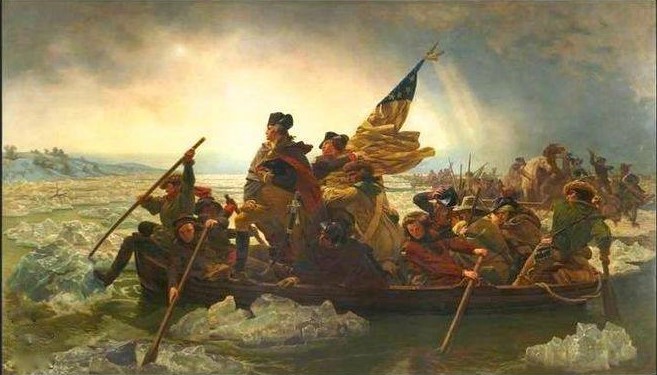
The iconic picture of Washington crossing the Delaware by Emanuel Gottlieb Leutze. While fraught with inaccuracies, the image is a powerful reminder of the total commitment the rebels had, pledging their fortunes, lives and sacred honor to the cause.
Now used as a parody of saccharine inspirational posters. It translates the 18th century ideology to current parlance, a simplified version of commitment.
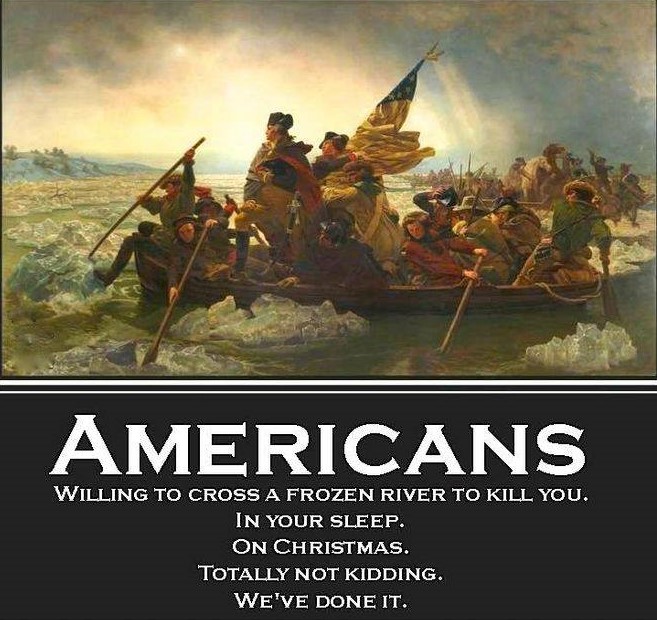
Washington defeating the Hessians at Trenton proved that the rebel army could defeat professionals. Washington developed a challenging battle plan – crossing an ice choked river in the middle of a very cold winter night to surprise the Hessians – it required three separate and coordinated landings. Only the men in Washington’s command were able to execute the plan, but they were sufficient and the Americans won the battle.
It is far too easy to forget what total commitment meant to these Patriots. Paine’s words chided the sunshine patriots who only fought during their enlistment because they were not truly committed. Washington, however, risked everything. If captured he would have been hanged as a traitor. He pledged his family fortune – spending his own capital to support the war effort. The raw physical endurance – years of cold, fighting for supplies, battling discipline, the infighting among his generals, and the lack of support by the Congress – Washington exhibited the power of will and a steadfast commitment to character to endure it all. Imagine carrying the courage of your convictions through the winter encampments, the long years of toil… In an age where entitlement is the norm, the value of sacrifice is unknown. With one-day shipping even delayed gratification is a quaint concept.
I spent July 4 watching my boys celebrate with fireworks. Oregon regulates the sale of fireworks to sparklers and snap caps so I did not worry about the explosives (thank you Nanny State). I do worry, however, for their future. Try as I might to instill the importance of history, discipline, patience, and gratitude, I fear that the inept and sanctimonious narrative that is the current zeitgeist will poison them: make them believe that they are owed something.
The 4th of July should celebrate the determined spirit of independence and reminds us of the high price that was and must be paid for it.[1] I only hope that my children at least learn that lesson.
I also hope that you all find a greater degree of self-reliance and independence through your training. Martial arts should inculcate more than physical skill. Training should forge the spirit. No one gave you the skills you are acquiring – your skills are yours by your efforts alone and you are setting yourself on a higher path. A path that requires dedication, perseverance, and leads to greater independence.
___________________________
Required reading
Frederic Bastiat (1801-1850) is most often read by economists because of his work on popularizing free markets. His emphasis on the unintended consequences is seminal, greatly influencing Friedrich Hayek. Bastiat’s pamphlet on The Law is a great reminder of the use and abuse of legislative power and should remind us all of the nature of Liberty.
Too few read history with purpose: that is; to learn the lessons oft painfully earned by our ancestors and thus avoid Santayana‘s admonishment, “Those who cannot remember the past are condemned to repeat it.”
____________________
Of course, even the great among us has their flaws and we love to parade their lesser moments in order to feel closer to par, but the sad truth is, we are not. Read the biographies and more:
Podcasts by Joseph Ellis Revolutionary Summer, His Excellency, and NPR
____________________
[1] Only decades after I graduated did I learn of the sacrifices some of my teachers made; ones I could never have understood as a teenager in high school. I remember learning that our new principal was coming to our small regional high school from New York. I have a distant memory of his introductory speech which seemed overly harsh – bringing big-city draconian discipline to our small (graduating class of 65) school. I vaguely recall he had been in the military. A reminder that we may never know the true spirit that lives in others. Col. Roy Conklin – R.I.P. (2019).
_______________________
Another Barker reflection on July 4th
Long Forgotten Fourths of July
July 4, 2019
I rarely think about my brief military career, but July 4 brings it to mind. It was on the first weekend of July 1961, that I reported for training at Fort Dix, New Jersey, along with a busload of fellow reservists from Northwestern Connecticut.
I was supposedly ‘in charge’. As the oldest recruit, with the most formal education, I had been given the temporary rank of ‘Sergeant’ complete with easily removable chevrons. Nobody listened to anything I had to say. It was a raucous bus ride that ended outside some run-down WW 2 barracks which would be our ‘home’ for following eight weeks. We were hustled off the bus and chivvied into the barracks by the training sergeants, who took the opportunity to teach us some of the basics of Basic Training–like how to get into a line, and which foot was the left.
But we were left alone for most of the following day, the Fourth of July. In those happy days, even soldiers were allowed to enjoy the national celebration–unlike today’s service members who must march through the heat and humidity of Washington D.C. to feed the ego of our contemptible Commander in Chief, ‘Bonespurs’ Trump.
It happened that one of the training sergeants was a black man named Sergeant Barker. He was delighted to greet me as I got off the bus, with my removable stripes. “Ah,” he greeted me, “another Sergeant Barker…” From then on, although not in charge of my platoon, he took a ‘familial’ interest in my military career, sometimes addressing me with ironic courtesy as ‘Sergeant Barker,’ although I was as miserable a recruit as any that ever served.
In those days (and I hope still today) the army selected its training sergeants from among the best it had to offer. Sgt. Barker was a veteran of the battle at the Chosin Reservoir. My own platoon sergeant, Sgt. Mastrovito, a small Italian man, not a great deal taller than his M-1 rifle, was also an admirable example–a veteran of the Battle of the Bulge–a first class leader and teacher, well able to turn recruits into something resembling soldiers.
At the end of Basic Training most of us were sent to Fort Sill for Basic Cannoneer Training. This course was run by Captain Wing, a Chinese-American officer, and his Battery ‘top’ Sergeant Rodrigues–who warned us all to remember that although born Mexican, he was “A U.S.Army citizen.”
Again, he and the other artillery training sergeants were outstanding teachers and leaders who returned us to our Reserve Unit eight weeks later as reasonably competent artillerists. Several months later I returned to Ft. Sill for OCS training under Captain Dawson, a professional soldier, and his ‘Tac Officers’, Second Lieutenants, who had been outstanding graduates of an earlier OCS training cycle.
I was certainly not destined to be a soldier but tutored by these men I came to realize that there was honor and satisfaction to be had in a military career. I admired them, and I still do. It has not escaped my notice that many of them were minorities. Contrary to those who mock the military and suggest that professional soldiers lack the qualities required for success, ‘in the real world’, I admire that great institution for nurturing and utilizing abilities which might otherwise have gone to waste in a less ‘color-blind’ civilian society.
I wonder what happened to them later.
I would not be surprised if Captain Wing became a general–and I dearly hope that Sergeant Rodrigues achieved his retirement dream of processing and selling Mexican food–which, in those long-ago days, would have been a new thing.
 Protective Arts