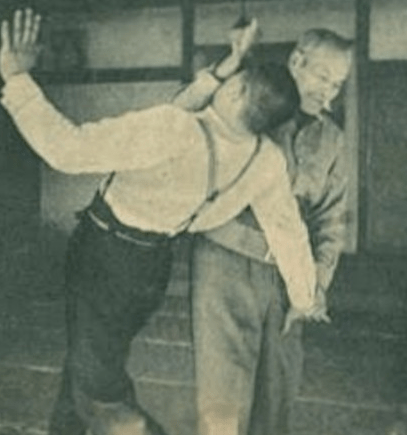
Ryotedori – two hands vs two hands. There are any number of basic body-building reasons to train ryotedori – tanren development, resistance training – but for the advanced practitioner it is an indexing exercise.
Indexing. The total number of combinations in a two hand v two hand wrist grab is three: double inside, double outside, one in and one out. The actual count is higher because the hand inside vs outside could be left or right, but the relationship is the same, so keep it simple (for now).
Uke attacks ryotedori – nage responds double inside, aka “tenshinage” (heaven and earth throw). Translating the Japanese – the heaven and earth is a simple reminder of the directionality of nage’s hands – it is a split vector – from the centerline one hand vectors down the other up. Look at the early photos of O’Sensei to understand the entry at its most pragmatic:
It is simple – blast one hand down to destabilize and then strike uke hard on the neck. You must understand how to make a technique work before you can understand its depth. The practical also shows how to avoid some basic dojo problems – for example uke resists the exercise; responses: snap kick to the front knee and/or quickly slap your own palms together to disengage uke, then blast high and low. These are simple tricks to effect a throw, which ultimately is the goal of a martial art.
Aikido is a more subtle play. In the double inside response nage’s hands stay within uke’s centerline. Focusing on one hand at a time we have the high line and low line hands. To better understand the flow lines assume nage is holding two knives. The lowline hand is an inverse C cut – the blade traverses uke’s belt line (blue worm) and then to the femoral artery – this is a cross-body draw to an outside line lead. Simultaneously the highline is an arcing downward thrust to the subclavian artery. With proper targeting your hand positioning should be elegant. With the presumption of a double knife, uke should become fluidly responsive.
With the logic of the encounter established we can now focus on its development as sensitivity training. The low line lead is a draw, uke is ‘invited’ closer to the high line hand which remains relatively static in the initial phase – uke comes toward the high line hand which arcs upward in order to avoid uke backing away from an advancing thrust. Nage should play this encounter with an elevation drop – not a pull-push. This play requires good quad development and strong range of motion in the knees. A variant that doesn’t require the depth of bend in the knees would be to use the same lowline lead but to turn the hips simultaneously in a horizontal arc to further draw uke into the highline hand (the axis of the encounter). For those familiar with her standard presentation, this is Okamoto sensei’s preferred lead (‘invitation’).
However you play it, nage’s hands remain inside uke’s grasp and nage thereby controls the centerline.
The double outside is simply nage applying nikkyo with each hand simultaneously. Uke grasps and nage slips each hand to the outside on uke’s wrists and applies nikkyo. The basic presentation often has nage’s shyuto (hand blade) down and fingers oriented toward uke’s center. This is a ki-hon presentation and there are critical lessons to be learned here: the little finger is primary, cut over don’t grab, the hand has priority over the shoulders, etc. I presume you already know these lessons at a deep bodily level. The variation to feel is a ‘scissoring’ of the hands whereby nage does not project the shyuto toward uke, but rather passes his blades over and essentially parallel to nage’s front. A fanning action. Done well this should result in a two for one hand release – nage will have one hand (knife) free while uke has both arms neutralized by one of nage’s.
The double outside is a fast and slick play requiring good wrist flexibility, sensitivity and excellent kokyu (weight transference).
The final possible counter is one-in and one-out: A combination lead. In its simplest form nage flows one hand to the outside (resulting is a wrist hook) and leaves the other on the inside line (beginning position). As an example: nage goes outside R and inside L. Nage’s right hand will flow ‘soto‘ and draw uke forward. Nage’s left hand flows up uke’s advancing center. If nage remains on the line of approach the effect will be an ‘iriminage‘ variation. Most often however, as uke advances into the topline hand, nage will perform a ‘face rake’ and quickly change hip orientation to end behind uke. This is an enveloping trap. Uke’s spine should be very compromised if done well.
A more kokyu-dynamic variant is Mulligan sensei’s ‘hip blast.’ Uke approaches to grab both wrists only to be preempted by nage shifting forward (like the rowing exercise) thereby causing uke to rebound and reflexively come in again with more velocity. Uke can then be spit out by their own momentum – nage will look like a bull-fighter with uke shooting through the invisible cape held between nage’s low line (soto) and high line hands.
So we have the in-out variation described with a simple hip turn (half tenkan), a ballistic rebound on the line of approach and then the last cardinal direction is for nage to perform a full tenkan.
Uke grasps both wrist for wrist. Nage performs a soto lead and as uke approaches, raises the high line hand. As uke approaches the axis of the highline (and the highline hand is at the apex of extension, i.e., full vertical) nage snappily tenkans while the high line hand cuts shomen.
There are of course variations that will present themselves as you explore the dynamics of the encounter but the foundational matrix is simple – the double grab hand positions can only be in 3 reference combinations: inside, inside / outside, outside / inside, outside.
___________________________________________________
Once you can perceive ryotedori as an indexing exercise, your ability to see the ‘universal lines’ should expand. Ryotedori isn’t a wrist grab but a relationship that translates to any double weapon attack. This development should lead back to sinawali, heaven-six, and other double attacks.
__________________________________________________
Recall the five primary knife retention techniques. The entire logic of the hand-wrist grab presumes that uke is attempting to arrest nage’s knife wielding hand. As such, the typical “ryotedori‘ techniques all play off nage turning the cutting edge of a blade toward uke’s wrist – this is all knife retention first technique. A simple cut over release which can be done either outside or inside. Grab a knife and train your wrist flexibility. Remember it is your ability to articulate the conical planes smoothly that makes any of these plays work. Slow is smooth, smooth is fast.
 Protective Arts
4 thoughts on “RYOTEDORI”