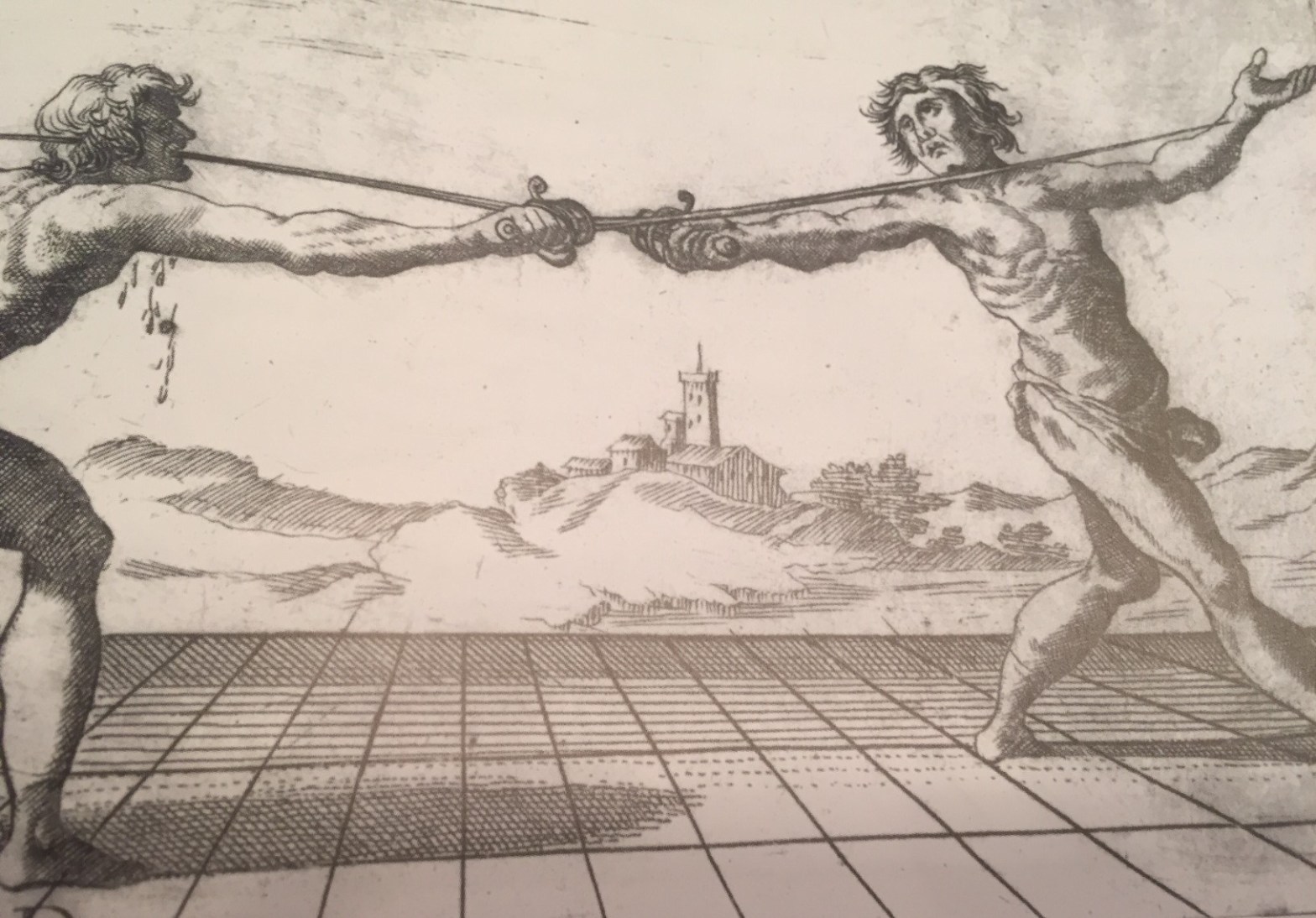
In ryotedori we explored the double hand grab as an indexing lesson. Ryotedori tenshinage is a double-inside hand positioning with nage remaining on the inside line – facing the opponent in front. The other body relationship is to zone out – which can be done with either a half or a full tenkan. This is a flanking move. Combining a flanking action while leaving the hand relationship on the inside will lead to ryotedori kokyuho or kokyunage.
Assume right hanmi. Nage will tenkan while leaving the hands on the inside-line. The hand work is R forward and the forward hand can work simply as if doing a one hand grab (i.e., gyakuhanmi katate dori kokyu ho). Just be aware that the front hand must stay above the back hand as you move, lest you trap yourself. The back hand must perform a subtle, if deadly, lead: just before nage begins the tenkan footwork, the back hand performs an evisceration – a horizontal draw across the bottom of the abdominal wall (blue worm) and the hand blade contours to the thigh as nage turns. The beginner’s mistake is to see only the front/top hand because it appears to execute the throw. That is a failure to perceive the difference between a single weapon system and a double.
To illustrate the contrast, examine the one weapon relationship. Gyaku hanmi katate dori kokyuho should be understood as a RvL (and LvR) attempt to arrest a bladed hand. The ‘throw’ then is best understood as blade delivered in reversa – or as depicted:

It is the relationship of the hand to the attacker’s body to study. The footwork is not the same as gyaku (RvL) because the sword is (usually) a RvR encounter. But ignore the feet and see the lines: Nage’s front hand controls uke’s centerline by attacking the head. The one-weapon direct entry requires precise timing, but the vector is simple and direct. The two-weapon encounter is a bit more complex, perhaps devious even because the more active hand is the back hand – the dagger held sinister.

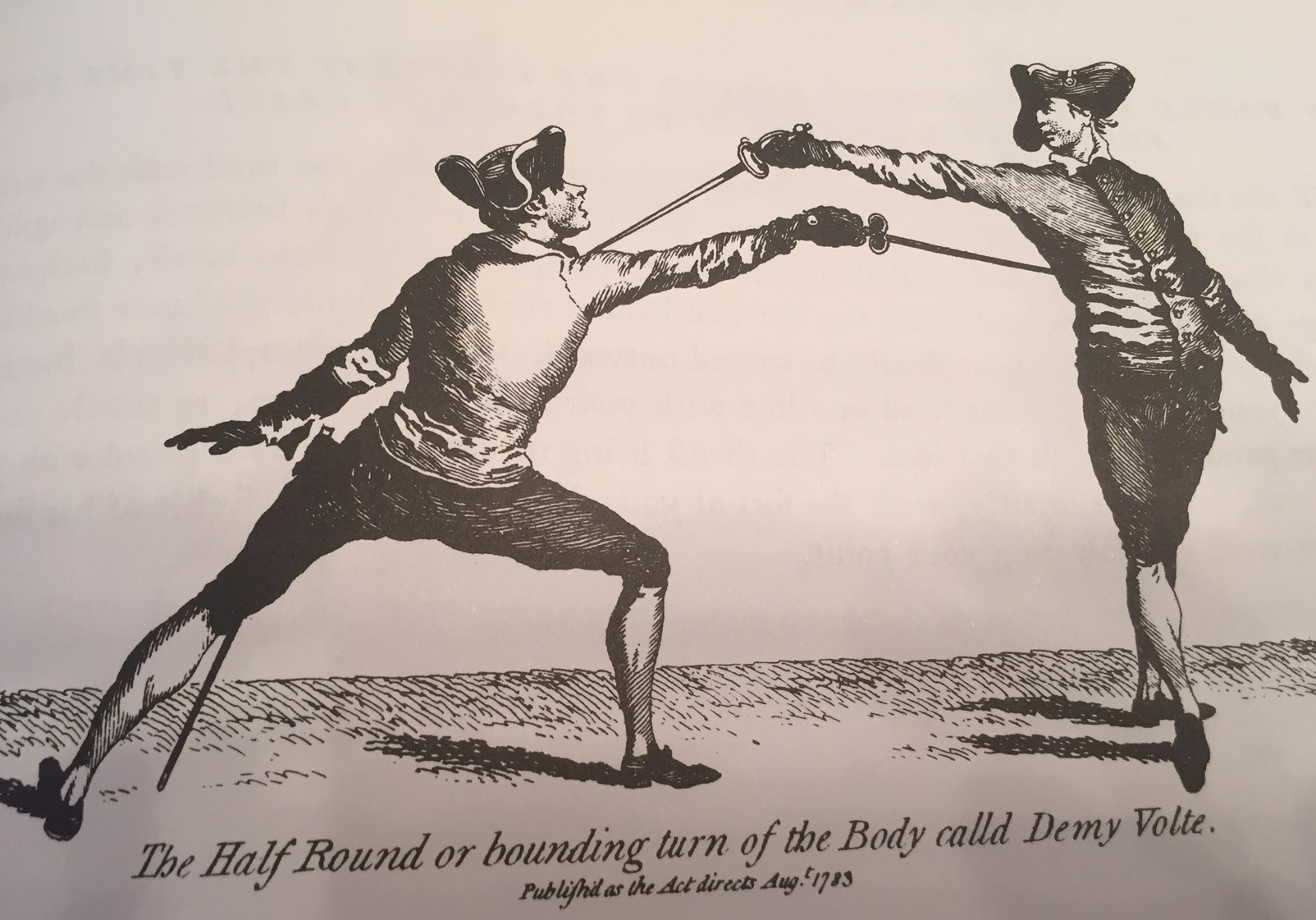
It is easier to show the one-hand encounter because it is far more common – and therefore more often depicted. The two-weapon encounter as I mentioned is devious because the obvious threat (the front hand) is the secondary play. The primary hand is the low-line back hand.
The back hand moves first (weapon, body, foot on the attack – in that order) and because the attack is on the midline (and lower in the opponent’s field of vision) it should be felt before seen. McLemore depicts the move in his Advanced Bowie Techniques (2006)
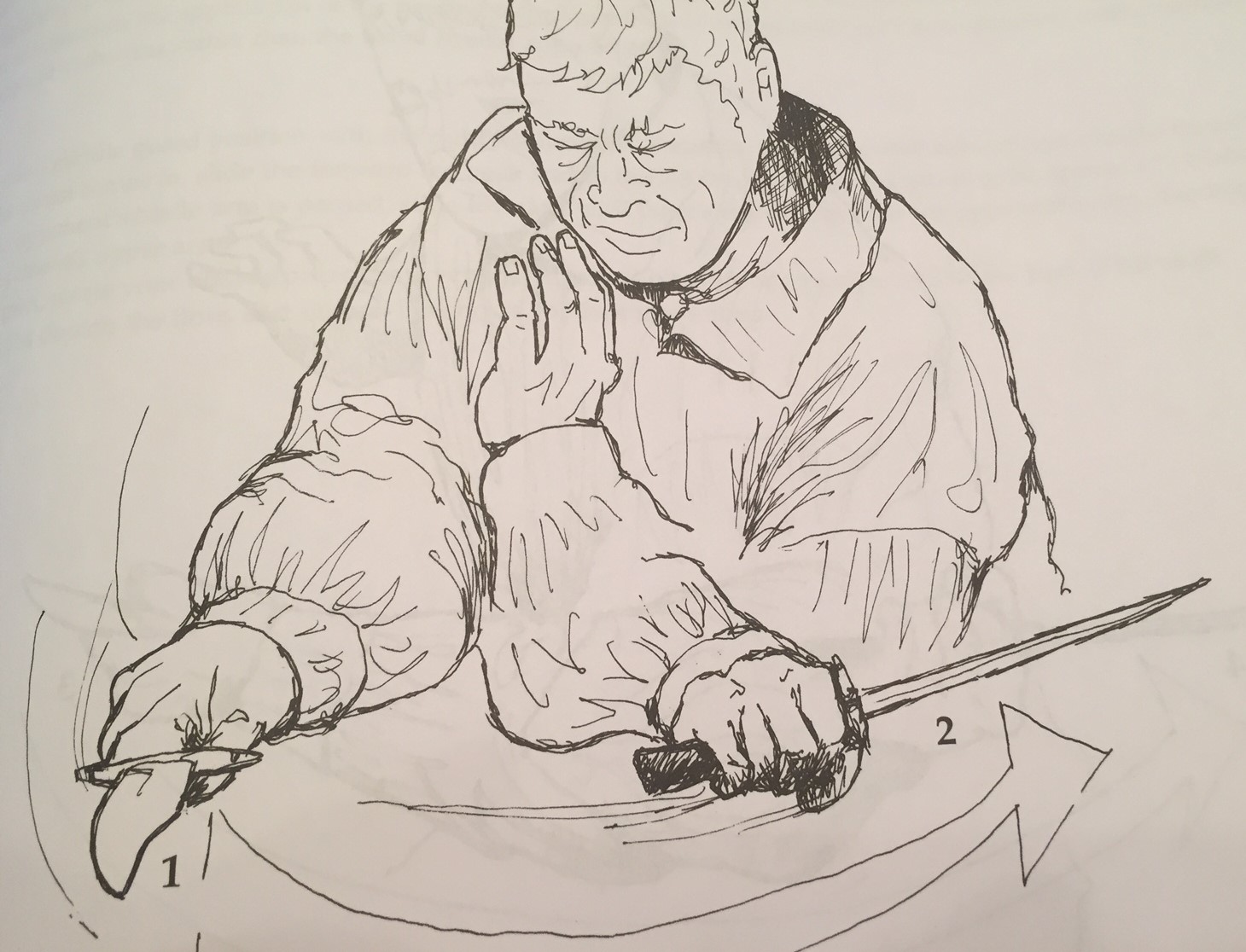
Again study the lines and the hand rotation. This is an evisceration. But when done from a two-hand grasp, the evisceration becomes the lead inciting uke to move. When nage achieves a harmonious integration of movement the ryotedori kokyuho lead can be sublime. Sublime and deadly when properly understood.[1]
Kokyu Nage from ryote dori uses the hands almost in the opposite manner insofar as the front hand now goes low and the back hand goes high. While executing a tenkan movement, nage leads uke forward and down with the front hand in a classical deployment while the top hand leads uke’s attention up. A more graphic description would be to say the front hand now executes the evisceration while the back hand thrusts on the #7 line. Of course this is a double thrust and uke will not be thrown but rather impaled. So, back to Aikido.
Understanding the proper (budo) use of the hands, nage leads uke forward with the additional low line vector (with the front hand) and a high line vector with the back hand. The two opposite vectors combined with nage’s rotational zoning (tenkan) creates the dynamic tension that engenders the throw. Nage adds energy to the throw by leading uke forward and then nage snaps his hands to a closed position. The details to recall – the backhand is now at the top of the rotation and on uke’s inside line. This means that nage’s edge is on the inside of uke’s wrist – so the shyuto cuts the flexor tendons. Nage’s front hand now executes a “C” cut.
These throws are part of the kihon curriculum but the hidden budo should provide a deeper appreciation for what can otherwise be dismissed as a simple technique. Find the hidden depths and recognize that bujutsu (martial applications) are foundational.
Further explorations of the outside-inside. Nage takes the outside relationship with the front hand to drive uke’s arm cross-body rendering it useless. This can be accomplished with a directed body entry which allows nage to also grasp uke’s second hand like yonkyo and then throw uke. This throw is similar to the soto-kyokyu slip that I more frequently present but the ‘throwing’ hand is the back hand and not the front. Think on these differences and build your matrix of possible combinations.
_______________________________________________________
[1] Having unpacked the budo behind a tenkan zoning motion, the next level of play is to reduce the time of the encounter, which necessitates that nage move less – the body stays on the line, but the hand-work (i.e. the blade play) remains the same pattern but it too is compressed in time – therefore the movement can become back hand deflect/eviscerate with a simultaneous reversa thrust (#7 angle) to the head.
 Protective Arts
2 thoughts on “RYOTEDORI 2”