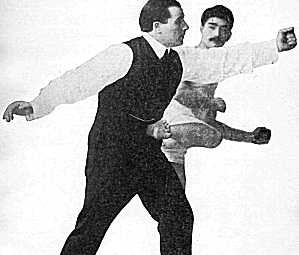
Playing off the fencer’s lunge, we have moved back to jodan tsuki with the emphasis on the role of the attacker – using the straight blast effectively. An explosive attack is a pre-requisite to honest training. Repetition – correct form repeated until the attack is both accurate and powerful is our homework.
Most of class was spent on material we have covered previously (review) but now I hope the ranged attack of the foil will inform the practice. From the straight punch we do a cross check, slip inside, counter trap and the strike to the side of the attackers head with a 90-degree pivot to the line of approach. A 3-beat counter to the punch. You have seen this numerous times – it’s shomenuchi kokyunage. Because shomenuchi telegraphs intention more than tsuki, nage’s response to a thrust requires a crisper timing. So the presentation this morning was more staccato than connection.
From the kihon 3-beat direct kokyunage we played with beats.
In a 3-beat the pattern when uke attacks with the R, nage’s pattern is R intercept, exchange for L – L exerts control, then finishes with a R to uke’s neck. Add a beat – go to 4: uke attacks with R, nage intercepts R, exchanges L, R strikes uke’s inside elbow (where nage’s L was a moment before), then nage strikes uke’s neck L.
As a concept the more beats, the more time required. Therefore, nage’s movements must be crisp, linked, and properly targeting uke so as to not allow uke to regain the initiative.
Decrease the beats. A 2 beat exchange can be done several ways. The most common response in Aikido is similar to yokomen uchi kokyu nage direct. Uke attacks R, nage intercepts L and strikes R. A very straight forward response that requires responding in true time and with a subtle inside slip so that the nage’s lead hand can properly intercept the attacking fist. I also showed an elbow compression in a 2 beat response:
Aikido presumes the sword, so most of the attacks and responses have the primary point of articulation at the shoulder. Shorter ranged weapons allow for the more prominent use of the elbow.
Uke attacks R, nage intercepts R and while keeping connected at the distal part of the limb while the elbow flows over to uke’s elbow to collapse it allowing nage to strike with the L. This will resemble the 4-beat response but done with just 2-beats. It requires greater sensitivity, flow and tighter proximity.
We did not cover today, but it should be obvious, that other 2-beat variants are cross-block (RvR) then shoot straight under the low gate to a counter thrust.
Jodan tsuki countered by a standard cross-block leads to the general kihon response matrix: on the cross-body line – ikkyo through sankyo; inside to outside – kokyu nage direct; outside line – irimi nage, kaiten nage; complete the responses.
For the more advance play we added a pak sao feed with the front hand – this is a half beat feed to the cross hand.
Uke attacks jodan tsuki with the R – nage uses lead L to slap feed the attacking arm into nage’s R – this could be a power assist to drive to irimi nage direct, the front arm-trap & choke by selecting either the high or low gate.
After these parry-riposte plays of attack, block/blend, counter, we then moved to more complex – compound exchanges. One player initiates with a straight thrust – the responder then starts a cross block to execute a technique, which is defeated by the attacker pulling back to counter strike. Recall the concept of beats. If nage is executing a 3 or 4 beat response to uke’s one attack, nage must be moving at a multiple of uke’s quickness. Review the Types of Speed. As we allow for the possibility that uke could attack and if blocked then attack again. Uke will therefore re-chamber, so nage must learn to follow the attack back. As nage follows the initial jodan tsuki back, nage has closed to the shikaku. Uke’s back is now presented to nage, as is uke’s second arm – so grab it! Now the players are in ushiro-ryote-dori’s position. Uke is now in nage’s role.
Ushiro-ryote dori as typically presented is entirely devoid of martial content. The budo of Aikido is not on the surface and I rarely see it explicated in a sensible manner. Nage presenting an arm that floats in the air for uke to grasp. Balderdash and nonsense!
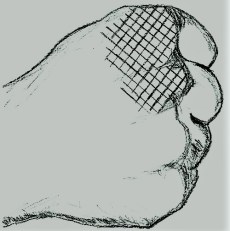
Keeping it real, if we keep to the kihon presentation – nage will initiate the action with a back knuckle (uraken) to the temple/neck which uke must intercept – and then does a press trap to enter to nage’s back in order to arrest both nage’s hands. The standard responses now ensue.
Or the more complex (compound) set up described earlier from the jodan tsuki. But keep in mind these are concepts to provide proper context to the ushiro attack. The grasp/attack could just as easily be ushiro ryokata, ushiro ryote dori, ushiro kubishimi, etc. The logic chain to get to the position is the focus. The responses from the ushiro relationship will be the next focus.
________________________
The ushiro relationship is dramatically different from an eridori attack. As discussed here – ushiro is a secondary response (i.e., your first plan failed). A primary attack from the rear is eridori, which is a sentry removal technique.
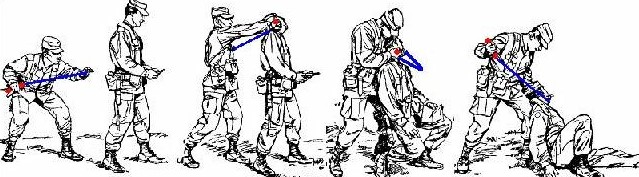
The simple fact is: you never want anyone to get behind you. Your inattention is your demise.
An attack from the rear is a thuggee favorite (remember etymology) – with a garrotte
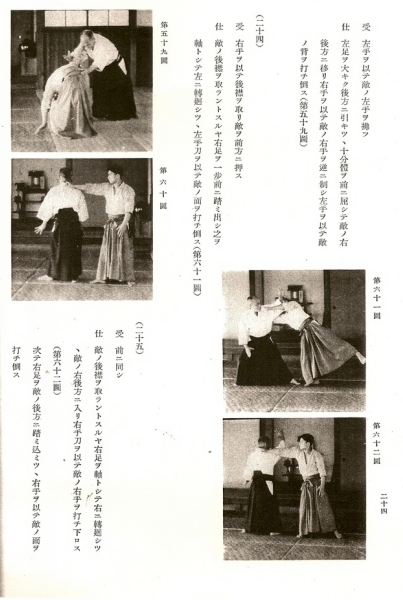
As a preview – the responses to eridori are far more explosive that any ushiro precisely because the eridori grasp is an imminent threat. Study the early presentation and look at the dramatic movement O’Sensei achieves from the intial to the terminal position. Do not allow adversaries to approach from the rear and if they do be decisive and immediate in your responses!
 Protective Arts