
George Orwell advised against using any metaphor you were used to seeing in print – so rather than ‘like moths to a flame,’ Orwell suggested, ‘like bluebottles to a dead cat.’ His contention was that reflexive writing betrays non-critical evaluation: Poor habits of thinking when critical and sober reflection is required.
So it is with any art. As we grow in experience, certain phrases, patterns and movements become automatic – reflexive. Sometimes this is the goal: we seek to ingrain a patterned response because it is faster than a deliberative one. The reminder I take from Orwell is that training for a proper reflexive response is dramatically different from training reflexively. Shoshin – beginner’s mind is an admonishment to question constantly, to not allow what you know to blind you to the possibility there is more there than you think.[1]
Makiotoshi 巻き落とし, meaning “twist down” is an essential concept – and once understood as a concept rather than as an isolated technique – its power will manifest.
In our dojo, the most obvious exemplar of makiotoshi is the jo technique wherein a yokomen strike is received in a cross block and then the jyo is snapped down. If you need a reminder >here< but the hand that needs attention is the back hand. The back hand drives the response and makes the conical entry that provides the energy for the technique.

Now repeat the same motion with bokken.
Then look at the empty hand presentation. Perform the action off the Okamoto-style stop-hit: stay on the line and receive uke’s strike. The back hand will receive like the bokken – while the front hand threatens uke’s trachea. This is a developmental exercise not a technical expression yet. We stop the strike only to develop the timing of the capture. The next step will be a makiotoshi snap of the back hand down to feed uke’s hand to the front hand at the low line: a set up for shihonage.
This is putting an energetic response into play. Rather than rely on kimusubi (i.e., the ushiro-tenkan absorbing action of yokomen-uchi shihonage) we are ‘snatching’ the attack to sharply feed the opponent’s hand to the low line where your free hand closes the trap and the hips drive the action. But it must start with the hand.
Just like with the jyo, bokken, whatever the weapon – the weapon must move first on the attack: weapon, hand, body, feet. The empty hand variant should match the weapon sequencing.
When confronting a blade held in reverse grip, the makiotoshi movement becomes a quick strip disarm.
At its essence, the base physiology, the movement is nothing more than turning a door-knob. It should be that ‘natural’ when you recognize that you have been training this motion since you were a toddler. You can parse it more, refine, it and study it (and you should) but in its essence makiotoshi is nothing more than rotating your forearm clockwise – initiating with the shyuto and terminating at your elbow. Change the plane – with elbow and forearm perpendicular to the earth or raise it parallel, the motion does not change, just the positional relationship.
Once you recognize the movement, then study the converse rotation. The counter clockwise rotation is the jodan uke (upward) and uchi uke block in karate.
Clockwise – inward – rotation is used to capture.[2]
Counter clockwise – outward – rotation is used to deflect.
Start to see the universal motions. They are universal because the human range of motion is delimited by physiology. These motions are ubiquitous, you just need to see them with a beginner’s mind. The patterns of motion can be as wondrous and common as diamonds falling like rain.
_________________________________
[1] Chiba sensei explained shoshin:
The character sho means first or beginning. The character shin means mind, spirit or attitude. The two together have been translated as “beginner’s mind” and indicate the mind (spirit or attitude) of a complete beginner when starting Budo training. This is marked by modesty, meekness, sincerity, purity and a thirst to seek the path.
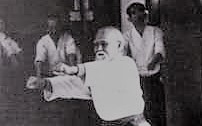
[2] If you need a traditional Aikido presentation watch O’Sensei >here< at about 3:52 and study how his hands move in the shin-kokyu exercise
 Protective Arts
One thought on “MAKIOTOSHI”