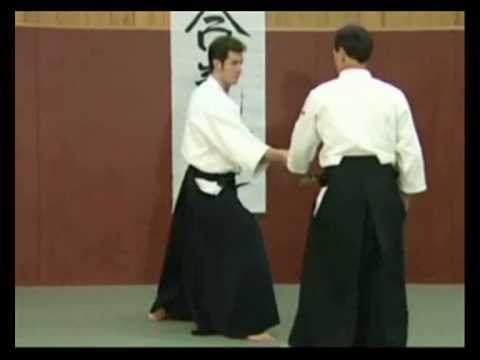
With an influx of new students I have presented contact exercises. In each of the last two classes there was only one technique taught in each. Technique is a secondary expression that derives from feeling connection. Aikido is frustrating to learn because it is an energetic art – one must not only feel the internal movements but also the connection to the external other.
Therefore: contact exercises.
Gyaku-hanmi katate dori is the introductory contact exercise because it controls for the variables of distance (maai) and time (rate of approach). Beginning students need to become familiar with the proper grab, understanding pressure, maintaining contact, moving from an athletic stance (i.e., combative stance, lowered center, knees bent and feet fluid). These are primarily internal exercises – understand and command your own body before attempting to manipulate another’s.
Senior students are the ‘feeders’ of information to give context where they draw out the best responses from the new uke – revisit the post on testing and consider the concept of grace(fullness).
Start at the beginning: establish the grab. Ultimately uke is learning how to grasp a weaponized hand so the contact and control is important. Uke must learn to keep a full palm pressure and emphasize wrapping the lower three fingers around nage’s wrist – teach to grip a katana and de-emphasize the index-finger and thumb contact. Proper grip will facilitate uke feeling how to follow. Please remember that the martial purpose of all hand grabs is for nage to learn how to perform a strip – the effective and forceful extraction of the grabbed hand. The purpose for uke is to learn to seize and control a moving and weaponized hand. Therefore do not compromise or diminish the importance of learning and continuing to practice katatedori. A solid connection will allow both players to work balance and angles (feeling the ‘hara‘) with subtle changes in pressure, shifting weight, rotational movements at the point of contact – but all these lessons vanish as soon as uke slacks the grip.
Nage as feeder should move at a rate that encourages uke to keep contact (despite the fact that nage’s goal is to break it…). When nage moves uke’s constant contact should engender a ‘natural’ movement that keeps uke ‘free’ to respond to new stimuli. Most often we are overcoming a beginner’s reflexive ‘rootedness.’ As people are encouraged to grab firmly that often causes a reflexive tightening of major muscle groups. We are teaching and learning to isolate and concentrate specific muscle groups (Prana-bindu) without impeding the overall ability to move. This is not an easy skill.
As nage, the beginner must learn to surrender the point of contact to uke. That point – the axis of the encounter – becomes the ‘ball joint’ around which nage moves. The first order of learning as nage is to move freely around the grasped point. To accomplish this nage must release tension in all other points of his body while keeping a firm contact with uke’s initial grab. As nage progresses in skill one learns to ‘lead’ uke by their contact, but that is a higher skill. Nage must first learn how to move freely around a point of impingement (the axis of the encounter) because if nage cannot control his own body, learning to control another’s is futile.
So advanced self-control: as nage start from a distance then advance to place your hand in uke’s oncoming grasp. Once the point of contact is established – allow your hand to remain and then continue your advance in and past the grasp – your hand ‘floats’ whilst you perform irimi-tenkan. The goal is to continue to move, not disrupt uke’s intention and provide as little sensory information beyond the forced contact at the wrist. This exercise prioritizes timing and connection (kimusubi) over control (tanren).
Once these concepts are transmitted – then back to tanren control. From the initial grab explore the vertical plane without moving the horizontal axis of the encounter. (This should also be done morote-dori as a development exercise, but that is for a future post.) Using only the one point of contact to control the encounter, drive uke’s weight down. This will require a level of tension that carries from nage’s body through the connection into uke’s. It sounds far more mystical than it is in practice. Vague terms like ‘connection,’ ‘hara,’ ‘kimusubi,’ are short-hand labels, but the actual learning and effects are very pragmatic explorations of vectors of force, changes in muscular tension, shifting of balance and position relative to your partner: all of which must be experienced to develop and learn fully. Keep training!
 Protective Arts
5 thoughts on “CONTACT EXERCISES – Gyaku-hanmi katate-dori”