
Thanksgiving 2017 – I was able to catch up on some neglected issues of The Economist and found a reason to be deeply grateful: an affirmation that people are fundamentally good. Despite the callous and sensationalist reporting that is ever fashionable, focusing on the salacious and vile behavior some members of species exhibit, the majority remain quietly decent and in our better moments show us pure greatness.
We all – and I do not mean that rhetorically – owe Stanislav Petrov our sincere gratitude for his decisions made in 1983:
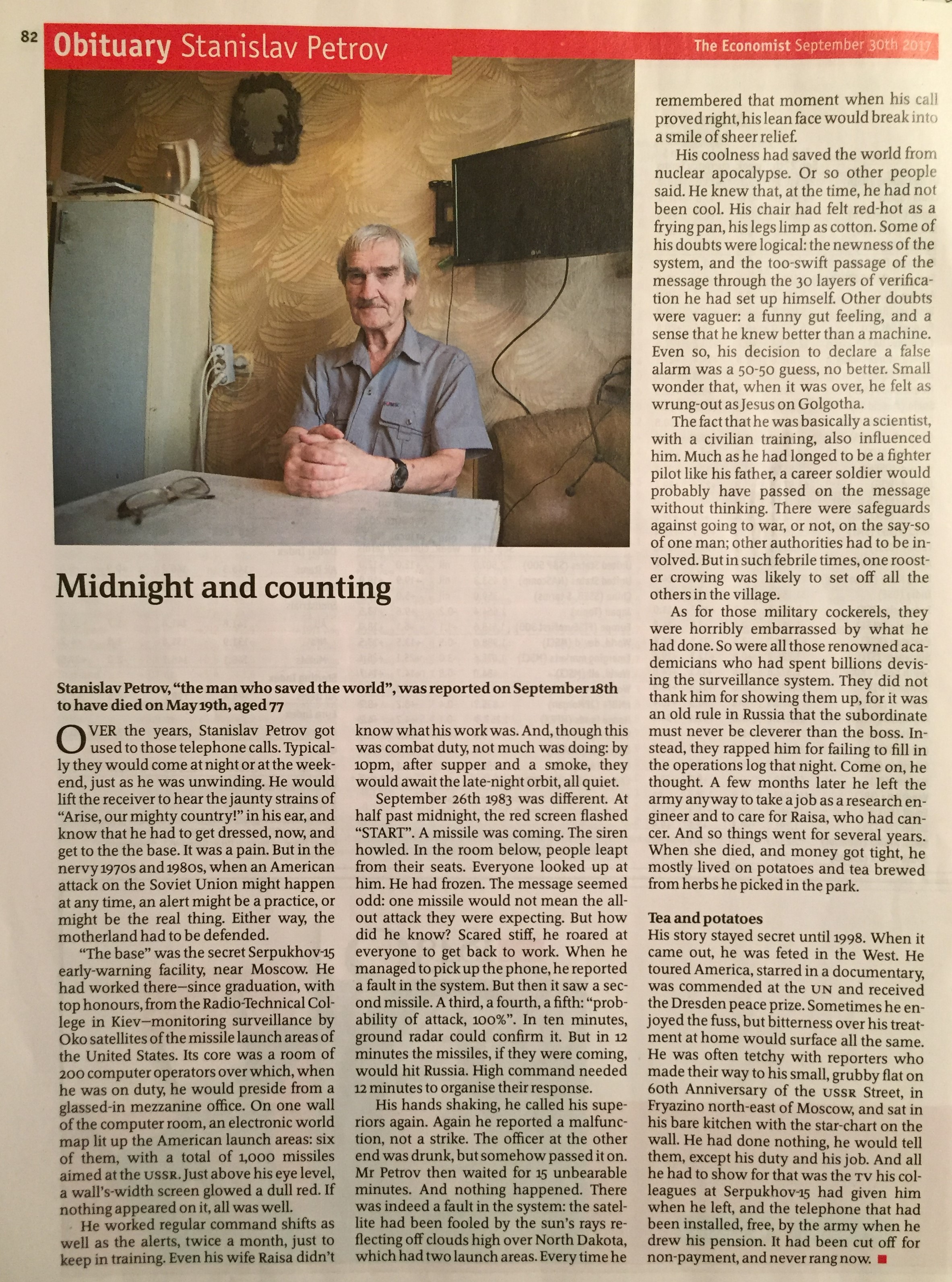
For me, Mr. Petrov on that potentially ill-fated day embodies a very important lesson: he believed more in the fallibility of machines than in the imperfection of human nature. The redundancies built into the early detection system failed; despite all safeguards it issued a false positive. A false positive that Mr. Petrov could not, did not, believe. Perhaps first because the initial data was intellectually wrong – “why just one missile?” – but I prefer to believe that he showed greater wisdom and the belief in our better selves.
_____________________________
Further Reading
Related post – Strategic Relocation
So you know how far to run to avoid the blast zone.
An interesting benefit of forgetting?
Nuclear war remains a very scary possibility.
What is the Probability of a Nuclear War?
I agree with Tyler who wrote recently that “the risk of nuclear war remains the world’s No. 1 problem, even if that risk does not seem so pressing on any particular day.”
The probability of a nuclear war is inherently difficult to predict but what strikes me in this careful survey by Luisa Rodriguez for the Effective Altruism Forum is how much higher all the expert predictions and model forecasts are compared to what we would like them to be. Keep in mind that the following are annualized probabilities. For a child born today (say 75 year life expectancy) these probabilities (.0117) suggest that the chance of a nuclear war in their lifetime is nearly 60%, (1-(1-.0117)^75). At an annualized probability of .009 which is the probability from accident analysis it’s approximately 50%. (See Rodriguez and also Shlosser’s Command and Control on the frightening number of near misses including one nuclear weapon dropped on North Carolina.)
 Protective Arts