For this post, I amplify Master Keating’s thoughts and imbed links to make more clear what he was imparting. Study these concepts, they pertain to your Aikido training as well:
______________________
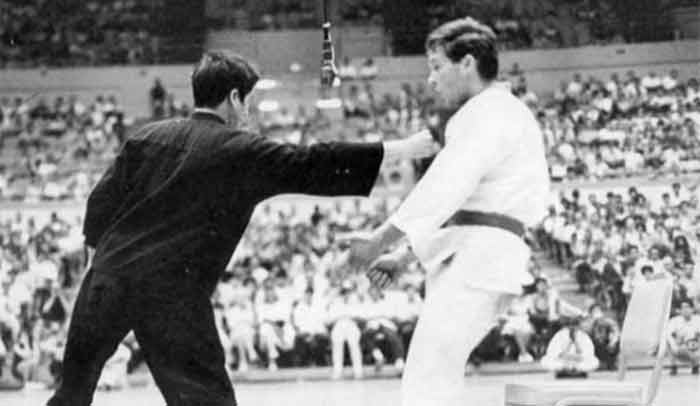
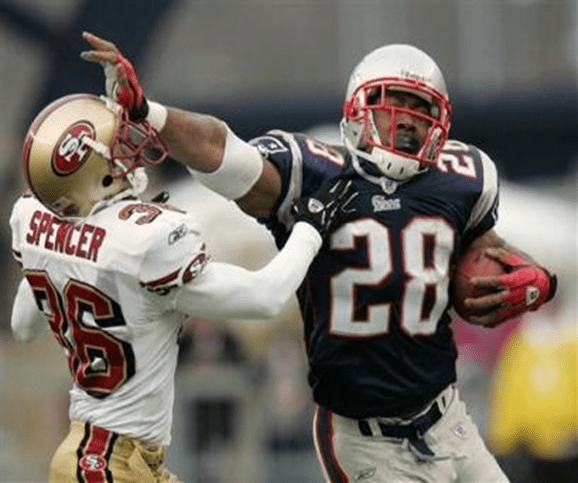
In Kung Fu to issue forth a blast of energy (force) from any place on your body is known as “Fa-jing“. It is what Bruce Lee employed in his now famous one inch punch demonstrations. It uses a quick-twitch muscle flex which in turn is based off of a “body-ripple” type action. The skeletal system delivers the force more so than the arm and hand. In this way the arm-hand merely act as struts, not pistons. Much like American football’s lethal (and banned) “stiff arm.”
In another example Maestro Peter Urban (USAGOJU) named his version of Fa jing the “shock-shove punch” (and aptly titled it was)! If you have not felt fa jing type energy blows it is difficult to believe or understand. When you do experience such energy it is shocking and impressive. Theory swiftly becomes reality!
In Tai Chi there is a concept taught as “severing the root” – it is comprised of two opposite energies, push and pull. To sever the root is to shut down the opponents ability to respond-react. They sort of stall out mid-attack, it is then that you strike back. To pull this off you need the “listening energy” as is taught in some styles of kung fu. It receives, it does not oppose. You accept first, then you repulse. They enemy gets sprung violently between the opposing forces. The effect is done in perfect timing with their actions and reactions. If you cannot sense and read the energy of the person before you, you cannot pull off something such as severing the root. This is energy work at a high level, to practice under a good sifu who is willing to teach this level of combat awareness is a priceless find for they are few. Time, patience and determination will help you on this quest. Relax, let go of the rocks you are clinging to and let the current take you, go with the flow my friend –
Energy can go beyond the physical barriers. It can become a catalyst for certain intuitive feelings. This type of energy can be passed between people through the eye to eye contact. It can also be shot outward through the plexus chakra in a blast of psychic energy. In the Book of Five Rings Musashi calls this force “vigor”. He advises to “instill the vigor” from your feet right up to the top of the head. In the art of Tai Chi Chuan one is taught to keep the head erect, like it is floating above the shoulders. This is for the purpose of achieving the higher energy flow throughout the body for healing or for personal defense. There are many names for this energetic effect.

Each culture recognizes this energy, each giving it a name that best describes it in that particular country or culture. Chi, Ki, Pneuma, Prana, Vigor, Inner Fortitude, the list is long and going through it is pointless. Whatever name this energy is labeled it remains the same. Most of the time this energy and the command over it are deeply connected to the breathing processes and will power over the inner self. So regardless of whether we speak of the physical manifestation of it or the more aetheric psychic forms of energy one of the big tricks in dealing with energy is to possess the ability to control it. To have it at one’s beck and call is the ultimate goal, but t’is easier said than done. Such skills or gifts must be earned through long years of study and self discipline.
Since most people assume such talk as we pursue here is naught but sham and scam. It is an overlooked and misunderstood element in the vast pantheon of modern fighting and defense methods. It helps a bunch if you actually know someone who has this ability. They can show you (in person) something relating to tactical energy. To experience it is faith building in itself. It becomes a more “real” goal to pursue in your training regimen once you experience it.
Those people who can sense the energies of the opponent correctly can actually “read” the intent of their adversary. They seem to have a mysterious fore knowledge of the aggressors actions. Through the awareness of “exchanged energies” one becomes a most difficult subject to victimize. Counter and riposte become natural after a few years of cultivating such abilities. Kali, Kung Fu, Aikido and other arts share this trait in common. Each recognizes the flowing energies of the fight and touch pressures therein. Other arts are in complete denial of them. People bound by those arts will call such sensitivity training as I am speaking of as false and worthless. Hence the eternal struggle of the “haves and the have nots” in its most obvious form. Some arts and practitioners are so ignorant they don’t even know that they are that ignorant. Darkness and cultism unfortunately comprise a great deal of many martial arts styles and their underlying philosophies. Often what they lack in ability and skill they adequately compensate for through anger and sheer toughness
For you and I “energy” (NRG) is a word which describes the effects of a force or pressure that is felt in the practice of certain martial arts. In kung fu it has been described as a feeling similar to a “spring under tension”. It can also be used to define the lack of presence or “no energy” during an physical encounter. These forces or pressures are part of the close quarter combat experience. To be unfamiliar with them is to court disaster. To know of their ways, in other words to know the meanings of specific pressures is to have a big advantage over others. Awareness and sensitivity figure in heavily in the correct interpretation of these myriad pressures felt during a physical exchange. Anger and callousness run counter to this idea. Those sort of emotion based effects work to block one’s sensitivity to physical situations. They are lower based skills and appeal to those caught in the common conundrum of “what should I do” syndrome that normally occurs when violence strikes.
_____________________________
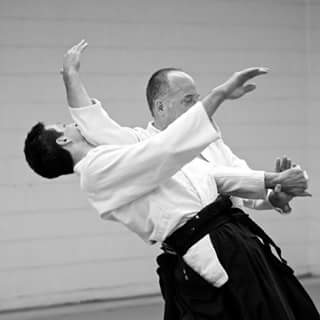
Please recognize the cognates here and learn to see kokyu as true power. Kokyu-ho as practiced is an intentional miss! Any application of kokyu is a powerful combat move, but as practiced in Aikido, it will seem to be more of a positional throw where the arm is used like a boom rather than a lance. Most Aikidoist are blind to the martial power in the art. Chiba sensei said the budo of Aikido is not at the surface.
Aikido’s essence as a budo is by no means close to the surface, but those with a degree of insight should be able to discern it. The aikido that we see on the surface, in other words, much of the aikido we see today, cannot necessarily be said to represent budo in the traditional sense of the word. Fortunately, in aikido there remains the potential for serious students to dig deep to discover its essence and through a long process of searching to make that essence their own. Aikido’s essence as a budo is by no means close to the surface, but those with a degree of insight should be able to discern it. The aikido that we see on the surface, in other words, much of the aikido we see today, cannot necessarily be said to represent budo in the traditional sense of the word. Fortunately, in aikido there remains the potential for serious students to dig deep to discover its essence and through a long process of searching to make that essence their own
So learn to look beyond the neutered presentation and perceive the application.
_____________________________
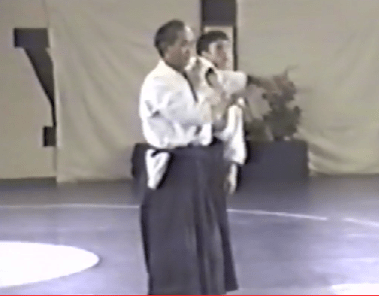
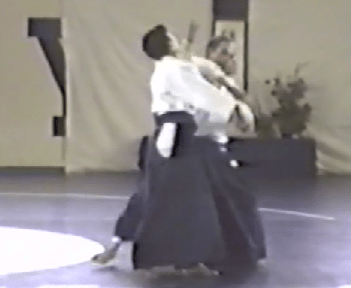
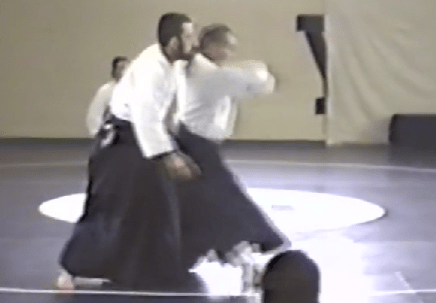
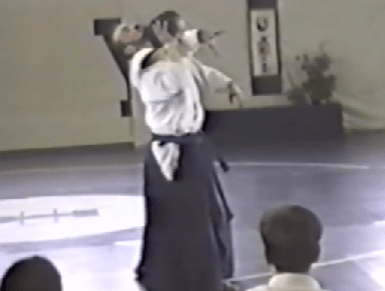
Bonus – Chiba sense kokyuho variation
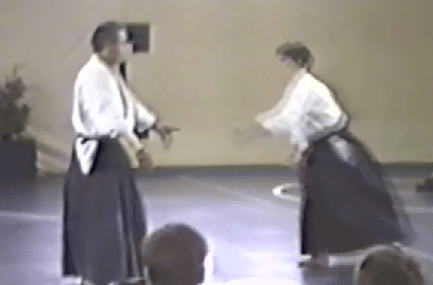
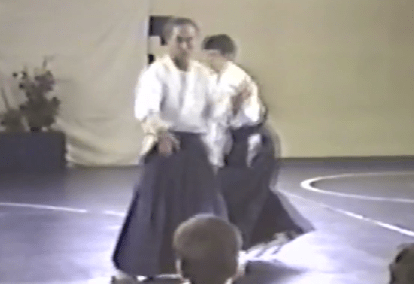
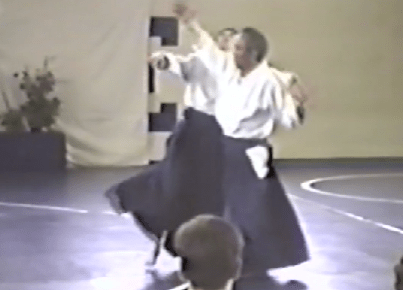
This is the same turning entry as one does for tachi-dori, except unarmed, uke grabs.
The second variation, Chiba sensei slips under (as in uchi-kaiten) but notice the kokyu position:
 Protective Arts
One thought on “KI/KOKYUHO – internal power and its cognates”