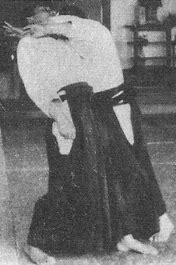
Although I have tried to stick to the basics and teach to the test, this morning I broke the theme – and re-introduced concepts. It was a small class so the deviation probably did little damage. Techniques are in many ways easier than concepts because they are discrete and short, composed of a few beats only.
We continued to explore gyaku hanmi kote gaeshi. As a contact exercise, gyaku hanmi limits the variables. Look at the initial cut over, the hand extraction: from the initial R-L arrangement, nage uses the back hand to cut the grasped hand free while the grasped hand simultaneously breaks against uke’s thumb and index finger to extract the hand. Simple beat.
Add complexity – introduce a half-beat: the hand that was initially grabbed by uke (and remember uke only arrested that hand because it had a weapon), once extracted hits uke in the abdominal/floating rib region before using the hit’s rebounding energy to capture uke’s front hand. We have moved from a cut/capture sequence to a cut/hit/capture.
The more facile we become with the basic movement (kihon waza) adding beats becomes an exploration of atemi (strikes). While not typically explained or explored in the ‘non-violent’ context of Aikido, we need to be aware and informed as martial artists to recognize openings and exploit vulnerabilities. The first atemi should then start a lined chain of subsequent hits that ride up the arm to the head.

Thus a technique that may begin as kotegaeshi can readily become irimi nage. Nage’s back (cut-over) hand that frees the grasped hand – allowing it to strike, then check uke’s elbow – allows nage’s back hand to flow-strike uke’s chin/face: irimi nage omote, direct. This is the power of half-beats. Each linked strike keeps nage in control of the encounter, each reset of the OODA loop gives nage the initiative to act, allowing continuity of motion.
Kote-gaeshi as a technique is limited to a ‘wrist-turn.’ Kote-gaeshi as a concept is much more powerful. What is kote-gaeshi as a concept? The turning action (gaeshi) is the key, the starting point at the wrist is just a reference point. We start at the kote (wrist/hand) because it is the distal point.*
As a training exercise stand facing your partner – and allow him to grasp for the basic kote gaeshi. Once the hand starts to turn, nage’s back hand adds the impelling force. Examine the action of that back hand – the rotational spiral is a conical entry. At the wrist it is kote gaeshi, at the elbow it is shihonage, at the neck it is irimi nage. All of these discrete techniques are nothing more than an application of a circular dissolve principle at different points on the opponent’s body.
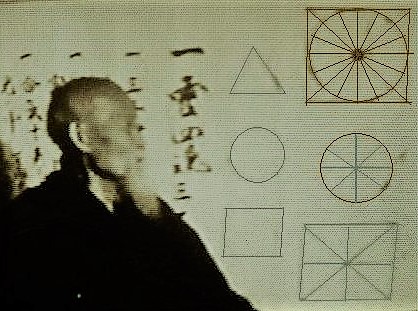
Remember: circles dissolve lines but lines bisect circles. Ruminate on that simple observation.
______________________________________
*The finger is of course the most distal point but Aikikai Aikido does not incorporate finger locks in its curriculum. Finger locks – Wally Jay and Chin Na well describe possibilities
 Protective Arts
4 thoughts on “KOTEGAESHI to IRIMINAGE: Circular Dissolves”