I am failing my new year’s resolution of teaching to the test. Concepts and connections are taking precedent over technique in my classes.
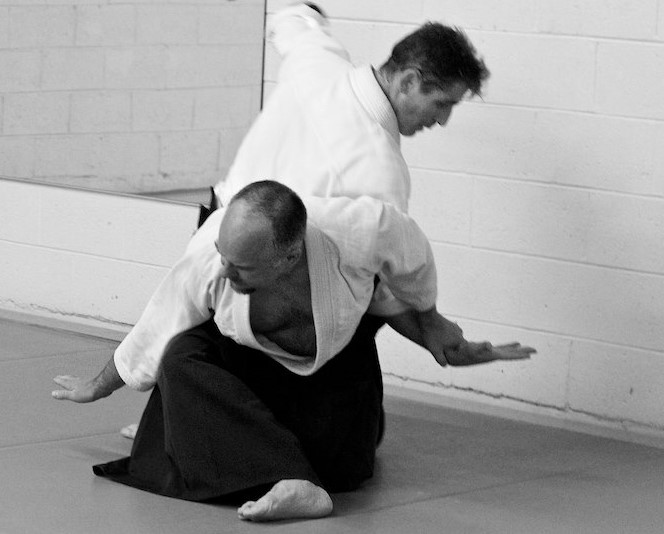
This morning the only technique I taught was ai-hanmi-katate dori kokyuho (and its variant irimi nage). I have covered kokyuho previously but this morning I used it as an exemplar of precision positioning. To perform a kihon presentation of kokyuho one must first perform tenkan perfectly. And remember – when I use the term tenkan it always references irimi-tenkan. Irimi because nage is closing the distance (control of space and timing) before turning (disappearing) tenkan. This in concept should be a very simple movement because ultimately it is, but a reductive analysis reveals complexities that need be refined before they can be incorporated organically to achieve fluid motion.
Simply stated: ai-hanmi is a cross hand (RvR, LvL) grab. Uke has arrested nage’s weapon hand, so nage must perform a single hand disengagement. Which is to say, use the shyto of the grasped hand to roll over uke’s grasping hand while simultaneously targeting uke’s lead leg. Proper targeting shows you how your arm must move. The cutting edge of the hand moves first but does not circle uke’s grasp – rather, once the edge makes contact with uke’s forearm, nage should lever his elbow to apply pressure and drive straight down toward uke’s leg. This is traversing the vertical axis. Notice that your fingers are pointed toward the ground and your elbow toward heaven above. This disengages uke’s grab and because nage has simultaneously slid forward, nage can now tenkan and replace the front with his back hand to index (find) and control uke. This is a linear entry and often fails because nage watches the hands which slows the rotation and misses a full 180-degree turn. Let your hands act as the deft sensory tools they are and find your mark on the turn. This requires spotting.
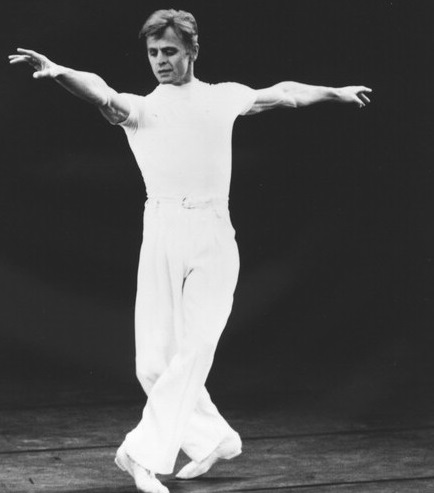
Spotting. I take that term from ballet and it is a useful reminder for a martial artist on how to turn purposefully. As martial artists, all our movements should be purposeful! First an example of how spotting works in ballet: watch Mikhail Baryshnikov turn (his movements are well worth studying in general). Notice how his head finds a fixed mark – he spots the point with his head first – allowing him to better keep balance on both the vertical axis and, as his rotational energy dissipates, to lower his center and extend his arms. Learning how to spot will improve your ability to pivot smoothly and quickly – and thereby improve your tenkan.
Tenkan. Too often nage remains mentally connected to where uke is and fixates on moving uke. But the true purpose of tenkan is a positional gain for nage – an escape to uke’s shikaku – dead angle. Spotting will improve your ability to find the proper mark, which is behind uke, in their blind spot. Mulligan sensei taught ‘spotting’ with the simple aphorism: “Where your nose goes, your ass will follow.”
By conscientiously spotting while you tenkan your rotational speed will increase and you will better direct your body placement. At first it may seem awkward, but once you incorporate spotting as a basic skill, you will find that your movements will be smoother and brisker: smooth because your rotational speed is improving and brisk because you will move from defined point A to point B with greater precision.
Aikidoists often present tenkan as a following or connection exercise and it certain can be emphasized as one. But at a more advanced level tenkan is a flanking exercise – creating a tactical advantage through superior movement. Never forget ours remains a martial art, you must always retain a spirit of budo lest you walk the path of delusion.
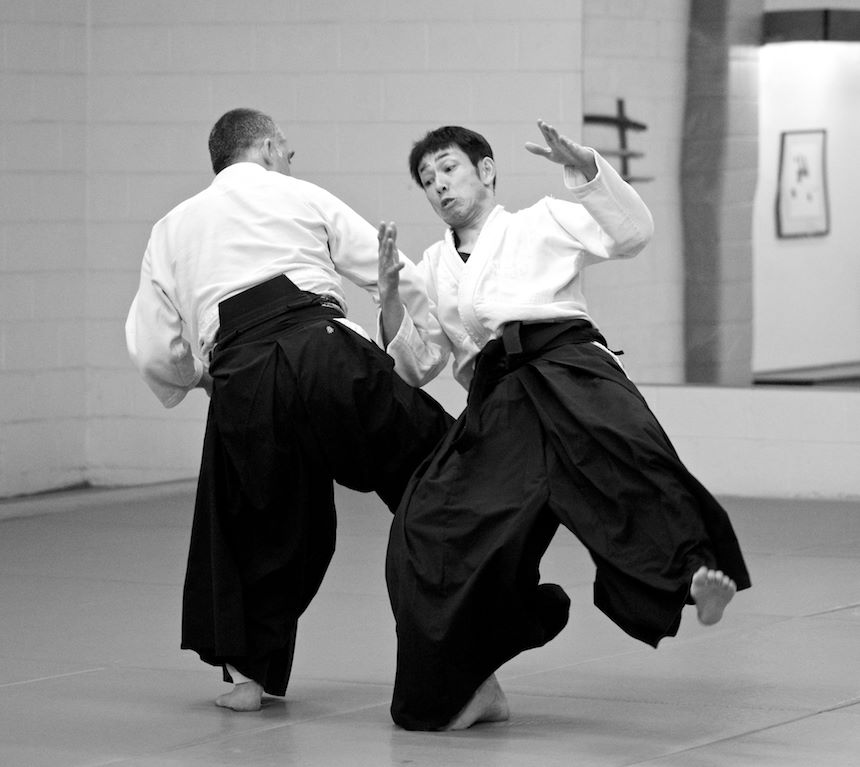
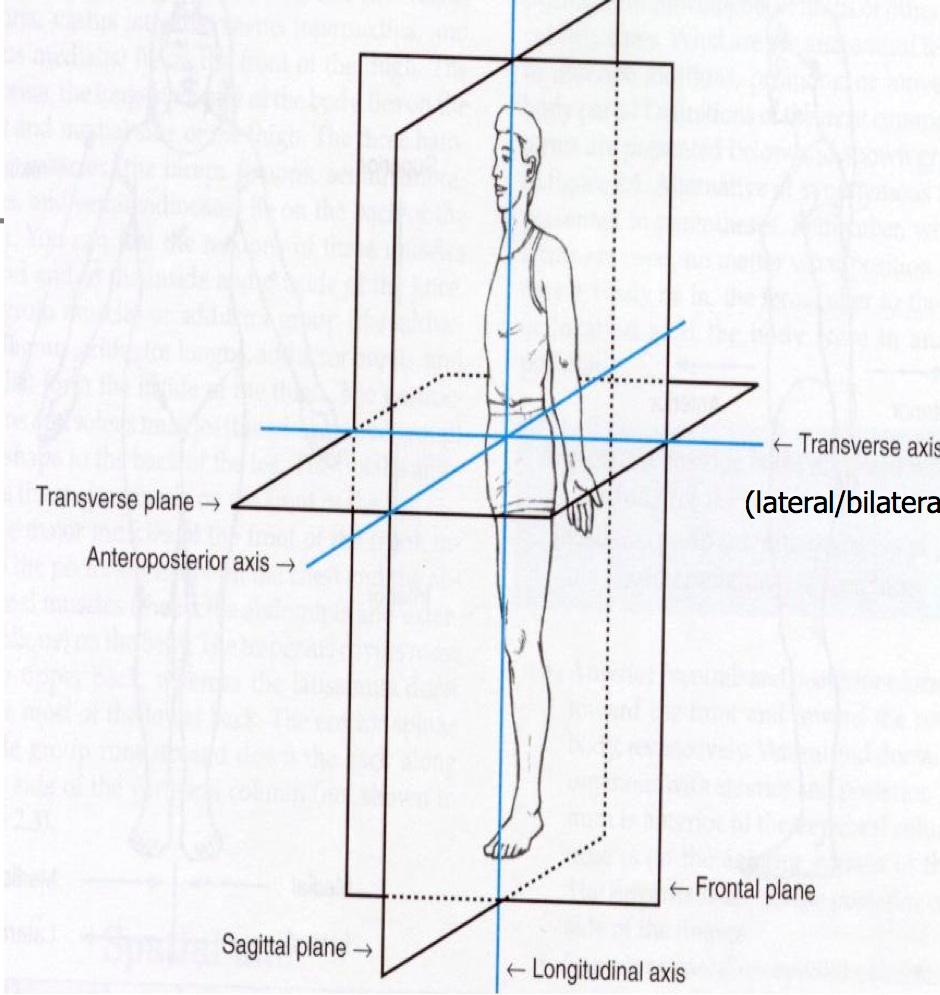
The second exercise. From the tenkan – which is a rotation 180-degrees from uke’s starting position (culminating in a position parallel with and slightly behind uke’s hips) – we now have to break plane (drop) and rotate to a full 360-degrees: a corkscrew toward the earth in order to cut uke’s Achilles tendon. Nage must now spot a more distant point and traverse two planes – the horizontal and vertical (or more properly, the longitudinal and transverse axes).[1]

Whatever the terminology, as martial artists and students of the potential of human motion we all need be aware of the planes of motion – left/right, front/back, up/down. How we traverse those planes is an art of subtle study, but fundamentally, we need to understand how to move through each of the six zones.
The terminal position of this second exercise is a classic iai-goshi posture: spine erect, one foot tucked under the gluteus maximus, the other positioned in front. This is all to teach postural alignment, stability during rotational motion, and proper targeting (i.e., knowing what you want to hit and why).
After the development exercises, we moved to kokyuho. The principles of tension and release and adding proper body levers are now added. After performing a proper irimi-tenkan entry, nage has already done a cut-over release and done a hand replacement. From this position, nage must ensure that his control hand leads uke down and forward so that uke is close to nage’s center line. Nage ensure that your hand remains on your center line, nowhere else! From that point, the hands must transfer again – the distal hand drops forward and down while the inside hand goes up (striking uke’s chin) and drawing the tension to the maximum extension that nage can achieve based on her arm length. Once uke’s body is under tension, nage merely twists at the waist (leaving the hands alone to ensure constant tension) and slide to take the physical space where uke once stood. A full body lever where the hip is the fulcrum, the tensioned arm extension is the lever. Slide bodily through the space uke occupies whilst twisting at the hips. The abdominal muscles must be held tight and the breath low – hence, kokyuho or breath throw.
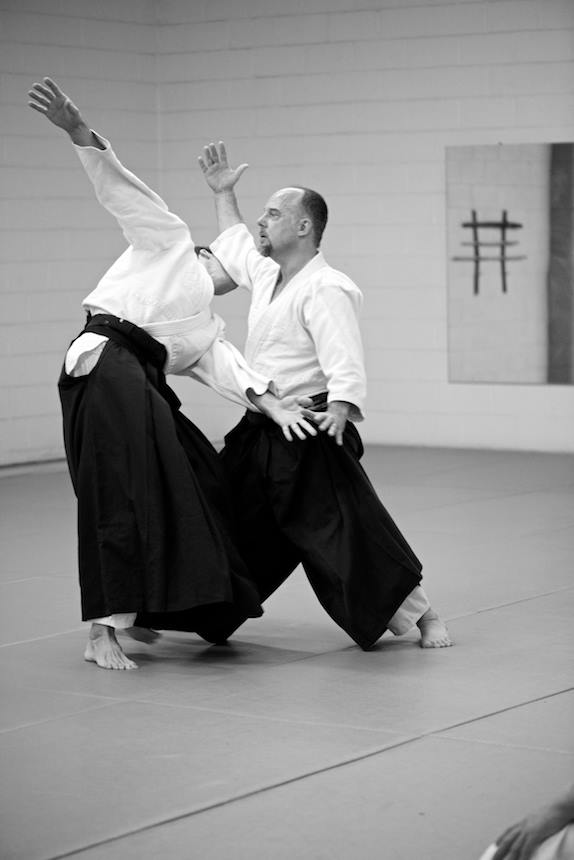
At this point please recognize that the throw done with the arm closest to uke is kokyuho but if nage simply rotates a few degrees farther into uke’s center and changes the driving hand it becomes irimi-nage.
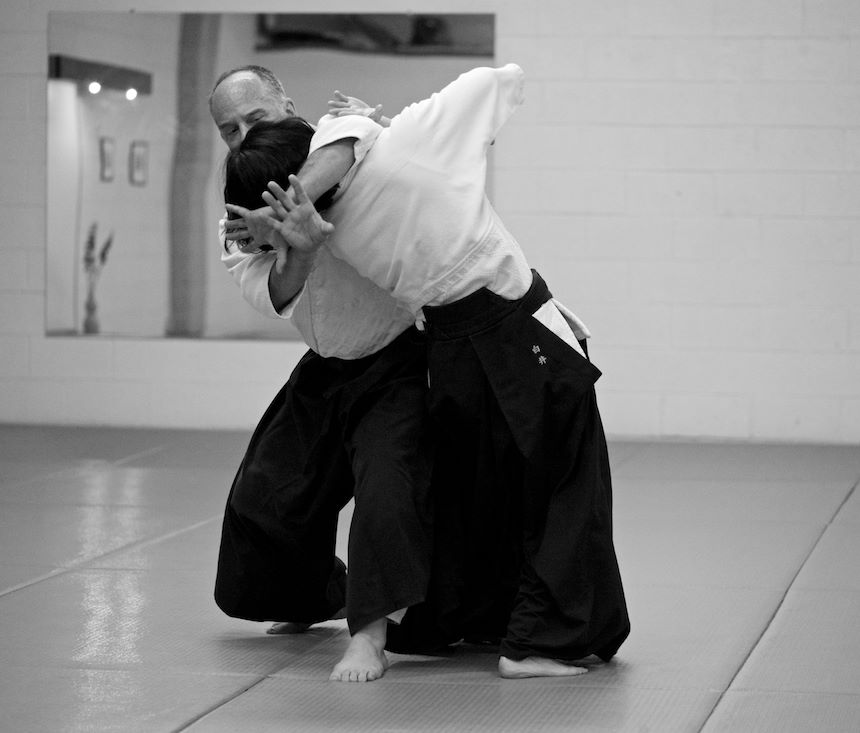
The kihon-waza of Aikido preferences continuity and smooth motion because this visually connotes connection with uke (ki-musubi). And as beautiful as this presentation is, there are other tempos to explore and understand.
Simplify the footwork by executing an entering slip rather than a full tenkan. This allows nage the opportunity to play with beats. One-beat: the grasped hand cuts over and drops vertically while the free hand takes uke’s elbow to simultaneously drive uke’s elbow straight down on the vertical axis. Two-beats, looks very similar to one, but the timing is (a) cut-over, then (b) the free hand cuts at uke’s interior elbow joint toward uke’s center.
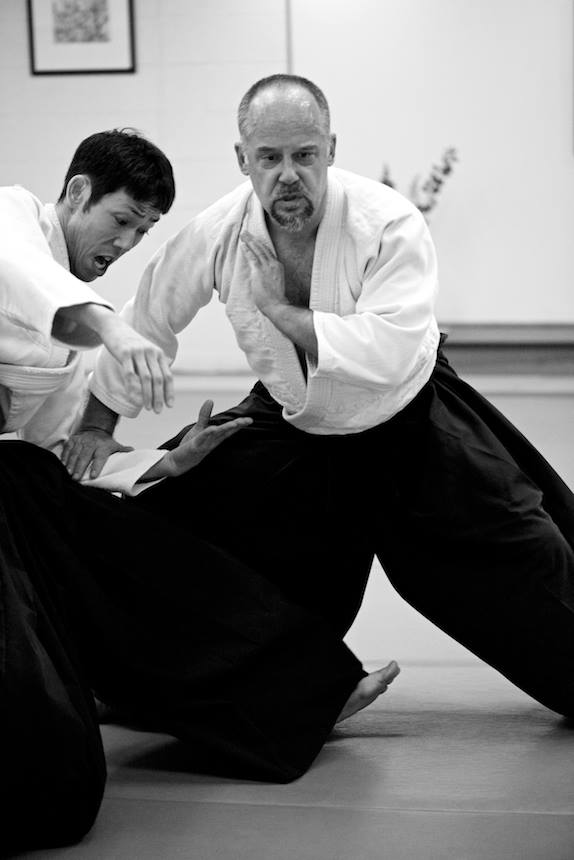
Two-beats each hand moves on its own vectors whereas with one-beat both hands augment the one vector. Three beats, the cut-over (extraction), replacement (trap), culminating in the throw (kokyu– or irimi-nage). Add the leg and we can add a beat to make it four (or more). The point is we are now introducing a ballistic motion where each beat represents a discrete hit to effect a strike on a vital point or elicit a reflexive response from uke that is then exploited for tactical advantage. Focus on beats rather than continuity of connected motion and Aikido looks like a different art.
And this is why I find it difficult to simply teach to the test: to teach one damn technique after another. That mode of presentation (for me) demonstrates a paucity of understanding. I want to show the principles of motion, the logic chains that become effective action.
Train yourself to see beyond the technique to move past their limitations. Hence my mission statement.
_________________________
[1] The L/R sides are called the sagittal plane, and the frontal plane defines the front/back side of the body
________________________
Thank you to Russ Gorman for the photos
 Protective Arts
2 thoughts on “SPOTTING”