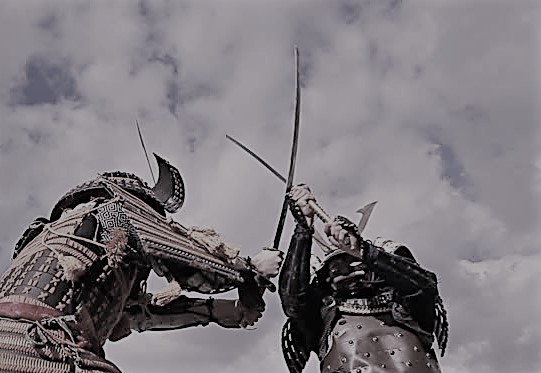
This morning we started with bokken. Standard shomen cut suburi to free the shoulders, then slide-cut to incorporate footwork (ashi-sabaki). From solo suburi to shomen uchi as a paired exercise.
Shidachi gives gedan no kamai to invite uchidachi to strike.[1] Uchidachi strikes at the available opening: shomen. Shidachi receives with a cross block with a slight forward advance whilst simultaneously lowering to dissipate the force of the strike – absorbing the force with the legs not the arms. Similar to this classic kendo exercise:
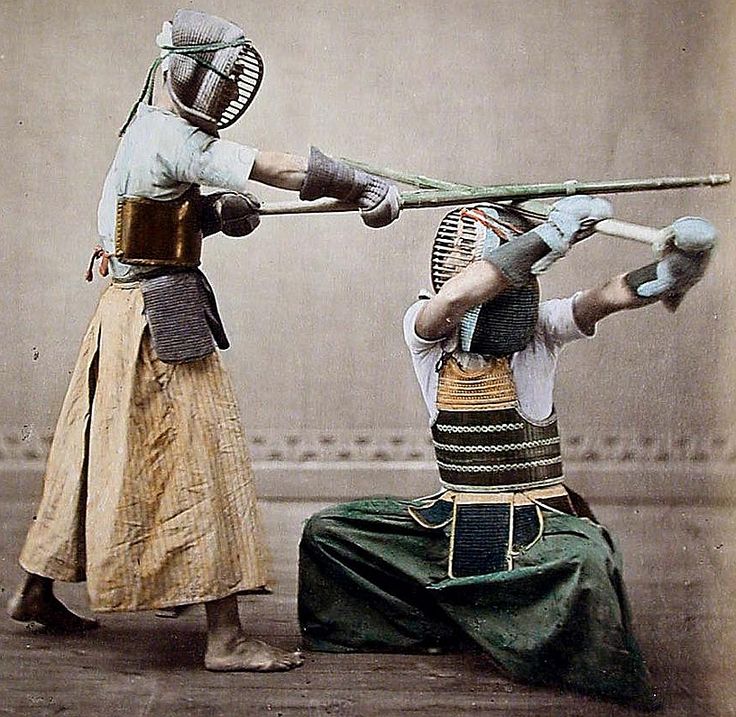
Unlike the photo above, shidachi having started from gedan raises the sword one-handed and supports the forward portion of the blade with the flat of the front palm.
Shidachi then executes a makiotoshi by snapping the right hand precipitously down and the left hand helps roll the blade from its flat to edge to traverse uchidachi’s sword (or forearm) and control the center. This is ikkyo.
Ikkyo as a concept is makiotoshi.
But a digression is in order to ensure that the terms are defined. If we understand that Aikido is a metaphor for weapon play (usually weapons are the metaphor), then it should be obvious that ikkyo is really a response in time; a cut, counter-cut. That is, at its most primal, ikkyo is responding to shomen uchi with shomen uchi in time. Done perfectly, uchidachi strikes first, thereby creating an opening that shidachi fills with a counter-shomen which efficiently dispatches the attacker. Brilliant timing, but not much of a ‘technique’ to explore.
Now understand that if shidachi does not time the counter strike perfectly, the resulting encounter will be the cross-block. Shomen meets shomen. Examine our samurai from the banner photo:
If the samurai on the right had better timing, he would have simply avoided the attacker’s shomen and moved off-line (flanking) to counter cut. But he was late and had to receive the strike instead. He is now behind his assailant’s OODA loop! And because our defender has received the assailant’s sword too close to the foible, the attacker might be quick-witted enough to keep sword pressure, ride down and slip his point under the cross block before our defender can dominate. Remember you cannot win by defending! And defending with imperfect technique seals your doom.
To prevail, our defending samurai can makiotoshi immediately or continue to receive as described above and perform makiotoshi with two hands. Ikkyo as a concept instantiated at different elevations (planes) and in two different times.
To emphasize the point, a block with a sword must be done closer to the cross-guard/tsuba – i.e., with the forte/strong portion of the sword. As a visual reminder – the forte is that portion of the blade closest to the cross-guard (tsuba) whereas the foible is (roughly) the last 2/3 of the blade extending to the point.
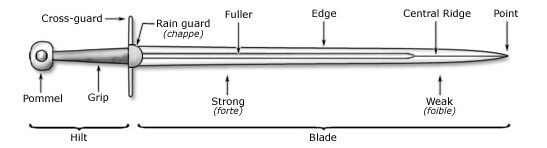
We need to receive a block forte to forte to ensure proper leverage (think 5th kumitachi) and a good bind on the opponent’s blade. One cannot block with the foible, just re-direct, beat or slip. As I have indicated in other posts, none of this is unique to Japanese arts. Some beautiful applications are found in the manuals of the west. I will continue to blend eastern and western terms when one provides greater specificity.
Translating this analysis to an unarmed presentation, it should now be clear that ikkyo is not a manipulation of the forearm and wrist but rather above the elbow on the humerus. Contact may be made at the foible, but the control is done at the forte. The unarmed presentation is more challenging than the weapons because the arm is articulated: it bends at the wrist, elbow and shoulder. When we train, however, the entirety of the arm is used as if it were a sword, so uke must learn to hold the arm in a constant shape when performing shomen uchi. If uke allows the striking arm to bend at the wrist or elbow when received by nage, the entire structure will collapse and to uke’s detriment because nage should be counter striking (not blocking).
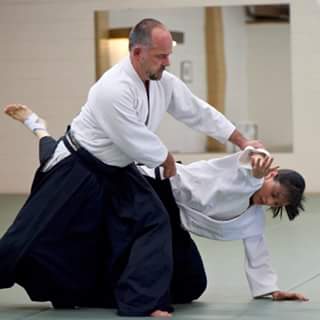
Only when both players appreciate the need for proper striking form will ikkyo be revealed as a universal application of makiotoshi. Years of training is one way to see this relationship, or study deeply the need to treat all encounters as a weaponized encounters. There are no unarmed techniques in Aikido. Just weapon work without the tools of the trade. Unarmed techniques is a failure in logic: it presumes that you know your assailant is unarmed.
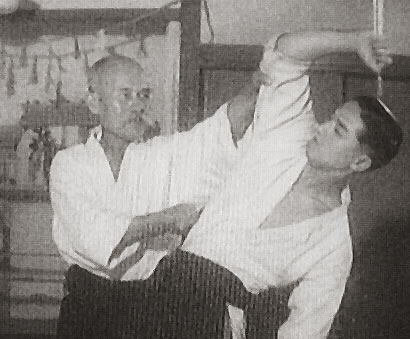
Arikawa sensei disabused me of that assumption when I saw him at end of a class when he was teaching ikkyo, suddenly step into the shomen, perform a gokyo stop-hit, magically pull a hidden tanto from his keikogi and stab uke. Ikkyo as gokyo: There is always a weapon.
Gokyo is ikkyo done on an advancing beat. Ikkyo in true time is makiotoshi. Ikkyo in superior time is kiri-otoshi.
I am illustrating examples and concepts so you can draw connections.
Weapons training is the foundation but it is taught as a supplement. I have never had the courage of my convictions to correct that pedagogical flaw and begin a training cohort starting with weapons. Even this, however, would be nothing more than an experiment in pedagogy. In the end, there should be equal emphasis on both armed and unarmed training, and further, to treat every scenario with the possibility that it involves multiple assailants.
This post tries to make explicit the logic of this morning’s class starting with bokken, moving to unarmed and then connecting the two. Weapon vs weapon, then unarmed vs unarmed. With more time I would have shown the weapon vs unarmed to complete the presentation.
For good measure, although I emphasized the kimusubi (connected flow) of Aikido’s rhythm, I interjected staccato beats and nerve disruptions, limb and bone destructions. Kuden to be kept alive.
_____________________
[1] Training nomenclature. In Japanese arts, the uchidachi is typically the one who initiates the violent action and invariably is the one who dies in the encounter. There is a certain irony in that Aikido will usually present kumi-ken (and kumi-jō) with nage taking the role of shidachi (the role that ‘wins’) to demonstrate technique. This is ironic because in more traditional arts, uchidachi is the senior student who controls the pace of the encounter in order to help shidachi learn to react in the concise and structured environment of the form. In FMA, the role of uchidachi is the ‘feeder.’ Uchidachi should verify shidachi’s form, body mechanics and zanshin before moving to the next sequential step.
With this in mind, uchidachi must perform their portion of the kata with precision and clear intent in order to make the training sequence useful. Hence the senior taking the default role of uchidachi: because the role of the feeder requires greater skill (controlling shidachi’s pacing) and should be embraced without a sense of competition. A true uchidachi is ready to assist the shidachi without any other intent. This is expressed through the uchidachi performing their strikes cleanly and purposefully, allowing shidachi a proper training environment.
 Protective Arts
7 thoughts on “IKKYO IS MAKIOTOSHI”