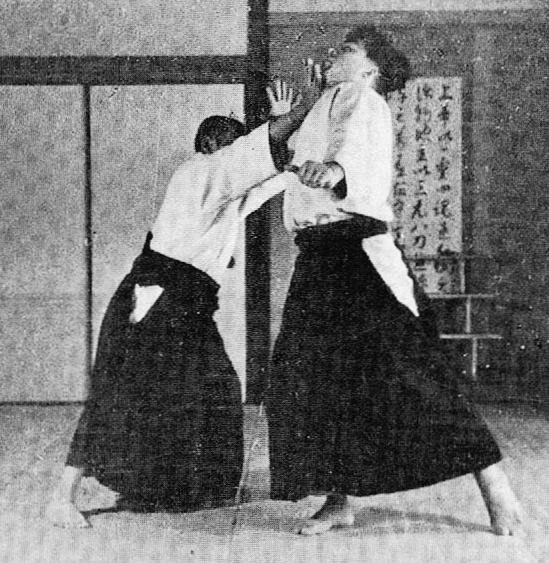
Suwariwaza ryotedori kokyuho as a means to establish correct tension, indexing and lines of force.
Correct tension. Uke must approach nage with the intention of controlling nage’s arms with force from high to low and nage will receive with equal counter force from low to high. The resulting tension is the starting point, the axis of the encounter. At this point there are two primary means of releasing the tension. First – what I labelled Mulligan sensei‘s approach. The forward hand meets at the elbow and nage shifts bodily to the opposite side with the back hand ready to strike: a flanking action. Once nage establishes this superior position, nage shifts from the hip and toes to drive through uke’s center of mass. The second – Okamoto sensei – will approach more directly with the back hand softening at the elbow to allow greater contact with uke (driving into the sternum as necessary). The first approach dissolves the tension, the second will develop the hara by meeting it more directly.
Indexing. The ryotedori relationship is a L/R and R/L on the inside line. Indexing is a quick reference – i.e., “you have been here before.” Knowing where your hands are in relationship to your opponent’s body is critical to understanding what responses are available.
Lines of force. We flank uke’s center in order to traverse and cut though the initial approach. This means we drive through 90-degrees off the original line of attack.
Move to standing – the technique does not change. The primary reminder is to ensure that you step through with your back leg. (In combat, your front foot has trapped uke’s lead foot and now your back leg will be coming through as a strike.) Stepping through should be as simple as walking. Shizentai, the natural body posture. Once you have shifted off line and disrupted uke’s force with a redirect with both hands, then walk through the space uke occupies.
Then add dynamic movement. Uke could still grasp both hands while in motion, but uke might slip up to (or nage may redirect to) both shoulders. Ryokatatedori moves to ryokatadori. But the technique does not change. Nage’s response is still, slip, flank and drive through.
Change this to yokomen and nothing changes. Your response as nage should be the same. Front hand intercepts, back hand strikes.
Change the attack to shomen and now and a beat: stop-hit cross-hand (RvL, LvR) and then move back to the same response.
Then look deeper still. The front hand that was receiving and setting up the back hand as the strike now is primary. There is no block, the front hand moves directly in and strikes.
“The same response?” In Aikido’s lexicon, we have covered a number of techniques, but only one concept.
In The Five Keys to Kali Master at Arms James A. Keating teaches a simple set of body movements. All of this morning’s class is motion number five. The beauty of the Kali set (kata) is that it provides a very concise formula. That formula shows the principle motions of the upper torso, you are given the “key” or understanding to then “know” any and all movement the human upper torso is capable of making (conceptually). Disguised in this class of kihon Aikido techniques was the exploration of one range of motion of the upper body from the basic Kali set.
_____________________
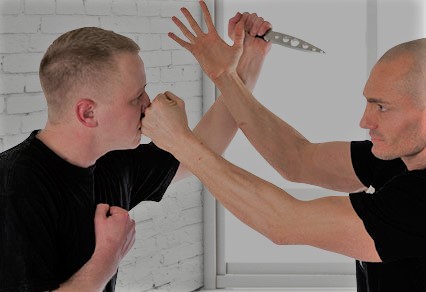
Secret bonus – watch Cliff Lenderman on basic knife concepts to discern (a) how ryotedori is a weapon technique (b) how kokyu-nage can be employed.
 Protective Arts