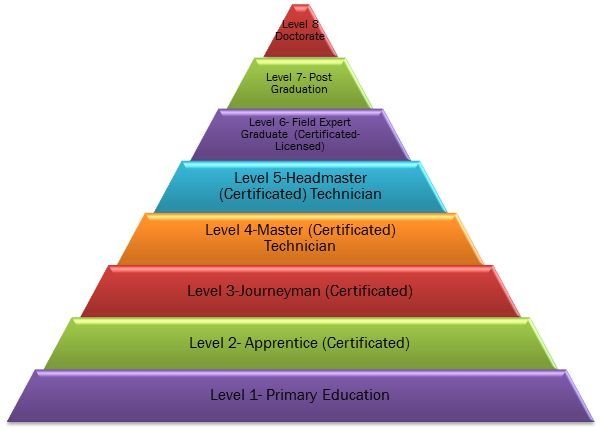
Traditional pedagogical transmission reinforces hierarchical structure:
Shoden (初傳, beginning teachings)
Chuden (中傳, intermediate)
Okuden (奥傳, hidden or inner teachings)
… and then there is Kuden – the secrets taught “mouth to ear.”
This is a good way to ensure structured progression (kyu -> dan) and maintain social gradients (kohai -> sempai). Mass production and replicable standards is the goal.
There is also a winnowing effect – not everyone gets to learn the ‘higher level’ techniques – not everyone has the same physical ability – not everyone has the same perspicacity.
A coaching model is more familial, wherein the transmission is all Kuden all the time. One tries to individuate the lesson to the practitioner in order to draw the best performance in that moment. There is also the focus on concept more than discrete technique. By separating techniques into levels, each technique remains discrete. But the ultimate goal is to make connections.
Gyaku-hanmi katate dori ikkyo
Shoden transmission: a RvL static encounter. Nage presents R, uke grasps L. Nage closes with the back foot and delivers atemi L. Uke is destabilized by atemi, allowing nage to grasp uke’s control hand, making the encounter LvL. Nage executes ikkyo. [Kuden clarification would be to enforce the distinction that in gyaku-hanmi, nage’s ikkyo control necessitates uke’s wrist is bent when nage strips it, whereas in ai-hanmi, uke’s hand remains straight.]
Chuden transmission: as in Shoden but nage refines the movement to zone to the outside line after the atemi and adds a ‘camming’ action to connect the flow between the jo-dan atemi and the contra-control of uke’s grasping hand. [Kuden at this point would explicate ‘camming’ vs drawing (a typical point of failure and frustration).]
Okuden transmission: adding flow and kimusubi, the encounter is contextualized. Nage’s thrust is stopped (grasped) to create the RvL set up, but before uke can stop the thrust, nage changes plane, turns the edge out to target uke’s pulse (or femoral depending on uke’s closing speed) whist using the back hand to target uke’s throat and zoning to the flank. Moves that are discrete point to point movements at the shoden transmission now are demonstrated as lines. [Kuden at this level explains that lines are vectors of force. Therefore as uke increases speed, nage still targets the same points (i.e., wrist, leg, throat), but will need to further adjust space to accommodate closing speed. Meaning: when nage can match uke’s speed in true time (sen-no-sen), nage will zone to the outside flank. However if uke closes in superior time, nage will need to ‘blend’ to the inside making the execution more circular.]
The conceptual challenge is that each level is a progressive accretion of information – adding variables, or levels of complexity. But the complexity is not in the response! Meaning the technique is simple. All effective techniques must be simple, otherwise they cannot be effective. Do not add complexity to your responses, it is the circumstances in which techniques are deployed that add complexity. Complexity is environmental and contextual. Who is attacking (big, strong, fast, tentative, committed)? Where are you (crowed room, open area, confined space)? What are the ambient conditions (day, night, wet, dry)? But the technique never really changes. It’s just, punch, zone, counter-grasp for control, and immobilize (pin).
This was the general structure of my last class. I presented gyaku-hanmi-katate-dori-ikkyo omote in a progressive manner to try to visually and physically present the narrative. And, yes, ura was shown as an alternative, but I remain steadfast that there is no ura as a ‘technique’ – rather it is a secondary response to uke’s superior time. Or said crudely, ura is your ‘oh shit’ trained flinch response when you realize that uke was well ahead of your OODA loop.
But once you tenkan to execute ura, the sequence of action returns to the omote presentation. In short, ura buys you time.
And now the true kuden – the deep secret technique:
There is no gyaku-hanmi ikkyo!
It’s all an illusion created by a traditional framework that fractures universal lines to make digestible component movements.
Think on this: gyaku-hanmi is a RvL encounter. Ikkyo as a response is a RvR/LvL control. Review the concept of a matrix. Therefore, the entire technique is to make a RvL become a RvR response. Ikkyo as a technique is by physical necessity a RvR/LvL encounter (ikkyo is makiotoshi) therefore the technique doesn’t change – only your initial relationship to your opponent does. The complexity is in the context. Not in the response.
 Protective Arts
I did my best to cover this last night in intermediate class and accidentally discovered the same thing.
LikeLike