I learned of Abraham Wald from Jordan Ellenberg’s How Not To be Wrong.[1] It is a story well worth reading because it provides a poignant reminder of the power of thinking critically. During WW2, Wald was part of the Statistical Research Group working through real-time problems to make strategic decisions. Among the questions posed to the group was where to add armor on airplanes to improve their survivability. The data set provided showed the damage was not uniformly distributed – there were more bullet holes in the fuselage but not as many in the engines. Wald made the key observation, put the armor where the holes were not as frequent: the engines. His insight was that the returning planes showed which types of damage they can survive, therefore the missing planes must have sustained damage to the critical areas; where the bullets did not hit on the returning planes. The engines. Obvious once someone points it out.

This story reminded me of a great post by Mark Hatmaker – Via Negativa – the power of learning from the negative. In that post, Mark quotes Njal’s Saga “Let another’s wounds be your warning.” You should read Mark’s posts since he takes that lesson down a different path, but let us focus on the mundanely obvious:
The first rule of combat is don’t get hit. [2]
Chiba sensei in one of his more imprudent moments was trying to impart this lesson by repeatedly striking a student shomenuchi. Collapsing through the student’s attempt to block, Chiba hit the student with the admonishment “Do you understand?” Only to break through again and again. The point he was trying to drill home was don’t try to block or ‘receive,’ the prime directive is to not be in the way of the strike. Obvious once someone points it out. And a lesson I learned through the wounds another suffered.
Positive reinforcement is better than criticism – or so I have been told. Positive and safe environments are certainly better for student retention and therefore good business, but I wonder if a safe environment is the most conducive one to learn combative arts.
Read about any celebrated martial artist and their experience was inevitably traumatic. Training in the past was always more brutal, more difficult, more challenging than it is today. Read broadly enough and it all sounds the same: “When I was a kid we walked to school backwards in the snow with no shoes…” But there is a profound truth in the hyperbole of these stories: deep learning will be painful. Acute pain used to lock in a lesson.
I recall reading somewhere that often among non-literate people of Medieval Europe an important contract would be witnessed by a young member of the community who was then subject to severe pain to cement the memory. That person would then be a longitudinal recording device of the agreement. Although I cannot find corroborating research, it does comport with my own experience that in the martial arts context, some of the more enduring and important lessons I ever learned were because I was either emotionally or physically damaged in learning them.
Early in my career during one of Mulligan sensei’s classes, I kept asking him clarifying questions. I was looking for positive feedback, that is: I wanted him to explain how to do the technique. Finally tired of my pestering, Mulligan sensei turned suddenly, came over to me, had my uke sit down, and he proceeded to throw me vigorously and continuously for several minutes. He then bowed curtly and walked away without saying a word more. Although I was well conditioned and inured to normal training trauma, there was a psychological sharpness to the lesson. The harsh crisp throws, the silent pounding forcing me to learn for myself. “Do you understand?”
It is far easier to forget the “this is how to perform this action” lectures than those actions that dislocated my shoulder. We can learn much through the negative. Don’t do that ever again can readily start to inform your body on how to perform the action correctly.
Fear as performance enhancement.
Watching my older son is instructional for me. He loathes informal pick-up games with neighborhood friends and only thrives in tournament. Why? There is nothing at stake when playing with friends. He needs the competition, for something to be at ‘stake’ for it to be a real or worth playing. More tragically, some who experience combat need that continued threat to feel alive: watch The Hurt Locker again (or for the older readers The Deer Hunter). The thrill of gambling, the need for something to be at risk to make the event meaningful or memorable. It is only the spectrum of risk that makes us healthy or not – but the simple fact remains: we must risk to feel a genuine reward.
Our failures can become our greatest sources of pride when we return battered but alive and wiser for it. Later to recount the tale sitting at a table sharing stories over drinks among the comfortable companionship of friends: esprit de corps. These stories can be used to create hierarchy (who suffered the most at the hands of the noblest adversary) but listen carefully and one should learn how to avoid ever being wounded in the first instance.
Humans have a strong aversion to loss. And perhaps that is part of the key to negative lessons. Perhaps we have to lose to learn deeply.[3] By paying attention to the stories of the survivors we can (should) learn from their example. Learn from the wounds of another. And just as critically do not fear those wounds you may sustain in your training. Use them as deep learning experiences, learn how to avoid making those same mistakes.
Experience is something you get, shortly after you need it!
______________
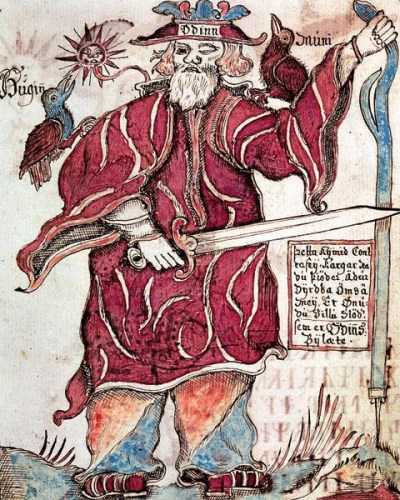
It is easy to reduce everything to trite aphorisms. Pain is temporary, quitting permanent, etc. Do not avoid the depth of the stories. Odin sacrificed an eye for received wisdom.[4] Pain is the great teacher if you survive the lessons. The shaman learns to see beyond through scourging and depriving the body. Pain and suffering create art. The trials and temptations Christ suffered in the desert. And as Guatama Buddha concludes – pain is inevitable but suffering is not. Pain transformed becomes wisdom. Fixate on pain and all you have is suffering.
_____________________
[1] Ellenberg’s talk at the Royal Institute Royal Institute. Excerpt from his book.
[2] Don’t get hit. Scars are visible evidence of surviving combat. Among upper class German and Austrian academic fencers in the 1800s proudly bore scars from Mensurschläger (or simply Schläger, “hitter”) bouts. Schlager matches used specially developed swords, confined movement and the primary target was the head – with the goal of a wound. These honor scars were visible proof of bravery, but Ed Parker quipped that all a scar did was prove you got hit.
[3] Economics and evolutionary psychology: Kahneman and Tversky. Overview articles >here< and >here<
[4] Loss of an eye. To ‘turn a blind eye’ is attributed to the story of Lord Nelson. Hear it from Paul Harvey >here< where then Vice Admiral Horatio Nelson purposefully ignored the order to retreat during the Battle of Copenhagen (1801).
 Protective Arts
15 thoughts on “PAIN AS A TEACHER”