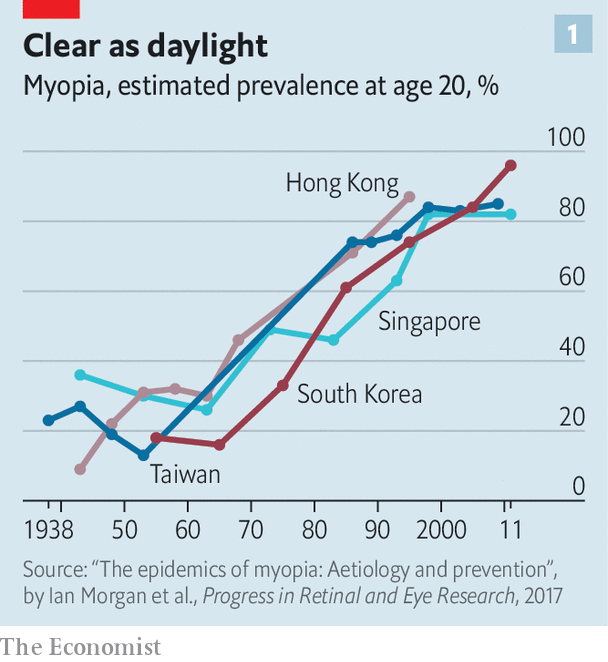
The human body has numerous design flaws. Poor eyesight (40% of Europeans and 75% of Asians need corrective lenses), an optic blind spot, choking remains a problem (air and food enter via the same tube), etc.; simply stated, humans could be better engineered. But our big brains and the division of labor allowed us to become the dominant species and because of social specialization we do not have to have a perfect body design.[1]
A well-versed martial artist will use that big brain to study these design flaws to exploit weaknesses.
The following then is an exploration of how to exploit physiological weaknesses – a focus on bunkai or application rather than the flow (ki no nagare). Effortless control requires that nage understands how to exploit these design flaws first – concentrating on the stopping points in each technique before moving past ‘hitting the points’ to concentrate on the connections between the points.
Aikido teaches some basic nerve, muscle and bone manipulation – exploiting structural weaknesses. The bunkai or application of a coercive force is not emphasized but remains a critical skill to acquire.
Ikkyo. At its essence ikkyo is a levered re-direct. The nuances have been discussed in earlier posts, but put simply ikkyo returns a vector of force back toward the assailant through better levers or superior time. The pin, however, is an attack on the elbow joint. The simplest attack is to apply a shearing force against the elbow. As nage directs a downward force just above the elbow joint, nage then lifts on uke’s wrist – concentrating the opposing lines of force at the elbow. Given that we are playing with uke’s bones we will call this the skeletal level (bone locking). Ultimately nage would severely damage the elbow joint should uke fail to comply. A more subtle attack would be to compress the ligaments using the shyto (hand edge) against the area just at the ‘funny bone’ above the elbow joint. This pin can be executed one-handed by a skilled practitioner. It is a pain compliance technique and therefore not designed to cause permanent damage to uke. Nage can also exploit a true pressure point control, by attacking the nerve complex (again at cavity above the elbow, or along the ulnar nerve against the humerus). The nerve attacks require the highest degree of precision and therefore are more difficult to achieve outside the training environment in the dojo. Again, nerve attacks will only result in a temporary loss of function.
Nikkyo. Nikkyo attacks the wrist joint. There are two primary variants on a wrist lock – the first where the wrist is bent 90-degrees (or more) before applying a rising force (i.e. through the thumb raising the little finger to the sky with rotational energy) or the second where the wrist is kept in line with the ulna so that the forces concentrate at the wrist but the entire forearm is used as a lever. (Understand the physiology of nikkyo and kote-gaeshi becomes nothing more than the anterior [uke’s palm up] application of nikkyo [uke’s palm down].)
[An observational digression: kotegaeshi attacks the wrist along the lines it would normally bend. The converse line of attack is possible but not emphasized in Aikido because it requires controlling the fingers. When I was in high school, boys would test their mettle in a game of Mercy where we would interlace our fingers and force each other’s wrists backwards in a contest of strength and pain tolerance. Small circle jujutsu also exploits the smallest bones, but pain compliance or even breaking the finger joints is not sufficiently debilitating for battlefield efficacy. Working the distal joints to gain control of the larger joints is a great skill to master however, so do not ignore finger locks.]
Once the nikkyo control is established, then nage drives to the pin. The bunkai is a true driving dive to the ground: Having momentarily arrested uke, nage can then transition the hand controlling the elbow higher on the humerus to forcefully drive uke’s shoulder to the ground (to rupture the bursa or break the clavicle). Once uke’s shoulder is on the ground, the arm should be nearly perpendicular. The standing pin is a muscular attack – bracing uke’s arm in the vertical position with the leg, nage will bend uke’s wrist, fingers pointed down, and continue to exert pressure forcing the fingers down. A more sophistical approach would be to compress the index finger alone. The seated pin attacks the bones: with the shoulder joint firmly pressured to the ground, nage will compress and rotate the shoulder joint in an effort to grind and separate clavicle, scapula, humerus and acromioclavicular capsule.
Sankyo. Sankyo is a progressive attack – first establishing control at the fingers in order to then grasp the wrist lock in a continuous cork screw action that ultimately focuses on the tip of the elbow and then locks the shoulder (lock flow). I prefer the bunkai of sankyo as a knife strip or return, but as a joint lock the focus is on the spiraling energy directed through fingers, through the radius/ulna in order to lock the elbow. Continued application of force will then drive the elbow point forward and toward uke’s face, thereby moving uke backwards allowing humerus to lock the shoulder. Nage then cuts the tip of the elbow down to drive it into the ground. If uke preserves the elbow by dropping the shoulder first, then the elbow is hyperextended and nage can execute a pressure lock or break as the situation demands. This would be a standing bunkai. The controlling lock requires nage place uke’s palm on the knee to exert a twisting downward pressure into uke’s shoulder. The seated variant allows nage to apply body weight and additional range of rotation to further compromise the shoulder structure. The grinding separation is the same vectors as nikkyo’s seated pin, nage just has the opposite hand on top. The force applied to uke is the same because we are attacking the same structural weakness.
I encourage the diligent student to continue this analysis and investigation. Yonkyo is an obvious nerve attack. Gokyo differs only mildly from ikkyo in concept and is a wrist destruction rather than an elbow destruction for its pin. Some will explain that gokyo is a knife defense, I would caution the astute student that all these techniques are weapon disarms so do not become blinded by didactic failures.
Some additional pointers to consider and explore:
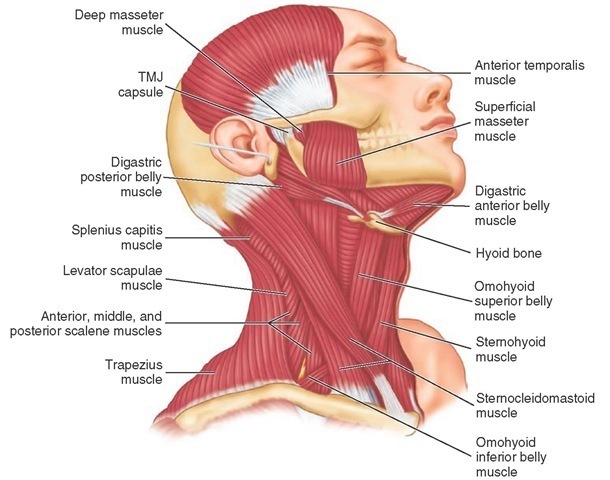
Irimi nage is clearly a skeletal / neck destruction, a manipulation of the mandible to rotate uke’s head. The more advanced entry requires a preceding control and muscular attack to the sternocleidomastoid or a nerve attack under the ear to the spinal accessory nerve to better gain control over the mandible. If you cannot control the head, then the throwing arm can become a rear naked choke.
The need for corrective lenses is a reminder that human vision has other flaws to exploit. When delivering a straight thrust (jodan tsuki) the line of attack should be down to visual cone. Attacks delivered straight on are harder to see coming and leave less time for reaction. That’s because punches thrown straight at you are more difficult for your eyes and brain to recognize compared to a punch coming from the side. Our peripheral vision is attuned to pick up movement (rods vs cone concentration) and therefore oblique attacks are easier to spot.
In terms of your own offense the advantage here in throwing jabs and thrusts straight out from your chin and back. If the punch is in line with the eye it bypasses the motion detecting rods in your opponent’s peripheral vision making it much more difficult to detect. Learn to improve perceptual speed to overcome your own biological limitations.
While we can not always overcome biology (pain is a necessary to inform our bodies of danger)[2] by studying human vulnerability we can both better understand how to make a technique more effective (create a path of least resistance) as well as how to better gird ourselves against others exploiting the same flaws in us.
__________
[1] In the early 1980s Taiwan’s army realized it had a problem. More and more of its conscripts seemed to be short-sighted, meaning they needed glasses to focus on distant objects. “They were worried that if the worst happened [ie, an attack by China] their troops would be fighting at a disadvantage,” says Ian Morgan, who studies myopia at Australian National University, in Canberra. An island-wide study in 1983 confirmed that around 70% of Taiwanese school leavers needed glasses or contact lenses to see properly.
The design of the human eye is an example of “good enough” but not smart engineering.
Because the nerve fibers coming from the rods and cones need to come together as the optic nerve, which then has to travel back to the brain, there needs to be a hole in the retina through which the optic nerve can travel. This hole creates a blind spot in each eye. Our brains compensate for this blind spot so that we normally do not perceive it—but it is there.
Novella, S. Suboptimal Optics: Vision Problems as Scars of Evolutionary History. Evo Edu Outreach 1, 493–497 (2008). https://doi.org/10.1007/s12052-008-0092-1
Cephalopods have a much better design – no exploitable blind spot!
An interesting and general consideration is the future of human evolution. Extrapolation from current trends does not bode well for the warrior of the future. See also >this< post.
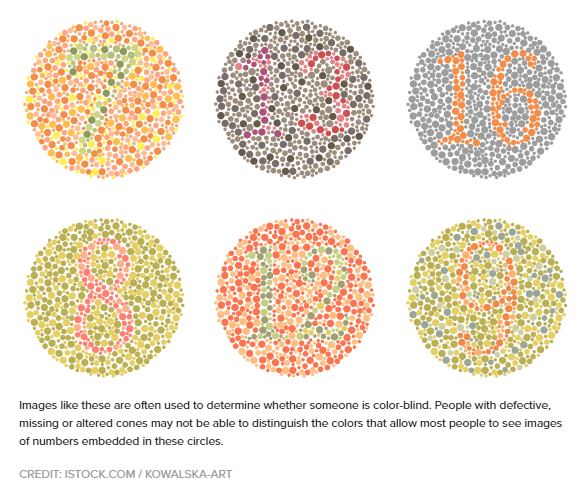
Color blindness puzzles me. Why does red-green color blindness primarily impact men? Seems odd given that following a blood trail in the green woods is more difficult. I suffer from partial color blindness and can only see the “16” clearly and it takes effort for me to recognize the “7” while the other numbers are lost in the meaningless sea of dots.
[2] Tiger Man was one of Buck Rogers in the 25th Century greatest adversaries. In the television show he was invulnerable to pain because his nerves had been surgically removed. That impressed me as a great thing when I was a young man, just imagine feeling no pain! A more mature perspective shows how deadly that in fact would be: congenital analgesia is a life threatening condition.
 Protective Arts
6 thoughts on “HUMAN FRAILTY”