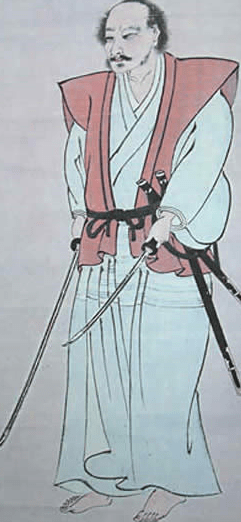
In an interview, Nishio sensei unapologetically labeled Musashi as “the lowest form of human being.” Understandable. Nishio looked at how little human emotion and human engagement Musashi exhibited; he never married, never started a family, and spent a life dueling to test his skill and mettle. Musashi manifested a coward’s response, by developing skill from a fear-based approach to life: Life denying skill vs life affirming skill.
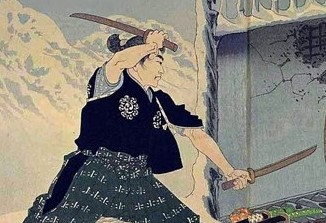
Nishio sensei’s is an easy conclusion to make, given that in The Book of Five Rings, Musashi admonishes:
Do not sleep under a roof. Carry no money or food. Go alone to places frightening to the common brand of men. Become a criminal of purpose. Be put in jail and extricate yourself by your own wisdom. [1]
Musashi rejects all the trammels of society and suggests breaking its laws to be put in jail. Why? History was not kind to him. Musashi fought on the losing side against Tokugawa Ieyasu whose Shogunate effectively unified the nation by destroying regional authority and power. He is a man who desperately clings to his martial prowess as the only valid means to define himself:
The only reason a warrior is alive is to fight, and the only reason a warrior fights is to win
Musashi is a warrior adrift, without purpose or cause to serve. So he turns inward to define himself:
There is nothing outside of yourself that can ever enable you to get better, stronger, richer, quicker, or smarter. Everything is within. Everything exists. Seek nothing outside of yourself
The external world is a testing ground, opponents are a means to an end (violating a Kantian imperative) to perfect his art.[2] But Musashi is perfecting the art of fighting during the Shogunate when violence is centralized to the state. He is a man out of time.[3]
Therefore, while I understand Nishio’s characterization, Musashi’s writings merit study. The Book of Five Rings are the reflections of a warrior who has refined the lessons of combat to principles.
When I reached thirty I looked back on my past. The previous victories were not due to my having mastered strategy. Perhaps it was natural ability, or the order of heaven, or that other schools’ strategy was inferior. After that I studied morning and evening searching for the principle, and came to realize the Way of strategy when I was fifty.
The Way of strategy is not a compendium of techniques. It is not a fechtbuch. Musashi is claiming to have discovered something more universal
The true science of martial arts means practicing them in such a way that they will be useful at any time, and to teach them in such a way that they will be useful in all things.
These maxims are easy to gloss over because they are concise and can seem perfunctory, or obvious:
If you wish to control others, first control yourself.
The problem is that we all too often forget these lessons, so Musashi shows us how to be mindful: A hyper-vigilance to external sensory information (Cooper) and to internal processing leading to sangfroid:
Both in fighting and in everyday life you should be determined though calm. Meet the situation without tenseness yet not recklessly, your spirit settled yet unbiased.
Control and calm in the midst of chaos is Mushin.

Mushin: the term is shortened from the Zen principle, ‘Mushin no shin’ (無心の心). It refers to the state of ‘no-mindness,’ when the mind is not fixed, or cluttered by thoughts or emotion. How do we achieve the Way? First the grounding principle:
Do nothing that is of no use.[4]
Precisely! But it is brilliantly difficult to know when we are doing things that are of no use. It is all too easy to cede the responsibility of knowing what is of use to an authority – the teacher – and in the early stages of every journey we all need a guide. Musashi’s biography teaches us that pain and experience are great teachers.
And as important as learning, pain, and experience are, the highest key to understanding is meditative reflection:
It is difficult to realize the true Way just through sword-fencing. Know the smallest things and the biggest things, the shallowest things and the deepest things.
A poetic way of reminding us to think! When we practice a martial art it is all too easy to focus on the physical aspects of learning; how do I move my arm, what is the timing and sequence of operations, because these are necessary to learn. But we must learn to make the broader connections – among the movements and with our partners from the simple act of rotating (camming) your forearm. Moving your hand as if you are turning a door knob, a simple act we repeat many times a day, is camming, which is makiotoshi, which is ikkyo, and ikkyo solves for the infinite. See the smallest things in the biggest things, the budo is not at the surface. By seeking and seeing the connections we can,
From one thing, know ten thousand things.
There are not infinite techniques. There are only limited expressions of the body that can then generate a large number of responses in a large combination of encounters. I look at it like chess – a game played on a fixed matrix with a defined and small number of rules that generates an incredible number of combinations. Do not get blinded by mathematical possibilities! Not all possible moves are valuable. Thus, by knowing principles you can know all the responses you need. And because any given possibility must be instantiated to be real, you are only ever dealing with precisely one encounter and one response at a time. Each encounter also is with a person with their own limitations that we must exploit, therefore, Know the limitations of the body. But more critical is to know the limitations of the mind:
In battle, if you make your opponent flinch you have already won.
Musashi reminds us that we are playing an opponent, therefore mental combat is even more important than physical engagement. Musashi informs Bruce Lee’s later “Be like water” taken directly from the water section:
With water as the basis, the spirit becomes like water. Water adopts the shape of its receptacle, it is sometimes a trickle and sometimes a wild sea.
In the fire section, Musashi outlined three methods to forestall the enemy:
- Forestall by attacking
- Forestall by responding to his attack by feigning weakness, then attacking
- Forestall by attacking when he attacks and meeting him head on
Bruce Lee expanded these to the five methods of attack – which I covered in >this< earlier post. These lessons are explicit in many arts but not well-integrated in many Aikido dojos despite O’Sensei employing them (“Control the encounter before it is enjoined”), or;
In contests of strategy it is bad to be led about by the enemy. You must always be able to lead the enemy about.
Afterall, the distillation of combat is goal oriented: to win. And to win will often require an attack, which is a mind-set embodied physically:
When you decide to attack, keep calm and dash in quickly, forestalling the enemy…attack with a feeling of constantly crushing the enemy, from first to last.
Because Musashi wrote when violent encounters were likely and because he was a swordsman, the language of winning is combative. Combat is life, you cannot keep them separate:
In all forms of strategy, it is necessary to maintain the combat stance in everyday life and to make your everyday stance your combat stance. You must research this well.
The Book of Five Rings enjoyed currency as a business text and I am sure it will continue to flux in and out of vogue. The point is winning does not necessitate violence red in tooth and claw but it does require decisive action. You cannot win by defending is perhaps the most important lesson for a martial artist who aspires to non-violence.
Which leads to my favorite conclusion for deep consideration:
No man is invincible, and therefore no man can fully understand that which would make him invincible.
_________________________
Resources
Searchable PDF The Book of Five Rings
Additional meditations on Musashi’s Book of Five Rings and >here<

Visit Ganryu-jima – the uninhabited island where the duel between Musashi and Kojiro was fought.
___________________
[1] Note the similarities with Plutarch’s description of Spartan training – agoge (ἀγωγή).
[2] Mark Manson on Kant.
[3] I wonder if The Book of Five Rings wasn’t a job interview in the same way Machiavelli wrote The Prince to ingratiate himself to the Medici.
[4] “Do nothing of no use” – O’Sensei echoed Musashi in his Secret Teachings of Budo, poem #29. “What use to learn this sword work or that! Cut off all thought of useless things.”
 Protective Arts
7 thoughts on “MIYAMOTO MUSASHI”