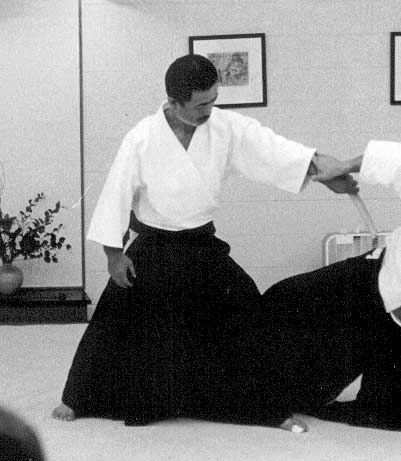
Gyaku hanmi katate dori ashi sabaki. I use the static encounter as a starting point because it safely teaches powerful concepts.
Aikido’s focus on connection is important to feel as a bodily (somatic) connection with your partner. From the moment uke grasps nage’s hand, nage must sink (break plane, dropping the center) in order to capture the encounter. Nage then shifts off line (to uke’s flank) to enter with a circular hip motion that drives the hand forward. The hand looks like it is a driving force, but the elbow must be soft and the shoulders relaxed so that nage can drive from the low to high-line. Entering to control the center line nage’s elbow will be up and the shyuto edge toward uke’s center. I have covered this in earlier posts in more detail so I cover it in only a cursory manner here. Connection is key (hara to hara engagement). Uke must continue to face nage as long as possible through the action.
The power of the exercise is the principles of motion it unlocks. Tighten the lines, increase the tempo and add broken timing and the combative possibilities manifest: With a weapon, this is an inside parry-riposte. In boxing it is a block-(counter) punch. In Aikido it is a key to better understanding the direct response to yokomen.
This morning we added ushiro-tenkan as a lower body complication to the movement.
From gyaku hanmi, the wrist grab establishes a ‘ball joint’ connection that both players need to respect- this is the axis of the encounter. [1]
Ushiro-tenkan is an absorbing act – uke approaches nage with advancing energy to grasp nage’s wrist. At the moment of contact, nage keeps an equal forward engagement while breaking plane using the same ashi-sabaki upper body mechanics, but with the lower body doing a circular dissolve. (Reflect on this: dissolves can be done with both the upper body [mechanical redirects] and with the lower body [positional disengagement].)
As a tanren-geiko (body development) this is an aerobic burn. Nage is in the center of the circle and must execute a rotation of greater than 180-degrees (I prefer to hit at least a 270-degree arc). For nage it is a grounding exercise – learning how to keep a stable center whilst rotating and keeping connected to uke. Uke is racing to keep up because of simple geometry. Nage’s arc forces uke to race the circumference of the circle, ultimately flying away once the connection breaks due to momentum. For this first stage, the exercise is developmental: learning mutual timing to keep connection, finding when the connection breaks based on angle and momentum, playing with changes in elevation, and most importantly learning to feel more than just the arm contact.
Once both nage and uke can maintain connection by learning the basic mechanics of motion, the focus should come back to the ball-joint created with (uke’s) hand grasping (nage’s) wrist. Nage’s lower-body ushiro-tenkan action will take uke’s balance (through a continued ‘invitation’ to move continuously forward). At the point where uke is at the apex of their movement, nage should then be driving the grasped hand from low to high up uke’s center line to traverse uke’s chin and neck (while still inviting the advance) to execute irimi-nage (direct) as either a stretch or throw. Both players should feel how the connection rolls – I described the hand-to-wrist connection as a ball joint very purposefully. That rolling mechanical connection between the players is critical. There will be similar feelings of capture and tensioned rolling in weapon play. Add the weapon into nage’s hand and the implications of this are grave in extreme. [2]
Ushiro-tenkan irimi nage direct then readily flows to the first variant. Assume uke is still too solidly balanced to move through at the apex of their movement. Nage must then adjust to throw with movement – not arm power. As an indexing exercise, nage should bring uke to the point where irmi-nage direct is possible – but rather than stepping forward and closing the arm to throw uke – nage continues to rest the throwing arm across uke’s neck, but then moves behind uke to collapse the structure. For nage this should be a smooth and powerless throw – meaning that rather than stepping through uke’s center, nage now steps behind it. The footwork drives the throw, but there is a hidden arm movement that solidifies the action. As nage moves behind uke, nage should be in the position to execute an elegant rear-naked choke. I also showed the implications of the Bagua Teacup exercise. The simple act of stepping behind uke amplifies its martial effectiveness when nage has proper integration of the upper body arm mechanics. We will reserve a deeper explanation as kuden for the classroom.
As a progression exercise we then moved to uchi-kaiten nage. The flow progression results from the “what if” questioning (which I encourage all students to do – always question!). If nage attempts irimi nage direct and uke is able to block the entry, they will only be able to do so by creating an opening (tsuki) on the low gate. Which is to say, nage has advanced in and up with the fingers toward uke. Uke has maintained connection and stopped nage’s advance. There is now an arc created by both player’s arms and nage must step through that opening and snappily turn their hips while simultaneously cutting the grasped hand down. (From a pedagogical progression, the step before uchi-kaiten- nage, is kokyu-nage.) If uke breaks connection as nage cuts precipitously down, then the throw is called kokyu-nage. If uke maintains connection, then nage must pick up control of uke’s lowered head, keep it down and lever the arm across uke’s back for kaiten-nage. Think on this progression and feel the rolling action of that ball-joint connection. That ball joint must flow – your goal is to have it feel well-greased and not forcibly move it through space. Play with a gyroscope. Get it spinning and then roll it in your hand as you move through space. It wants to resist your motion. With a similar idea, you want to transmit as little force/information through that connection with your partner lest they resist you.
This is the higher art: manipulation through connection.
______________________

[1] Respect: to quote Robert Heinlein, “An armed society is a polite society. Manners are good when on may have to back up his acts with his life” (Beyond This Horizon, 1942). Humility should result from two deep lessons: there is always someone better than you and you will never know who that person is. Therefore treat everyone with respect (circumspect). Less cynically: the encounters we set up in Aikido are derivative from weapon based engagements. Treat all encounters as if they were armed engagements.
[2] There are any number of deadly variants, some of which are contingent on the weapon used. In class I showed some basic concepts that are not paramount to Aikido’s focus on connection but should inform your understanding of the movement. When the blade is held fore-grip, start by (1) breaking plane – when uke grasps the weapon hand to control, immediately flick the blade off-line (to the outside) then snap your elbow down and immediately bring the point back to center. This will cause uke to pitch themselves onto the point (usually with their soft palate); (2) the move up the centerline from low to high could be a stab (a #5 at any level) or can skid up the sternum to the neck then over to hook behind uke’s head. If done with the blade in reverse-grip (or with a karambit), (1) breaking plane is an immediate attack to the flexor-tendons (uke’s forearm interior), and (2) the rising line to the neck for a traditional irimi-nage is a continuous contouring cut. I also showed that the knife in reverse-grip could just as easily be elbow strikes (we are just moving up one joint as the impact point: from hand/wrist with a weapon to the elbow without). Panatukan concepts should inform the close quarter interpretation of these movement patterns.
 Protective Arts
One thought on “USHIRO TENKAN”