It has taken the entire year for me to actually start a more systematic presentation of the kihon waza, which was my goal in January. And so it goes. Ikkyo through yonkyo – the first through fourth techniques.
Gyakuhanmi katatedori sets up the encounter. We focus on nage and the count.
- Step with the back foot to strike atemi. The feet are parallel and nage is square to uke.
- Nage’s striking hand now flows to uke’s elbow to destabilize uke. Nage simultaneously draws the grasped hand with the front foot 90-degrees to the flank.
- Nage’s striking hand then takes uke’s grabbing hand to strip it and return it toward uke’s face.
- Uke protects by raising the elbow, which nage then takes for the control and executes a downward cut for ikkyo.
The geometry of the footwork needs to be precise. Kihon waza should be didactic and regimented to ensure accurate transmission and execution. The angles of the hand work also requires discipline to allow fluidity to develop without inculcated bad habits (allowing openings).
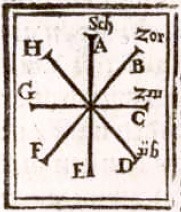
Keep the cutting rose in mind. This is your mental map uke is at the center. Your atemi is on the E ->A line. The destabilization is H->D. Your return is D->H.
The footwork is a simple angle change – move in, strike, break balance and flank. Return through uke’s center from the superior angle.
The kihon handwork is a control/strip. Nage grasps uke’s hand to force a release and keeps a compression grab to execute a strike and control throughout the movement. Note that the grabbed hand must act as a spear-thrust to help drive uke’s response (elbow compression)
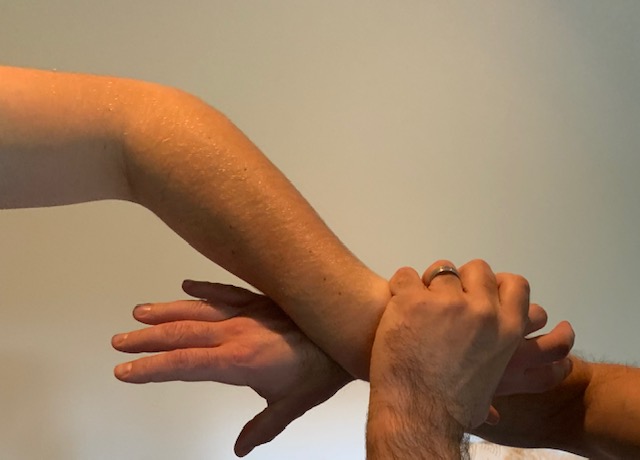
The strip is from the top (the high gate) meaning you must cover and control uke’s grab hand.
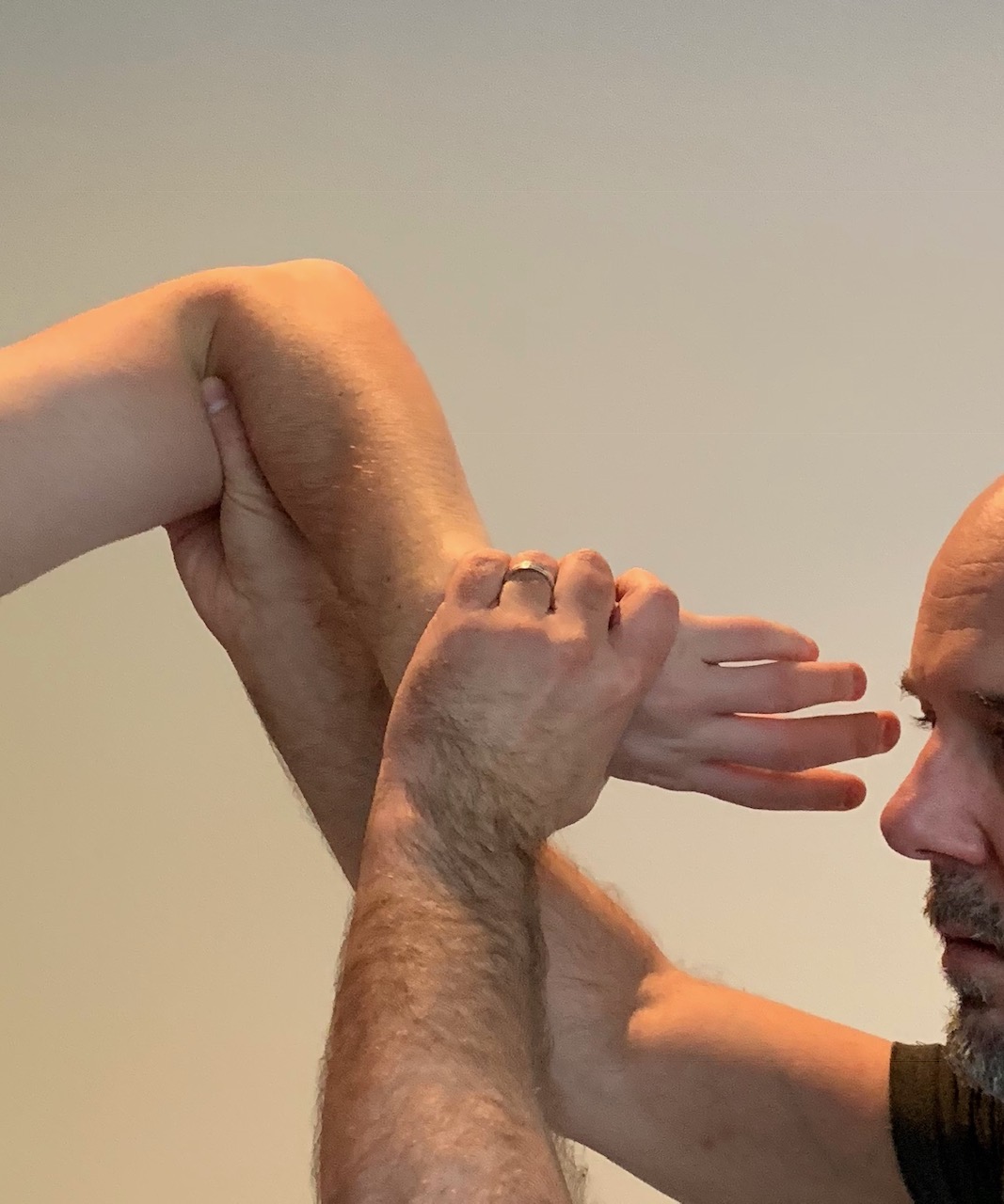
The second variation would be to come from the low gate which replicates the sword movement and looks like ai-hanmi insofar as nage does not grab uke’s hand/wrist but rather maintains a pressure contact.

As with almost all techniques, once contact/control is established with the upper body, the driving force is the lower half – engage those glutes and quads starting with the feet. Lower your fundament below the line of your uke’s hips by softening your knees then drive up and through uke’s position while pressing uke’s elbow toward their ear and simultaneously cutting down (uke’s elbow is your kissaki).
Uke is now controlled, their arm parallel to the mat and your vector of travel through their center is done with a downward focus on uke’s shoulder – the bursa should hit first to close any tsuki (openings) afforded to uke’s free hand. Following uke to the mat, nage drops the inside knee first to uke’s arm-pit while keeping a vertical pressure through the controlled arm toward the shoulder. Using the outside leg as a brace, nage can now sit seiza as uke’s arm slides down nage’s thigh to the arm trap. Sitting proper seiza, back straight, toes up, buttocks on heels, nage can slide uke’s arm flat to the mat.
In every pin where uke’s arm is flat against the primary rule is this: uke’s arm must be above the line defined by uke’s scapula. This is why nage’s inside knee must be at uke’s armpit and be the first point to touch the mat. Nage’s knee defines the pivot point and contact point so when nage slides uke’s arm down nage’s thigh, nage can maintain and increase the controlling pressure down and into the mat.
Arm above the scapula, nage should use the shyuto to control uke’s elbow (nerve compression) and the grasping hand needs to roll uke’s trapped hand so that uke’s shyuto is against the mat. Nage then applies a compressing pressure – palm to back of uke’s hand with attentive focus on uke’s index finger which needs drive toward uke’s ear.
In the second variation (which essentially is ai-hanmi) nage never grabs uke’s hand, therefore the pin is achieved when uke’s arm is flat against the mat, nage will press down on uke’s elbow but lift at uke’s wrist. Opposite force vectors to achieve a pain compliance (attacking the bone structure).
From ikkyo, all other techniques flow. [1]
Nikkyo is achieved just like ikkyo with only the pins being different. Nikkyo essentially results from uke being less docile once taken to the mat, necessitating a more robust pin. The omote version results from uke trying to rise, forcing nage to drive more forcefully on the shoulder and raising uke’s arm vertical. From that vertical position nage should pull uke’s arm tight to nage’s chest (eliminate all slack), then cradle uke’s elbow and forearm as nage leans forward from the bladder, keep your weight down but lift your tailbone (coccyx), and feeling uke’s arm can travel no farther, turn towards uke’s head without allowing the trap to loosen. This pin attacks the structure of the shoulder.
The ura variant has two primary approaches, both however result from uke being more stable and thereby preventing nage from coming directly through uke’s center. Meeting resistance, nage smoothly adapts by rotating to the outside line. Adapt and overcome! If this rotational energy is sufficient to bring uke belly to mat, then pin the arm flat and as uke tries to rise again, bring uke’s controlled wrist to the chest lean forward to keep compression and nage uses the free hand to control uke’s forearm which, grasping above uke’s wrist, is levered down – nage closes his elbow to ribs. A two-point bone lock that concentrates all forces at the base of uke’s wrist at the carpal bones (i.e., all those bones below the metacarpals).
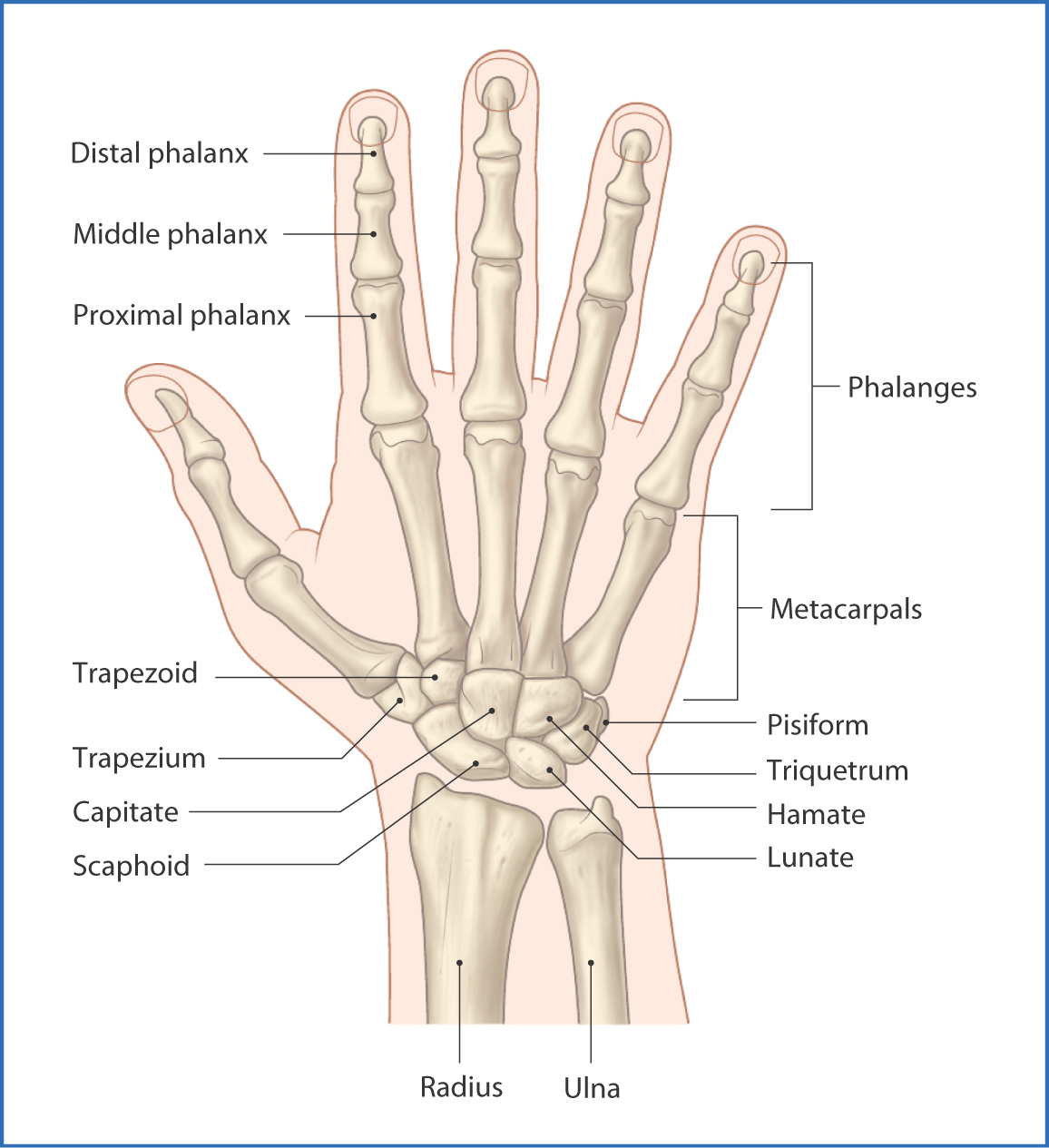
Details to focus on for the nikkyo pin: Make sure that uke’s thumb is firmly pressed into your chest – allow no air gaps. The bones of uke’s hand should be aligned with uke’s radius and ulna – do not focus on ‘bending’ uke’s wrist. I describe this as bone locking for a reason – we are exploiting anatomical weaknesses. This compression is high to low (since uke is at a lower level – closer to the ground than nage).
A second variant occurs when uke does not go entirely to the mat with one rotation or when uke rises faster than nage can apply the pin. In this instance uke and nage are roughly at the same elevation. Therefore, nage must start the pin by compressing uke’s hand to nage’s chest, but then nage should force uke’s elbow up, such that nage can now palm uke’s elbow to do a dual vector compression – treat uke’s forearm like an accordion: drive your chest and uke’s hand toward uke’s elbow point which is being driven down and toward nage with nage’s free hand.
As part of kuden, I have shown Mulligan sensei’s ‘snake,’ reverse grip and use of the head as augmentations to the kihon. Keep those tricks in your repertoire.
________________
[1] A more refined approach would mimic Tissier sensei’s presentation but I would submit that one cannot focus on his flow pattern without a solid understanding of the basics outlined above.
 Protective Arts
One thought on “KIHON – IKKYO AND NIKKYO”