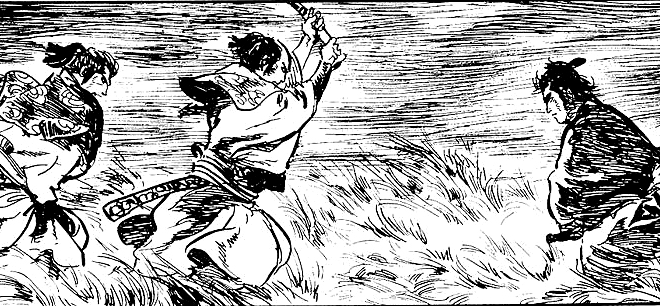
The flow of any given technique can be broken into constituent elements that are linked in logic chain: an if-then series based on the openings and opportunities.
Another way to understand the logic of a technique is to ask – what if this doesn’t work? What is the backup plan?
As an example – here is one possible logic chain outline for shomen-uchi kotegaeshi “advanced” from the initial encounter of shomen-uchi ikkyo omote:
IF Superior time (nage is ahead of uke’s OODA loop) – THEN, ikkyo omote
IF Inferior time (nage is slow, behind uke’s OODA loop) or
IF Uke counters, THEN, Slip under to kokyu-nage
Uke retains balance ->
Quickly turn hips to execute:
{mid line -> shihonage
{high gate-> kokyuho
{low gate -> udekimi-nage
-> Uke moves to escape
-> Switch hands to kotegaeshi
Each step in the chain represents a point in time during which the relationship between nage and uke is subject to change. The roles of uke and nage are convenient fictions useful for training but can result in dangerous ossification in thinking. To move beyond a mechanical understanding of any encounter, you must understand that there is no such thing as a nage or an uke. Ultimately those are dangerous labels that can habituate you to playing a role. There are no roles in combat – there are only active agents!
Approach every encounter with the proper mindset and the hidden budo of Aikido manifests. Move beyond the monkey-see monkey-do manner of training and learn to see.
The narrative of the encounter.
Seeing your opponent before you, you quickly strike shomen to defeat him. Your opponent intercepts your strike and begins to take control using ikkyo. Knowing the trick, you drop your weight to come under and begin to counter your opponent – ikkyo for ikkyo. Your opponent feels your reversing energy and surprises you by clipping your chin with an elbow and turning under your arm to execute a throw. Feeling your opponent using your momentum against you, you accelerate and step beyond your opponent’s arc to catch your balance and turn to make a horizontal cut. Your opponent knows that this is your only plausible response and counters by keeping control of your cutting arm and turns his hips so as to move past and again accelerate your strike, taking you past. Your opponent is now behind you. Quickly, you adjust by stepping forward to cut from the opposite side, but again, your opponent is savvy. Your opponent steps beyond your arc again – moving down your arm, from the elbow to concentrate at your wrist and cuts over to disarm you, kotegaeshi.
Play that sequence and watch it in your mind’s eye. Can you follow the action? Then put yourself in the other role.
Your opponent raises to execute an overhead strike. As soon as he begins to raise for the strike, you move in to close the distance and trap the arm on the rise. You then move in to displace your opponent’s balance and cut his arm down with ikkyo. You opponent is strong and knows how to use his balance. He catches his balance and begins to reverse your control. Feeling that your opponent can over-power you, you see an opening created by his intent to counter. Keeping your hands in their original position to not telegraph your intent (your top hand in contact with the wrist, your bottom grasping your opponent’s elbow), you relax your bottom arm, fold the elbow to drive the point up and into your opponent’s chin. Your opponent was caught unaware, but rolls with the strike but your atemi broke his balance and momentarily raised his center. You caught the initiative and pivot quickly to carry the momentum of your opponent’s counter to execute a throw – pushing his arm arcing out and down (kokyunage). Your opponent is well conditioned and the blow was glancing only. Before you can perfect the throw, your opponent recovers and feels the change in acceleration so goes with it – using your energy to his advantage to get ahead of the throw. He plants and begins to counter you with a horizontal cut at your belly. As soon as you sense the throw will not work, you know your midline is exposed, so you prepare for the cut. When your opponent begins the move, you take the cutting arm (in fact you never left contact) and accelerate it and turn your hips to get on the outside line. From the outside line, you drive forward and, grasping your opponent’s wrist like a sword, you raise it with the intent to turn under and do a cutting throw (shihonage). Sensing your intent, as you move your hands up your opponent’s arm, your opponent steps forward and away to avoid your raising throw and begins a cut from the other side. Feeling the potential escape, you move forward quickly and change hands while isolating the wrist to finally disarm your opponent with kotegaeshi.
You should be able to watch the encounter from both perspectives – you are both agents in each of these encounters. At any given moment during any encounter the openings and opportunities will present themselves. Learn to anticipate counters, to see openings, to sense vulnerabilities and lapses in your opponent’s control. Learn to close your own gaps to maintain a constant level of control so as to not create openings where you are vulnerable to a counter. Learn that the control must be firm but relaxed to better feel changes in vectors of force. Too much tension creates a lever where your opponent can find a fulcrum and use your strength against you.
The narrative is the flow, but see every point where the story could have ended sooner. For example, the simplest encounter would be:
Your opponent lowers his guard to create an opening on the highline. Sensing the advantage, you quickly raise and execute shomen, striking your opponent down.
The first If-Then:
You lower your guard to create an opening your opponent must take. Your opponent strikes shomen, so you step in to catch the strike on the upswing in order to dominate the center and take your opponent with ikkyo.
The second If-Then:
If you are being taken ikkyo, then you must get ahead (move away or under) of the descending cut in order to rebound it with your own counter cut. (Ikkyo is makiotoshi after all so the back and forth at this step between similarly skilled combatants until one elects to change strategies.)
Extrapolate and find each step in the narrative, and the narrative for each step – and you should be able to create the logic-chain. If-this, then-that, so as to develop a parry-riposte mentality that can move to a constant connection so that your Aikido becomes more than vacant choreography. To have connected flow, you need to know why you remain connected (ki musubi).
The pragmatist stays connected to better sense and control the movements of his opponent. The flow is a result of the constant contact resulting from a continuity of intention. The intention of both players is to win the encounter. “The purpose of Aikido is to kill.” Hyperbole, but a cogent reminder of the seriousness of the game we play. But it is only with seriousness and intention from both participants that the beauty of the art emerges.

Be like Itto Ogami (Lone Wolf and Cub) – always have a plan!
 Protective Arts