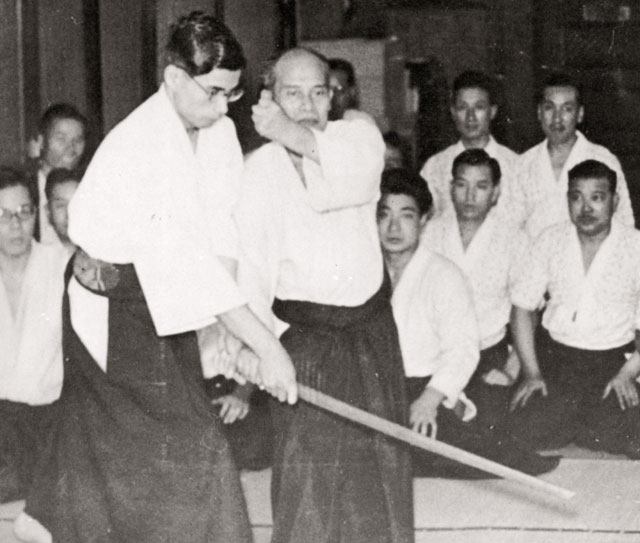
Testing for shodan requires demonstrating weapon take-away techniques against tanto, jo, and bokken. Simplify the phrasing and the concept we are discussing is disarms.
Here is the secret: all empty hand techniques in Aikido are disarms. You have been doing nothing but disarms since your first ikkyo omote. Aikido is not an unarmed art.
I have discussed the limitations of techniques over concept, so we start at the level of concept. Moving from the universal to the specific.
In response to any attack at contact range we can only either move to (1) engage or (2) evade. Both responses require a decisive mindset and purposeful movement to achieve the Prime Directive: Don’t Get Hit.
Engage v. Evade
To engage your timing needs be superior to your opponent – you are inside their OODA loop. Evading is a response to inferior timing (or a deceptive stratagem) and you need to avoid to break your opponent’s OODA loop.
A digression on Evading.
Kisshomaru Ueshiba recounts in his book Aikido (1985)
In spring 1925 a navy officer, a teacher of kendo, visited the Founder and asked to become his student. Then during a conversation, they happened to disagree over a trifle matter. Tempers rose. They agreed to have a match.[1] The officer dashed forward to strike him, swinging his wooden sword. The Founder dodged his sword very easily each time. The officer finally sat down exhausted without having once touched him.
Ueshiba, 1985:153
Evasion and the avoidance of conflict is the highest evolution of combative skill. To constantly avoid contact with a determined and trained opponent would require a level of budo that I can only dream about. Imagine being able to constantly slip Evander Holyfield’s punches until he stops from frustration and exhaustion, or contending with Bas Rutten by continuously evading a clinch. To prevail by evading would necessitate being far better skilled and better conditioned than your opponent. The more pragmatically minded Ed Parker pointed out that if you do not stop your assailant in the first attack, then you are not fighting one opponent, but two. Fail to stop the attacker on the second engagement, then you are fighting three opponents. Simple math. Longer encounters are equivalent to multiple opponents. Time is your enemy, draining your resources. Even ‘effortless’ techniques take energy. In the Newtonian universe I inhabit, you cannot win by defending. Hence the need to engage.
The logic chain (order of operation) for every encounter is:
Prime Directive = Do Not Get Hit
Do Not Get Hit = Engage with superior time, Evade to gain superior time
Engage = use timing and footwork to get inside or outside the weapon’s arc
Engagement is shorthand for gaining superior position (shikaku) by use of footwork (irimi, entering, tenkan, blending), and timing (kimusubi and atemi). Engaging as a concept is the most difficult phase of every encounter. Most difficult because it is the most ephemeral and easiest to miss. Hence O’Sensei’s poetic phrases to describe it in his “Secret Teachings of Budo” (Budo Training in Aikido):
#27 Embody ‘Yang’ in your right hand / Turn the left into the passive ‘Yin’ / Then guide your foe
#12 Should an enemy come running and strike / Avoid him with a step to the side / Then attack in an instant
Thus the initial engagement determines the outcome of the encounter. The greater the skill gap between you and your opponent, the earlier the outcome is determined.
Determination of the encounter however requires technical skill such that you can first control your opponent’s actions, then counter their original intent. Notice that these last phases are what most ‘techniques’ will focus on because these are the physical skills to refine.
At the conceptual level[2] for every encounter we must:
Evade don’t get hit
Engage enter to a superior position
Control deploy a response that limits your opponent’s actions
Counter ensure that your opponent cannot continue hostile actions
We have aspirational goals but the outline is very straight forward and requires dedicated practice to achieve.
#8 Progress only comes with constant practice / Build up and kept to oneself / Do not hope for ‘secret teachings’ / They will lead you nowhere
Keep training!
Control and Counter – the techniques.
In the Aikido curriculum tachidori is the defense against a katana – a two handed sabre. Therefore, the assailant is always in a fixed relationship to his weapon – holding the sword right hand forward (by the tsuba) and left hand near the base (there are no left-handed samurai). Furthermore, because the proper use of a katana in combat was with a levering action, the swordsman’s hands are at least a span apart.
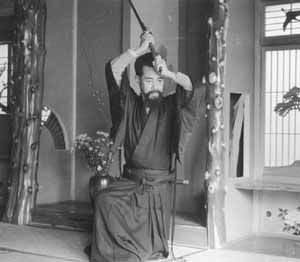
The attacker starts seigan no kamai and raises the sword to assume jodan no kamai to execute shomen.
Shomen, the overhead strike (Angle 12) bisects the body and provides a clear separation between the inside line and outside line. In tachidori – anything to nage’s right is the inside line and anything to nage’s left is the outside line when in context with the opponent’s sword.
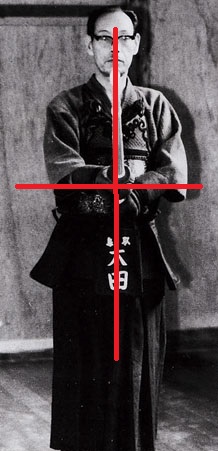
The first response is the direct response:
IKKYO – direct. As soon as uke starts the upward raise of the sword enter boldly to execute ikkyo. Because of uke’s relationship to his sword, this can only be done RvR (assuming right hand dominant opponents). Timing here is the key. Catching uke on the rise with superior timing you execute ‘omote’ and if with inferior timing ‘ura.’ But with either engagement, your lower hand must catch the opponent’s upper arm to stop the strike while your upper hand contacts with the opponent’s right wrist area. Recognize how you must use your right hand to control the sword. The reason for ikkyo’s pin is fully realized when you see how your opponent’s sword further limits uke’s options.
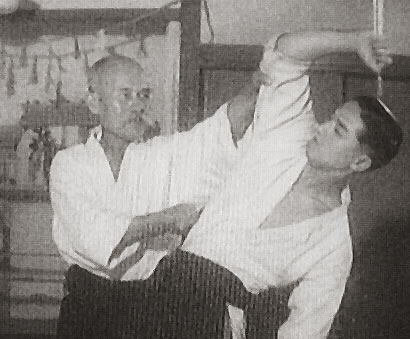
IKKYO – can be done from the inside line with inferior timing (blending). Uke strikes and nage responds with ushiro tenkan. As nage moves ushiro tenkan, cut your right hand between uke’s hands and grab the handle between your opponent’s hands. As uke raises to escape, add energy and lift straight up and then arc over, just like in tsuki ikkyo. The difference will be that nage will manipulate the sword such that the extraction will be more similar to nikkyo omote. As you extract the sword, move the kissaki toward uke’s head whilst levering the pommel out and away (uke’s hands will act as a pivot).
AUGMENTED DECAPITATION – a variation on the ikkyo blend. Rather than lift and arc the sword after grabbing the hilt, nage shifts back, drawing uke in, then snappily punches the sword toward uke. As uke spins to avoid the atemi, the sword will be vertical (perpendicular to the ground) and uke’s back will be to you. Drop the kissaki and with your left hand, reach past uke‘s head to grasp the mune in a pinch grip and close the edge toward uke’s neck. Uke is now at the point of bargain.
Build your mental matrix. Write it out so that you can graphically represent the options available to you on each side and each level.
| APPROACH | GATE | INSIDE | OUTSIDE |
| Direct | High | grab sword with left hand, palm strike to chin (irimi nage) | grab sword with right hand strike, palm strike with left (irimi nage) |
| Mid | augmented decapitation | grab sword with right hand, grab neck with left, drive pommel into uke’s midline to throw | |
| Low | parting two apricots | parting two apricots | |
| Blend | High | kokyuho | |
| Mid | hijikimi | ||
| Low | udekiminage |
The variations are numerous but finite. (Don’t understand the descriptive labels? Come to class!)
______________________
[1] As a biographical anecdote in Aikido written by his son, Morihei Ueshiba is revealed as being all too human here. Tempers rising over a trifle leading to a duel? (Chiba sensei reports O’Sensei telling the story in a different manner >here<)
[2] Acknowledgement to Pete Kautz, who was inspirational on the sequential framework. See his summary >here< and look for the universals that Master Keating admonishes us to find!
 Protective Arts