This is not a kihon-level presentation. The sequence of development presumes competency in basic lock-flow dexterity drills, the ability to keep connected pressure, and a familiarity with vectors.
It is a play off a standard shomenunchi – irimi tai sabaki exercise incorporating both the font hand and back hand intercept. The hand work is not necessarily tied to, nor as specific as, hanmi (gyaku v ai-hanmi) because the tai-sabaki is fluid in more dynamic or advanced plays. Foot movement at this level is presumed to be a method of conveyance and not as a reference point. The gestalt of the encounter dictates the foot position. Which is to say, you need to adjust your spacing (in time and space) according to the speed of your attacker’s approach.
The lines of action in this exercise are linear – but that is merely a pedagogical tool to limit variables. Once these skills are developed on a single line, then changing the vectors should be an easy adaptation.
CLASS OUTLINE
Ikkyo to Sankyo, direct Irimi-nage, and kaiten-nage logic chains.
Warm-up – shomenuchi, irimi entry
Goals: uke focuses on a good attack, nage focuses on a irimi entry with brush contact
Concepts to develop: spacing (maai), timing (True Times), creating an invitation for attack to lead uke.
Presentation: nage presents shizentai inducing uke to strike shomenuchi. Nage enters irimi to the outside flank with a rising (low to high) RvR brush block (glissade). In the terminal position nage has a pressure contact with uke‘s raised arm (the axis), on the same line, but facing the opposite direction. This is an indexing point, a transitional node to any number of subsequent movements. But the action needs be smooth – devoid of clunky contact and vector changes.
Second Presentation: nage presents shizentai inducing uke to strike shomenuchi. Nage enters irimi but this time LvR with a descending cut (as opposed to rising). Positionally nage will end in the same spot in reference to uke‘s body, but the vertical axis is now gedan (low line) v jodan (high line).
Transition to Jodan Tsuki.
Goals: uke focuses on a deliberate attack, nage must now contend with a point (rather than edge) attack. The attack is now more ‘real.’
Concepts to develop: no block, trapping counter, half beats.
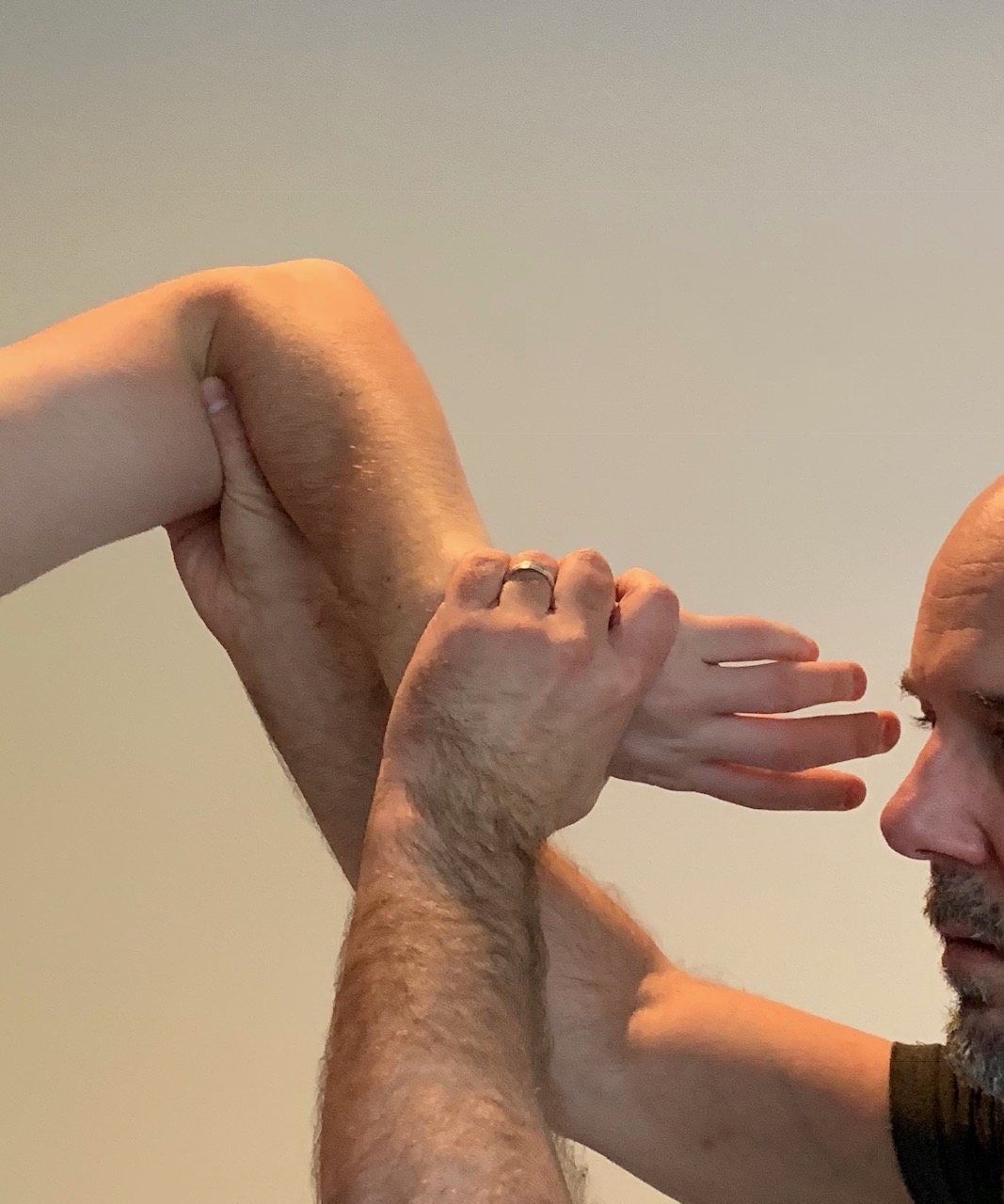
Presentation: nage stands shizentai inducing uke to punch to the face. Nage enters slightly with a cross-block irimi, but uses the free (back) hand to counter strike jodan on the inside line of uke‘s arm. The cross-block (RvR and LvL) is an indexing position. Nage‘s inside striking hand then rebounds on the same line to jolt uke‘s elbow forward toward nage while nage‘s index hand pressure strikes uke to the face along opposing vectors delivered simultaneously. This action will fold uke‘s arm and lurch him toward nage. The index hand then flows to grasp uke‘s contact hand and feed it to nage‘s strike hand (conveniently waiting at the crux of the elbow). Transition the hand grab for sankyo. This is an augmented flow sequence.
Kuden: The active application is to teach a strike-augmented sankyo. The concept is the introduction of a half-beat. The kihon level technique is ikkyo omote – but the inside line strike adds a half-beat that helps collapse the structural integrity of uke‘s arm. The brachial strike can therefore also augment ikkyo.
Nage is executing a linked series of actions, several are high dexterity, but each action is possible by putting uke in a time-deficit. Strike uke to keep them off-balance. Pressure contact keeps uke in your flow sequence. Only release pressure when you need to create the void you want uke to fill.
Second Presentation: nage stands shizentai inducing uke to punch to the face. Nage enters slightly with a front hand (LvR / RvL) irimi, but uses the front hand to tap uke‘s atemi just off-line, while immediately counter punching (palm to chin) under uke‘s striking arm. Done properly, this is an invisible strike. A slip-counter punch on the direct line of approach from the low-line.
Bunkai Skill Development: ura-ken (back knuckle) strikes to the inside brachial nerve. Rebounding strikes. Push-pull levers.
Developmental Presentation: from the LvR index, nage returns uke‘s strike back into the body – thus setting the logic chain for kaiten-nage.
Skill Development: keep connected to the striking hand as it retreats (chambers) for a secondary strike. Anticipate the counter and do not chase the encounters – pressure control from the first moment of contact.
As always – correct repetition is the key. All the basic body development needs to be employed: slight bend in the knees to keep the tanren connected to the earth, lower center of gravity; feet free to move; abdominal muscles engaged to support the spine and allow natural breathing patterns.
 Protective Arts