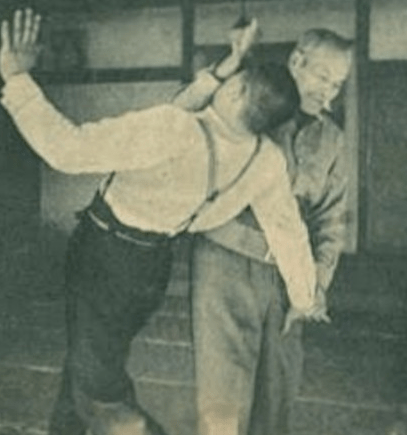
At first glance ryotedori is an inane attack. Two hands on two hands: Who does that?[1]
Contextually I have presented it as an means of controlling an opponent’s un-drawn sword. Uke approaches the pin nage’s hands to his hips to prevent deployment. Nage learns weapon-retention and countering. This post is a focused exploration but review the broader discussion on ryotedori as indexing:
Ryotedori, Ryotedori 2, Ryotedori 3, Ryotedori 4, and the related Prayer Entry
Isolated skill development.
Front Hand
Because nage must learn how to use two opposing vectors, we started class with gyaku-hanmi to show the use of the forward hand. The forward hand provides the initial de-stabilization by shifting uke’s center to the “dead angle” shikaku. From the grab, nage must (a) rotate the grasped hand palm down [c-cut], (b) shift forward toward uke’s flank (c) drop weight [often going to his knees]. This teaches kuzusu (崩す). Movements should be taught and practiced with bold movements at first and refined to the smallest amount necessary to create an unbalancing.
Back Hand
Nage’s back hand is used for the atemi. To ensure the strike is properly delivered, uke will grab both hands, but nage will need to focus on keeping the front hand in stasis. From the initial encounter, nage executes a half step to bring the back foot in line with the front while executing a (reverse) cork-screw punch with the back hand. The cork-screw is an augmented release from uke’s grip – nage rotates his grasped palm from pinky to ground to palm up while aligning his elbow inward toward the hip which is driving forward with the half-step. This releases the grasp and executes a centerline atemi to uke’s head.
This is a tanren development: Resistance training that allows uke to learn how to control an opponent with a forceful grasp. Uke will develop greater grip strength while keeping the fundament (abdominals) engaged, shoulders and elbows soft – a swordsman’s grasp. Nage learns to defeat a strong arresting grab with body mechanics rather than rely on timing alone.
Movement
Combine the two actions. The front hand starts to draw uke off line while the back hand creates the opening with a strike to complete the destabilization. Nage can now move to the flank. The atemi hand contours from the highline strike (to the face) to follow the shoulder to brachial to elbow, and the front hand continues to draw tension to the outside line. This is analogous to drawing the sword. The handle-hand draws the sword forward while the sheath is pulled back – opposing vectors to speedily clear the blade. This is an analogy to provide context not an explanation of a technique, but should remind the practitioner to keep the atemi hand (now at the crux of uke’s elbow) applying outward pressure toward uke’s center while the font hand draws uke out.
Focal Point
At the kihon level, nage has actively changed the relationship by dictating the dynamic tension – the focal point is uke’s elbow. Recognize that this new relationship is now gyaku-hanmi, and know that you can solve two-handed attacks by changing them to one-handed attacks. Logic chains.
In this narrow exploration, we used the dynamic tension to execute a sumio-toshi throw. With uke’s arm outstretched, nage controlling the crux of the elbow and with uke partially destabilized, nage executes an angle change and drops to complete the throw.
At the tanren level, nage keeps the abdominals fully engaged, spine straight and with uke’s body weight relatively static (i.e. a loaded throw, no energetic augmentation)
Once the basic physics and physiological mechanics are understood, then we add movement.
Movement
More dynamic encounters add timing and therefore the need for kimusubi.
Uke is now advancing – closing the reactionary gap – which means nage has to adjust and flow. Nage must encourage uke to take the front hand (bait), or alternatively, snatch uke’s oncoming fingers (small circle jujutsu) and the atemi morphs from a pugilistic punch to a soft pallet strike with the fingers (yohan nuketi). Nage thereby extends uke while entering, and the soft pallet strike fixes uke on the horizontal plane and then lifts uke’s center on the vertical axis. Because uke’s center is lifted, nage’s strike hand can then flow to the focal point on an elevated plane, so the sumio toshi throw now has the added power of a change in the horizontal axis (uke spins) and then a more precipitous change in the vertical (uke’s rotational point is higher making the fall greater).
This version has a dramatic visual impact when both players are in harmony. Theatrical flair!
From sumio-toshi we moved to a low-line strike (dropping reverse c-cut).
From a high-line setup, we can also move to any entering-under throws (uchi-kaiten).
________________________
[1] Indexing – you will see moments in Kali where the players are in a ryotedori relationship (see >here< at 1:20 for example) but also notice how quickly the solve it back to a one-handed relationship in lock-flow. So read my opening rhetorical question – no sensible player attacks with ryotedori, but all players who use traps in their art will inevitably wind up in a 2 on 2 relationship. Augment these skills by adding a knife to your flow sequences and watch how ryotedori evolves.
 Protective Arts