Read through these posts and a recurring theme, a lietmotiv, should emerge: what is the most effective way to teach, and the corollary, how do we learn?
There are numerous rules of learning. Malcolm Gladwell popularized the metric that it takes 10,000 hours to perfect a skill in Outliers (2011). That magic number implies a huge time commitment: 2 hours per day, 7 days a week, 52 weeks a year takes almost 14 years to get 10,000 hours. Before getting discouraged, Gladwell is on record that the 10,000 hour rule does not apply to athletic performance – although I have seen others use it as the magic number of repetitions needed to master an athletic skill. And importantly, that is the number to master, i.e., become one of a very elite, high-requisite-skill minority. Of course anytime an idea gets popular – and Gladwell makes his living popularizing ideas – others try to debunk it (qv. Fast Company and the cited study).[1]
I start with Gladwell because his is a simple numerical metric: clearly we need to dedicate time to practice in order to master any skill. Earlier posts have covered the need for time on the mat. If we assume that shodan is the attainment goal – not to mastery, but to be able to replicate and demonstrate the curriculum – the required training hours are between 780 and 1040.
The quality of the hours spent is critical. The easy rubric is deliberate practice. Earlier posts have alluded to the need for mindful and honest practice even in solo training. Developing excellence in a martial art requires the additional quality of grit and perhaps even enduring pain.
While military drill-sergeants can force discipline with brute methods, in the civilian world you need to be self-motivated. It’s all too easy to not show up, or to not train hard, or to assume the teacher will give you the information. A consumer mentality where by paying for it, the art should be packaged for you.
I do believe there are normatively better ways to teach and learn. My teachers have continued to evolve and refine their teaching methods in their pursuit of Aikido. And I too play with different ideas to foster student (and my own) development. I have not found the best way. When I do, I will patent that method.
A recent article by Cal Newport had the brilliantly provocative title “Flow is the Opiate of the Mediocre” [2] and outlined training strategies that are broadly applicable:
- Strategy #1: Avoid Flow. Do What Does Not Come Easy.
- Strategy #2: To Master a Skill, Master Something Harder.
- Strategy #3: Systematically Eliminate Weakness.
- Strategy #4: Create Beauty, Don’t Avoid Ugliness.
Because the strategies are from a pianist, the clarifying examples need Aikido analogies.
#1 – Avoid Flow: The point in the article is that weaker pianists play through their pieces, while the better ones drill and practice only the more difficult parts. This admonishment is somewhat ironic. I have very rarely seen, and almost never present, Aikido as it is ultimately played. Meaning the true flow of a multi-step encounter with attack, counter, counter-attack is rarely a goal. In general, we do avoid flow and practice only a small segment of an encounter. But the deeper point of drilling the more difficult aspects of the encounter applies. I will often segment lessons to train to the most difficult aspect, for example: a punch to the face requires conditioned mental fortitude to avoid a flinch response.
#2 – Master Something Harder: purposefully make a movement harder in order to master the underlying movement. Ever since beginning this experiment, I have been adding complications – beats, half-beats, staccato rhythms, targeted strikes, etc., – to make kihon movements unfamiliar. I have purposefully avoided Japanese terms to make it cognitively less familiar, to break mental maps and force students to make new (and hopefully deeper) connections.[3]
#3 – Eliminate Weakness: this is the entire goal of training! The strategy here is to isolate skills to develop where you are weak. For example, train gyaku-hanmi not with the idea that it is an end to itself, but rather with the deeper realization that it is a way to develop your response to chudan tsuki. And make sure to train your non-dominant side at least as much as your dominant (“I’m not left handed either…”).
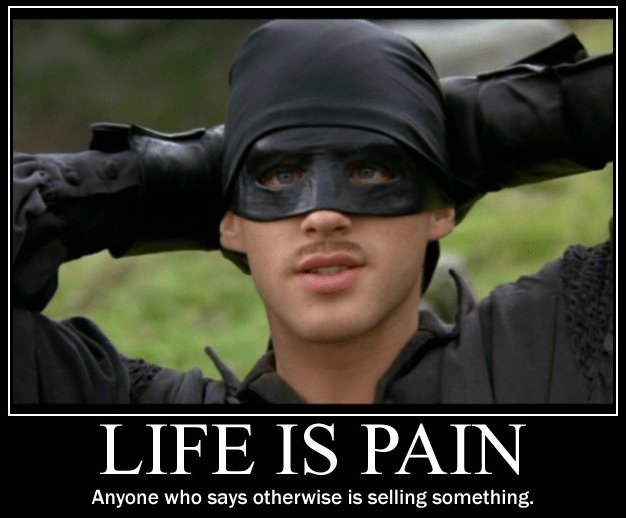
In The Princess Bride, Westley became a superlative swordsman under the neglectful Dread Pirate Roberts whose only guidance was – “Goodnight, Westley. Good work, sleep well, I’ll most likely kill you in the morning.” Westley was a self-motivated student and learned from everyone and anyone who would teach him. The citation may be whimsical but there is a level of seriousness: This (2019) Royal Society published study implies that teacher designated study was less relevant to improved performance than practice alone. In short – keep training!
#4 – Create Beauty: the quote is from a pianist, but is true for every art:
“Weak pianists make music a reactive task, not a creative task. They start, and react to their performance, fixing problems as they go along. Strong pianists, on the other hand, have an image of what a perfect performance should be like that includes all of the relevant senses. Before we sit down, we know what the piece needs to feel, sound, and even look like in excruciating detail. In performance, weak pianists try to reactively move away from mistakes, while strong pianists move towards a perfect mental image.”
Precisely! Move towards a perfect mental image. The challenge is finding the perfect mental image. Throughout these posts are links and references to those who are my inspirations – and read carefully – they are not limited to just martial artists alone.
Do note that we must balance the distinction between a martial art and the science of movement. What I mean is the artistry of movement must aspire to be beautiful, and because its application is martial, it must also be scientifically efficacious. I believe that the two are inextricably linked. Proper targeting is scientific, and the path of least resistance is physiological, so combining those two aspects is where artistry manifests.
___________________________
[1] Malcolm Gladwell covers a wide range of topics – see an earlier reference >here<
[2] A provocative title because it plays off Csikszentmihalyi‘s (2008) Flow: the Psychology of Optimal Performance which I reference >here<
[3] The largest barrier to learning is our experience, what we already know often acts as an impediment to progress. >Listen to Hidden Brain<
 Protective Arts
One thought on “DO WHAT DOES NOT COME EASY”