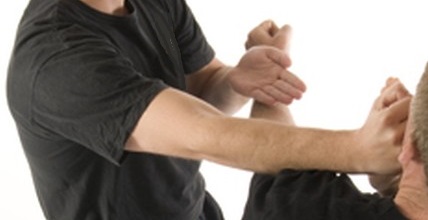
Closing Skills as described in an earlier post challenges the idea that Aikido is a defensive art. Aikido is not a defensive art because you cannot prevail by defending. Rather we use ABD to place the aggressor in a disadvantageous position – we draw the attack so as to be ahead of the aggressor’s OODA loop. What we need is a set entry.
Suggestions of class outlines:
FIRST
The scenario is a direct confrontation and nage will control the center through the inside line.
Uke as aggressor assumes a ready combative (boxer) stance, both hands up. Nage as defender takes a ‘natural’ (shizentai) stance.
A boxer’s stance with both hands raised is ryotedori in concept. You should recognize this as an indexing opportunity. Unlike a contact drill (ryotedori, ryokatadori, etc.) when uke starts hands-on, uke in a combative stance requires that nage close the gap. Inevitably, uke will present one side slightly forward, which for narrative purposes we establish as the R hand. (But do note: you need to train for both scenarios.)
Nage shoots R with eye spear (atemi) and can use rebound energy to then check RvR. Simultaneously, nage enters (follows the strike) and with L, wraps uke’s R to control the arm behind and under the elbow. Nage’s R then does an eye rake (moving L to R) to catch uke’s L arm behind the triceps, then pushes it cross uke’s body to feed it to nage’s L arm resulting in a 2 for 1 control.
Uke’s body will be torqued toward his captured arm (R) and nage’s R arm is free. A compound lock at this point is, nage hits uke’s face on the L side to bring the neck to nage’s waiting L hand. Uke is now firmly controlled, arms compromised and nage retains a free R hand.
An attack art – we enter to control the situation, neutralize the opponent’s opportunity to do harm. This pattern is an application of Sinawali. [1]
SECOND
Ai-hanmi katate dori kihon presentation of irimi nage omote is used as a familiar starting point. From the initial grab – nage executes a counter grab (measure for measure), controls uke’s grasping arm, slip irimi and grasps uke’s neck, then drops, breaking the plane of balance.
Goals
Nage (1) measure-for-measure counter grasp [knife retention] (2) neck control [pressure] (3) positional de-stabilization.
Uke (1) grasp strength and connection (2) core stability (3) continuation of action
Narrative Context
Ai-hanmi is a knife stop. Nage thrust and uke counters with a grab of the knife hand to stop the attack. Nage executes a rolling counter cut to extract the knife hand, but nage leaves the hand in stasis. The knife hand therefore is holding the knife point up.
As nage breaks uke’s balance, nage controls uke’s head – the aggressive interpretation is nage pitches uke’s head forward onto the waiting knife point. The take down is an alternative (secondary action) whereby uke manages to avoid the knife to the face, but then has the knife jammed into the chest as nage collapses the structure. Gravity is doing the hard work.
Change the scenario slightly – uke is the aggressor with the knife. Nage can use the same body entry, but the hand work changes. Uke thrusts R, nage back knuckles R while executing the entry. Nage grasps uke’s thrusting hand on the past. Nage’s initial strike may have disarmed uke, or if not, then by grasping uke’s lead (R) hand, thumb up nails down so uke is now holding the knife that will be used against the aggressor. Nothing else changes.
These are two simple outlines to emphasize the need for entry skills to close the gap.
Familiar assumptions should be discouraged. The timing is different. The focal points are different. Nage must enter with superior time and must be closer than typically presented. When Aikido presents a controlling hand (e.g., controlling uke’s neck) we can substitute a palm slap or shyuto strike. The low line strikes (nage knee to uke’s thigh) and half-beat disruption hits (rebound strikes) are now all added when uke’s balance needs further disruption or his focus broken. Once nage’s sequence of actions start, nage never stops until complete control is confirmed.
Think broadly on the irimi entry. This is an outside line attack. Uke aggresses R. Nage staccato strikes R to uke’s hand and L to uke’s neck. The direct counter for counter image is clear.
The refinement Aikido makes is the body slip to the shikaku and a blending pivot. Achieving the dead angle puts nage in advanced positional safety. From here options open. Chokes – both rear naked and one-hand lapel are possible – as are any number of strikes; or the traditional irmi-nage throw, but all at nage’s discretion.
These presentations are not part of kihon curriculum, and I am not suggesting that these explorations are to be construed as techniques. Collecting a compendium of techniques is a dangerous game. A certain accumulation is necessary to demonstrate mastery of a system. But every system is nothing more than a single cultural exploration of the range of motion and limited by circumstances when it was founded.
What I am illustrating is that understanding the principles of movement is critical for moving beyond the limits of a system. Making these links outlined above should be understood as eliminating unessential distinctions. Hone your entry skills to close the gap and watch the potential of motion unfold.
_____________________
[1] Making the FMA connections – sinawali as the entry skill to understand the applications. To develop the skill you need to drill.
___________________
A simple entry algorithm – the Salute System as demonstrated by James Keating
 Protective Arts