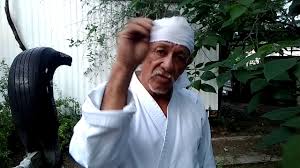
Saturday morning practice at 0830 – it’s not for snowflakes.
Shomen-uchi was the attack which of course could be a punch to the face. Don’t get stuck in linguistic ruts that occlude your ability to see the similarities.
The warm up was suwariwaza with the basic dexterity familiarization: ikkyo, nikkyo, sankyo, yonkyo in a linked (kanren) flow sequence. From there we added a few variations and refinements (henka): nikkyo with a Mulligan-sensei “snake” application, nikkyo using the head as the driver; sankyo done on the vertical axis rather than the horizontal plane; and yonkyo done with both the ligament press and the nerve press.
Moving to standing work through discrete responses: ikkyo, flow under kokyu nage, leading to the sequence of ikkyo – (chin strike) kokyu nage – (hip snap supported strike) udekime nage – (uke protects elbow so) shihonage. This is a set based upon chain-logic and proper targeting. Hit each break or strike with emphasis to find the stopping points that are the nodes in a ki-no-nagare presentation. Ki-no-nagare hides the budo, emphasizing the theatrical elegance to the detriment of a deeper understanding.
Deeper understanding: Shomen – irimi nage direct
The kihon presentation is ai-hanmi front hand intercept (R/R, L/L), allowing the back hand control of the neck.
Aikido uses this two hand pattern as a blending – the lead hand finds the oncoming strike, sticks to it so as to allow the nage’s body to enter, the back hand to control uke’s neck, then for nage to pivot snappily to blend parallel to uke (or Yamada-sensei style simply keep driving forward). Both presentations only represent a portion of the possibilities of the encounter.
Weaponize the lead hand, or simply use a bill-sao approach and irimi-nage direct is a one-hand response. The intercepting hand receives, redirects and thrusts (throws) all in one beat. This is a dagger response to the outside line.
Kokyu-ho is the inverse of irimi-nage done on a shallow approach. Irimi-nage is a closing (nage’s hands come from the outside to the center) whereas kokyu-ho is an opening (nage’s hands come from the center to extension). The shallow approach means nage’s body position is in front of uke’s lead hip whereas in irimi-nage, nage is behind uke’s lead leg. Stop thinking of these as discrete techniques.
Uke strikes sincerely and nage manages to slip past, then irmi-nage is a viable response. However, if the stike is less committed, or if nage is late and cannot slip past, then controlling uke’s weapon is imperative. Therefore, kokyu-ho.
Kokyu-ho with sword is a cut-counter-cut. Kokyu-ho with a jo is an arm-bar neck-throw (break). Empty-handed its all about how nage presents his shyuto. Both are possible when you are on uke’s outside line.
The inside line response is tenchi-nage.
From shomen-uchi, the kihon presentation is RvR/LvL lead hand cross-block, hand transition to clear the line (i.e., back hand then clears uke’s strike hand) and strike. The strike is done with the shyuto to represent an umbrella shield to counter-yokomen.
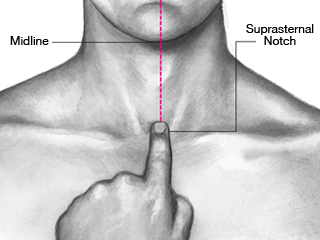
However, the more direct approach is closer to a prayer entry where nage receives the strike with the forward hand (LvR/RvL) and the back hand thrusts to the suprasternal notch. With a dagger this is a straight thrust. Empty handed, your back hand is a spear-hand strike followed by a press straight down fingers behind the sternum. Attack the weak points and exploit human frailty.
Related to the suprasternal notch press is attacking the brachial nerve plexus behind the clavicle
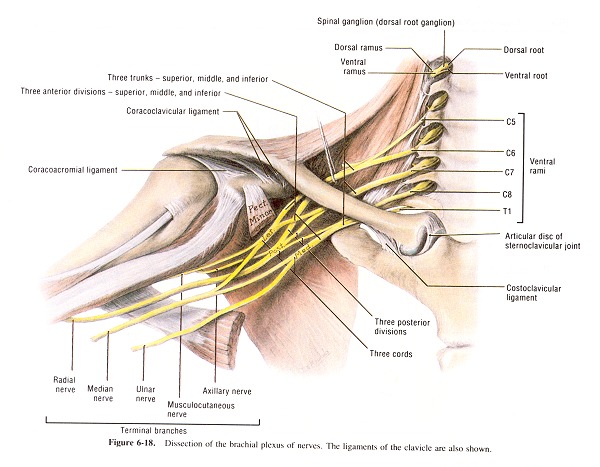
Enter irimi-nage and slip fully behind to move from a rear naked choke to come under both arms as if for a full Nelson. You must still control uke’s head (so place yours against it to isolate range of motion), but your hands now move from the back of uke’s neck to grasp both clavicles and dig your fingers into the brachial plexus on each side simultaneously.

Call them what you will – variations, applications, tricks – they are the pragmatic foundations that back-up your skills – this is how it works when you don’t have a complicit uke with dojo conditioning.
These applications are easy to understand when you have weapons in your hand. The form does not change when you do not have a weapon – you must make your hands into weapons. No that isn’t a metaphor.
_______________________
Nicomedes Flores – my Kenpo instructor’s father
 Protective Arts
5 thoughts on “SPEAR HAND IN AIKIDO”