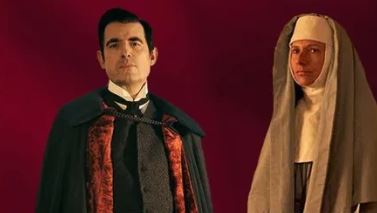
I admit to being a fan of the vampire genre: books and movies. Most recently, the BBC produced Dracula released in 2020 on Netflix.[1] It starts as a smart retelling of Bram Stoker’s novel with visual homages to classic movies along the way, but quickly takes new narrative turns. Unfortunately the series had a very short three-episode run despite quality production.
My favorite scene in the series: Dracula is awakened in the current era after an entombment of a hundred years. His first encounter with the modern age is with a modest home owner. He has feasted on the husband and confronts the wife Kathleen in their house. Looking around the cluttered home:
Dracula “You are clearly very wealthy”
Kathleen (incredulous) “Wealthy?”
Dracula “Yes. Well, look at all this stuff. All this food. The moving picture box (nods to the television). And that thing outside, Bob calls it um … a car. Is that yours?
Kathleen (nods and breathlessly answers) “Yeah.”
Dracula “And this treasure trove is your house!”
Kathleen “It’s a dump.”
Dracula “Its amazing. Kathleen, I have been a nobleman for 400 years. I have lived in castles and palaces among the richest people of any age. Never … never! Have I stood in greater luxury than surrounds me now. (Scanning the cluttered room.) This is a chamber of marvels. There isn’t a king, or queen or emperor that I have ever known or eaten who would step into this room and ever agree to leave it again. I knew the future would bring wonders. I did not know it would make them ordinary.”
I love that line! A poignant reminder that we do in fact live in an age of abundance and ease. And we take it all for granted and anticipate even greater convenience in the future. The irony is that our modern conveniences make daily labor rare so that we have to pay to exercise. We struggle with obesity not famine.
And watching history unfold from a disinterested perch (mere humans are food after all) grants a vampire the ultimate perspective of the longue durée. The vampire is very aware of the changes through time.
With a nod to Neil Gaiman, I amuse myself thinking about how such perdurable creatures might manifest now. Think about the Moirai (Fates): Clotho spun the thread, Lachesis drew it out and Atropos cut it. I smile to think that they now own DNA testing laboratories thinly prognosticating our moment of death. Protein chains as the thread of life.
How the hell does this pertain to Aikido and the martial arts?
This morning we covered sword basics. In describing the fundamental use of the katana and how the blade must be stopped by wringing the hands inward, my observation was that we moderns do not have the necessary grip strength. We do not daily work with our hands or engage with the sword often enough to wield it with effective ease. What should be normal is now specialized activity.
I recall reading about a history professor skeptical of Herodotus’ assertion that at the Battle of Marathon, “The Athenians advanced at a run towards the enemy, not less than a mile away.” The incredulous professor asked the college football team to don hoplite gear and replicate the run. None accomplished it. The professor concluded that Herodotus yet again got the facts wrong; the Athenians could not possibly have run to engage the Persians and then battled them to prevail.[2]
The arrogance of moderns! That football players could not replicate the martial feat should come as no surprise. A bronze panoply weighs nearly 70 lbs, approximately 50 lbs more than football gear. When not in annual battle, the ancient Greeks were in the fields plowing rocky soil and walking everywhere. No modern conveniences, no mechanical advantages beyond the basic lever and wheel. Everything was toil and, yes, people were tougher then: Because life was harder, people had to be.
So, when thinking about techniques and how they are applied, understand that we are all under-conditioned. When dealing with weapons and control techniques, hand strength is a pre-requisite to efficacy. And mental toughness is mandatory. We now label grit as if it’s a trait to be curated and not a byproduct of life-as-lived. When was the last time you slaughtered an animal to fill your larder? I have had to ‘process’ pigs and chickens in the past but have only ever hunted for ‘fun’ and never out of necessity. I relish the convenience and ease I take for granted. As a result, I am weaker for it.
The point is this: better nutrition, education and training methods are no substitute for the raw experience of daily exertions.
Dracula marveling at our material gains and highlighting the creature comforts we all enjoy also gave me a twinge of guilt; a reminder that easy is not qualitatively better. I have to remind myself: If the goal is improvement, we must do what does not come easy!
_____________
[1] BBC’s “Dracula” was created by the same visionary team that created the earlier BBC series “Sherlock.” See the footnotes in >Mining the Moon<
[2] I found the proper citation while reading Victor Hanson’s The Western Way of War and correct my imperfect memory of the study in that post.
_____________
Update – >here< is a brilliant essay on Dracula, time and economic growth
 Protective Arts