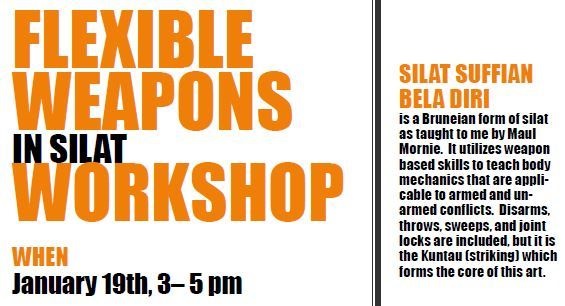
Brian Pike of Silat Suffian Bela Diri provided an introduction to the scarf as a flexible weapon.
Equipment first
Flexible weapons as a generic category can include a wide variety of everyday objects – most of which were once readily available objects or farming tools, such as the latigo (whip), chains, rope, and daily dress (sarong). The use of flexible weapons is not exclusive to the Filipino arts.[1] The very phrase cloak and dagger alludes to skulduggery which etymologically points to street fighting techniques of 17th and 18th century Europe. What were once traditional tools and common clothing now are specialized martial arts tools. This is antithetical to the very spirit of flexible weapons. They were flexible because found catch as catch can in the environs as well as being non-rigid.
The shemagh was introduced to the US by soldiers returning from Afghanistan where it was a functional article and now has an ironic cachet as a fashion accessory. Brian Chilton found a shemagh, sold by a charity which provides education for Afghan children, and is an excellent (and tacticool) scarf to use everyday. Or consider the tactical bandanna from Comtech. Either can be adapted for your EDC kit.
Orientation
A flexible weapon can be deployed with a snapping whip action on a line to hit targeted points and have the distinct advantage of being able to bend over a block (and therefore still hit) as well as trap limbs and weapons to immobilize and off-balance opponents.
When training the strike, flexible weapons are snapped like a towel. It doesn’t take long to recognize that to deploy a snapping hit, every attack requires full commitment. You cannot feign a strike and the strikes cannot be repeated quickly – each one must go to its full extension, then retract to load for the next strike.
Augment a scarf (load it with shot, line it with hooks, etc.,) and it will hit with more power and do more damage, but for EDC, the scarf is a tool to distract and harry the adversary, to gain you time and positional advantage in the conflict.
Break the adversary’s initiative and get ahead of their OODA loop and you can use the gained time to either escape or close distance as the situation dictates.
Closing the gap then affords you the secondary use of the flexible weapon as a binding tool. Here skillful deployment is critical and the typical focus of workshops and seminars.
Wearing and deploying the scarf
To use a scarf quickly in a self-defense situation, it has to be worn correctly. Place the midpoint of the scarf in front of your neck, then drape each free end around the opposite side behind your head so the tails hang on your chest. To deploy the scarf, grasp the mid point under your chin and pull out and down.
Holding the scarf
The scarf is a binding tool. Once deployed grab the scarf knuckles up, hands shoulder width apart, then roll your hands forward, look at the palms so the scarf makes one wrap and grasp the fabric with your fingers. The scarf can be pulled taut and held firmly while still allowing you to release it quickly in the event that someone counter-grabs your scarf.
Snapping the scarf
Drop one end of the scarf so it hangs loosely. Twirl it as it hangs to tighten it, the tighter the bind, the easier it will be to snap. Snapping the scarf is then like using a whip, or throwing a frisbee and can be done with a side throw or on the vertical. You have to practice distance to know the range of extension. Because it is a whipping action, it is most effective when the tip is at terminal velocity and close to the end of its maximum extension. Because the scarf does not have much mass, you will need to use considerable effort to accelerate it and once snapped, to bring it back to you. Its light weight means no rebound energy and a slow redeployment.
Trapping and blocking
At long range the scarf can be used to ‘block’ by creating a moving barrier. The good ol’ figure eight is your friend here. Just like the flourish with a jo or a weaving sinawali, create a constant motion between you and your opponent. As your opponent enters you have a chance to bind their weapon as it enters the continuous loop. Be careful. Your opponent can also grab or if his weapon is bound perhaps use the scarf against you (binds go both ways…), hence be prepared to release your end.
At closer range, with the scarf held with both hands, the scarf taut, it can substitute for any short baton for blocks.[2] The advantage of a scarf over a rigid baton is that once the strike is blocked, the scarf can wrap over the opponents weapon to trap it and potentially eject it. See the video links below.
Reminder: as a general rule to start the bind, the long part of the scarf orients opposite the opponent’s weapon. If the opponent’s knife if blade up, then start the wrap at the bottom.
_________________________________
YouTube Links
The bandanna as flexible weapon
_________________________________
[1] Nearly every culture developed flexible military-grade weapons (usually derived from agricultural tools). Some examples: European flail, (southern) India’s urumi, Japan’s kusarigama and kusari-fundo, bolas (boleadoras) used by the gauchos of south America, and the slungshot (monkey fist).
[2] The basic expanding baton techniques as taught to police departments all follow the same generic patterns. ASP, Monadnock, all have their variations, but generally follow the same manuals.
 Protective Arts