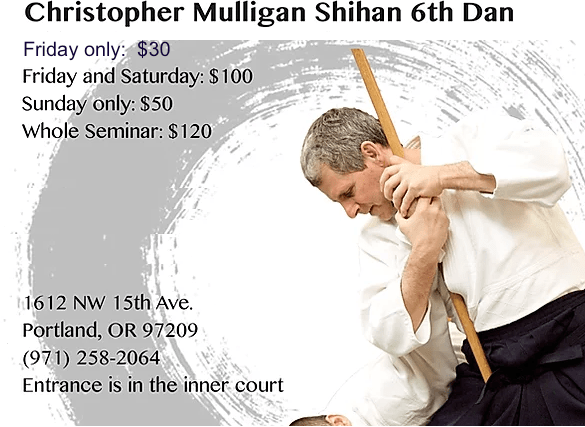
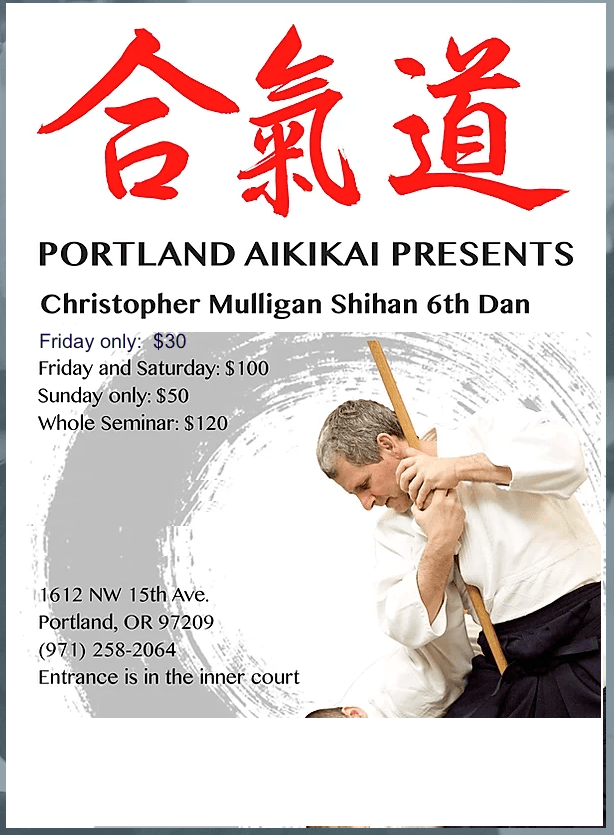
Chris Mulligan Sensei returned to Portland for his annual February workshop.
Friday night was body arts and the guiding principle was to gather power at the center. Simple phraseology; how does one achieve it? The closer one’s hands are to our own body’s center, the more structural and muscular advantage we have.
Therefore, Mulligan sensei demonstrated closing the armpits at the first moment of contact by the opponent. This adamantly does not mean pulling uke towards you! The shoulders must remain relaxed, so nage may have to first approach uke to gather the center and thereby define the initial axis of the encounter.
The basis for all these movements is a weapon, which Mulligan sensei illustrated, to train the line of motion. Two exercises:
Irimi – as an entry, nage holds the tanto, uke grabs to stop the weapon hand creating a gyaku-hanmi relationship. Nage gathers the center by moving the back foot first as a redirect of the line (an acute angle to the inside, i.e, cross body) while leaving uke’s hand in place as the point of rotation. Nage moves toward the grasped hand, bridge the gap, then drives with the back foot (which is now the same as the weapon wielding hand) and as uke’s weight is felt (transferred through the grabbed hand), nage raises the weapon up their own center line to bring the tanto to the top of their head.
Irimi as a cross-body entry should redirect uke to the flank. This is a set-up for shihonage and kokyunage which were two techniques we practiced as a culmination of the theme.
Tenkan – gathering whilst rotating. There is a stylistic difference to note between Mulligan and Okamoto sensei, but the principle is identical. In order to rotate around a fixed point (uke’s grasp), nage must gather the center by first bridging the gap. Hence close the armpits which will require nage advancing (a slide toward uke) which simultaneously brings nage closer to their gabbed hand. Only then, when nage’s navel is close to the axis of rotation can nage then rotate around the fixed point. Mulligan sensei will more closely present this action as a closing of the arms to nage’s side, whereas Okamoto sensei will often demonstrate this principle by ‘passing’ her hand with the advancing shoulder. Don’t let your eyes create a difference without a distinction.
The pragmatic representation of this action is when uke attempts to stop nage from drawing a sword. Nage responds by closing his armpits, bringing both hands to the navel (the hilt) closing to bring his body to the point of the encounter, then moving the entire lower half around the fixed point to then advance the sword by drawing properly: This action ‘opens’ nage’s chest whereby the hand drawing the sword extends away from the center whilst the sheath (saya) hand draws back. At the terminal position, nage’s shoulders are at a diagonal to the initial line of the encounter. Nage is not parallel to uke as is often demonstrated to beginners as a developmental stage in teaching tenkan. (Do note that in the sword presentation the palm is down.)
Ryotedori
Saturday focused on ryotedori but the principles remained the same – to bring the hands to the center line and collect the forces. To provide a tactical advantage the nage presents the hands in so that they are pre-cammed: rotated as if holding a ball, so that uke grabs but is not able to direct all the energy through nage’s arms and back into nage’s body. The positional redirection happens upon contact because nage has set up the encounter. Dictate uke’s reaction from the moment of touch.
The techniques used to illustrate the principles were ryotedori irimi, ryotedori ura, ryotedori ushiro tenkan. Each exercise then lead to shihonage as the culminating throw.
Kashima Shin Ryu
The weapon focus this weekend were bokken forms from Kashima Shin Ryu Kenjutsu. This expansion of curriculum is influenced by Tissier Sensei and one that has been percolating in the background for many years.
As a direct student of Yamaguchi Sensei, Tissier has a strong weapon-based approach to his Aikido as exemplified in its line precision and hand details. That precision comes from sword. Tissier Sensei practiced Kashima with Minoru Inaba Sensei while Inaba was still a student of the art. Tissier Sensei adapted the kenjutsu techniques of Kashima for Aiki-ken.
The approach of Kashima is very direct cutting on the entries with quick capturing counter cuts. There is little gap for a beat, riposte, rather the art focuses on a continued direct entry.
The syllabus of Kashima-Shinryû kenjutsu training includes 52 techniques arranged in seven series:
- Kihon Dachi (基本太刀): 5 techniques
- Ura Dachi (裏太刀): 10 techniques
- Aishin Kumi Tachi (相心組太刀): 5 techniques
- Jissen Kumi Tachi (実戦組太刀): 10 techniques
- Kassen Dachi (合戦太刀): 10 techniques
- Tsuba Zeri (鍔競り): 6 techniques
- Taoshi Uchi (倒打): 6 techniques
 Protective Arts
One thought on “CHRIS MULLIGAN – FEBRUARY 2020”