
Another missed Saturday in Covid-mandated isolation. Another opportunity to cross-train solo skills.
If you don’t already own one – a simple speed bag set up is a good investment. A free-standing unit is an inexpensive and portable way to start.
With the bag, start with a standard rhythm to get a pattern and response from the bag. This allows you to develop hand speed and precision, but the disadvantage is that to get a predictable response from the bag, your hand speed and pattern has to be predictable and consistent.
The problem with this is that when you move in accordance with a rhythm, your opponent can time you and counter between the beats. Bruce Lee discussed this and looked to Western fencing for examples and lessons.
In fencing, each movement is a “beat,” and learning a pattern is augmented by breaking complex actions into discrete beats. So do not dismiss patterns and beats, but learn their limits.
Once you master the beats, the next step is to become more random and to incorporate half-beats and broken rhythm.
A good visual and narrative break down is this analysis of Jersey Joe Walcott
Broken rhythm is essentially constantly changing both the tempo and power of what you are doing to confuse your opponent.
So translate that to a speed bag exercise. First get your basic rhythm down – get the bag to return every time and develop that sense of accomplishment. Then start adding complexity. Throw a couple half speed and/or half strength punches – the bag will respond differently, so your follow up will have to adjust accordingly as well.
Try to randomize the tempo. You will now miss the bag more often because it is not responding predictably. You hit it harder/faster/slower so now you may have to slip it to re-establish time.
Add some footwork. Approach from the left, then right, then double left, etc., keep mixing up the combinations. The standing bag has the advantage over the hanging, because you can throw upper cuts and keep moving.
The goal is to confuse your opponent and when you sense their defense is compromised then follow-up by throwing a flurry of full speed techniques to take advantage of that split second where they’re distracted.
Move in and out on the bag. Change maai (distance) while throwing a soft punch. Then advance back throwing half speed punches to mimic sneaking back into striking distance: hide behind the guard for you knife fighters. This is a technique to close the gap – a necessary component of any attack art.
Using broken rhythm also allows you to maintain maximum energy while at the same time pushing your opponent’s reserves. The changes in distance, timing, power all need to change “on the fly,” and is best accomplished when you can anticipate your opponent’s rhythm and avoid becoming rhythmic yourself.
Easy to write, hard to do.
Watch The Game of Death – specifically when Bruce Lee fights Dan Inosanto. Lee gives a lesson on broken rhythm. Here is a link (forgive the soundtrack overlay).
Another aspect of this is non-telegraphic movement. In Aikido we admonish students to relax the shoulders – the power of the sword is not generated by pushing the sword through space, but rather by freeing the shoulders to act as a pivot for the sword itself. Punches also need to have relaxed shoulders to avoid telegraphic “tells.” You can usually observe and know when your opponent is going to throw something by the way they set their feet, hold their arms, from changes in facial expression, and often because they look at the body part they intend to strike.
To help avoid telegraphing, Bruce Lee advised to never “cock” or “chamber” prior to striking (very common in Asian arts) instead, the blows are thrown from “where the hand is,” like a fencer’s thrust.
A great example of this is Michael Jai White showing Kimbo Slice the principles.
Kimbo Slice was a very accomplished fighter, so that he is surprised by Michael White’s ability to hit his hand with a slow throw shows the power of broken rhythm and non-telegraphed action.
Yes these are boxing skills. Boxing is the sweet science precisely because the training and methods have been well researched! The lessons are part of your universal movement skill set.
And best of all, you can practice solo with a minimal investment in equipment.
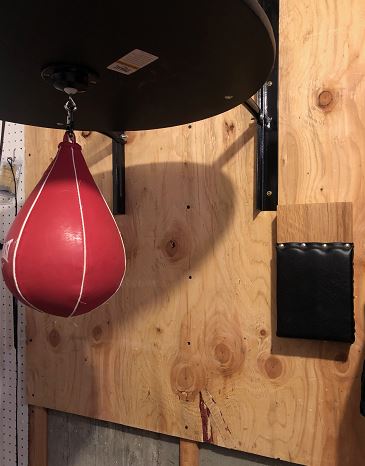
My set up is an Everlast hanging speed bag with a padded makiwara to do broken rhythm half-beat strikes.
And when you feel comfortable with basic punching and combination drills and have incorporated broken rhythm concepts, then see the universals and see how this will help with the finer motor skills required for Panatukan and knife disarms. Work the basics to refine the higher skills:
Virtūs et Honos
 Protective Arts
4 thoughts on “BROKEN RHYTHM”