It is unfortunate that Covid-19 keeps us from training together. Aikido is a partnered art and “social distancing” has made training together impossible. Nevertheless, there are ways to keep your connection to the art.
Okay, I admit to having a soft spot for some not-so-high-brow books. Steve Perry’s (1986) The Man Who Never Missed is just a fun read. A memorable fiction from this book is Sumito, the art of the 97 Steps. Sumito is a martial art whose training method is essentially an Arthur Murray dance step diagram

Just walk the 97 steps and you have mastered the art. Of course it isn’t that simple; to get from step A to B is easy, but C is challenging, and getting to D and beyond is exponentially more difficult and there are no explicit instructions on how to do it.
A marvelous fiction leading to being a bad-ass martial artist. But notice the deeper lesson – it’s predicated entirely on self-mastery. There are no partners, training devices, gimmicks, DVDs or other explicit instructions.
And the simple truth is that all martial arts are foremost a means of self-mastery.
So, what better time to work deeply on self-mastery than when you are forced to be alone?
The question becomes, in the context of Aikido, how?
Develop your base.
Funekogi Undo, the ‘rowing exercise,’ is a great warm-up and when done mindfully should teach you much about your body.
Funekogi Undo is adopted from Misogi 禊 (ritual purification) and importantly incorporates breathing patterns. As you perform the action: in through the nose, out through the mouth. Be sure your feet remain rooted as you shift your body forward and back. The action from your arms needs to have relaxed shoulders to ensure freedom of movement. Watch carefully how O’Sensei demonstrates the double-punch and grab return. Like most warm ups in every martial art – they are not simple ‘stretches’ or ‘calisthenics’ but rather essential movements necessary to execute techniques effectively.
With this exercise, your connection through your feet to the earth should provide a good sense of rooted stability. The flexibility and range of motion on a line (forward and back) are increased. Your breathing is ‘harmonizing’ with your movement and regulated by the kiai. More explicitly, the lesson is to learn to breathe like a fighter. Take this lesson from boxing.
Then add changes in direction.
Shiho– and Happo Undo are patterns to follow that develop tai-sabaki (foot work). If you have done weapons, Shiho– and Happo-Undo are exactly the same as Shihogiri and Happogiri, just without a sword.
The essential lessons are (1) complete each motion fully, (2) sequentially, and (3) each of the directions is nothing more than an entry on a line. Diagram the footwork vectors and you have traced the cutting rose.
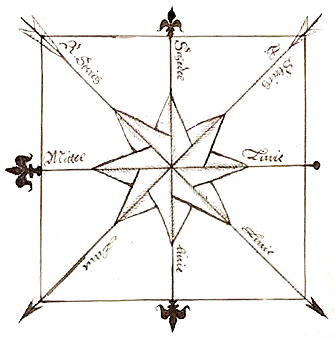
You need to unify the lower and upper body to benefit from this exercise. Add the weapon to build some strength and provide a feedback to your shoulders. As you advance your feet, your hands should proceed (hand, body, foot!) from your waist to your head – chudan to shodan – as if your feet are pushing your hands. Don’t lift your arms from the shoulders! The shoulders are relaxed, simple ball joints that allow your fundament (hara) to impel your hands (weapon) forward and up. Focus on completing each motion to its fullest range. Do what you are doing to completion, do not move to the next direction prematurely.
As simple as these solo exercises may seem, listen to your body. Done correctly, you are learning efficient linear motion. As a swordsman, the weapon should be an extension of your body. But because the sword has mass and only one live edge, its construction dictates the linear pattern you are tracing. Focus on relaxed shoulders to ensure the sword is free to move unhindered by muscular tension. A sword’s efficacy is its speed, not the force by which you push it through space. It is not a club and neither are your arms!
And this too is a critical body skill that leads to a technique – ikkyo omote. It is this self-guided practice that will challenge you to understand the material. The process of trying to recall and practice the material will force you to analyze it. You will not have anyone to follow, so you must use your memory and critical thinking skills.
To maximize the benefit from solo training, you need to develop your mental image of what the movements should be. With a clearer image, you will be able to replicate the movement more accurately. Add repetition, and you will get ahead. Rather than spending more precious class time on repetition for coordination, you can return to class, ready to move forward, with the skills you developed at home.
Virtūs et Honos
_____________________________
Added bonus if you have a training ring is provided by Master Keating
 Protective Arts
2 thoughts on “ISOLATION AND HOW TO TRAIN”