The rapier’s evolution moved to a shorter blade circa the late 17th century and increased in popularity to become the court sword (épée de cour), dress sword, or small sword.
Domenico Angelo Malevolti Tremamondo (1717-1802), began his study of the sword in Italy under Andrea Gianfaldoni, and then in France under Teillagory, where he completed his apprenticeship. He then moved to England and established a school in London around 1759. Domenico was accomplished in both fencing and riding and had achieved several notable fencing victories before he was employed to teach various high-status clients, including the Prince of Wales (future King George III) and the Duke of York.
In 1763 he published L’Ecole d’armes, avec l’explication Générale des Principales Attitudes et Positions Concernant l’Escrime. The first edition of the English translation, The School of Fencing, was published in 1765. It is thought that Domenico was assisted in translating the text by his friend the Chevalier d’Eon.[1] The first edition is beautifully illustrated in color.
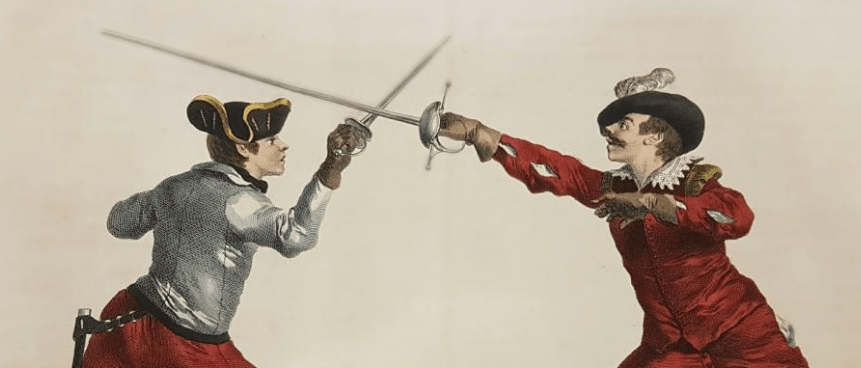
The manual of arms for the court sword is the basis (through the colichemarde) for modern épée sport fencing. Although Domenico started in the Italian tradition, the use of the small sword is largely associated with the French tradition and continues the emphasis on the use of the point and diminished use of the cut and edge.
The transition from the rapier (which had military applications and use) to the small sword shows a move to the civilian need for a smaller, lighter weapon primarily used in dueling for honor, and usually to first blood only.
With that context, Domenico advised “…in single combat, the hollow blade is preferable, because of its lightness, and ease in the handling.” And furthermore, the swordsman should “proportion his sword to his height and strength, and the length of the sword ought not to exceed thirty-eight inches from pommel to point.”
_____________
The Cold Steel Small Sword was made with Domenico Angelo’s advice in mind.
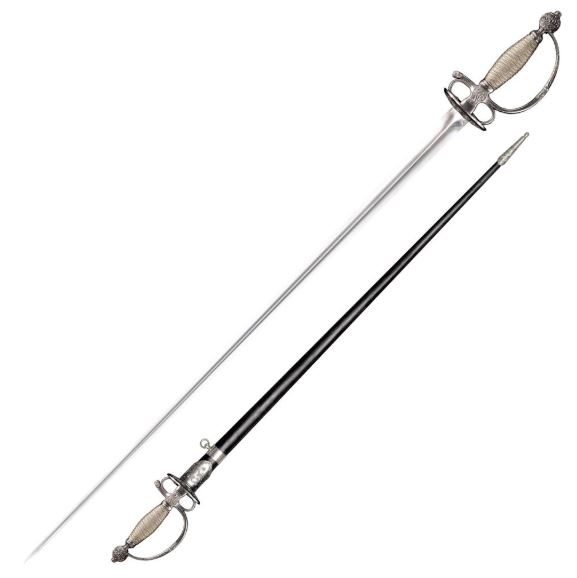
Made with historical accuracy and functionality, it has a stiff, lightweight blade forged with a triangular cross section, and a functional hilt, consisting of an elliptical plate, or two shells and a knuckle guard. Cold Steel’s modern version uses 1060 carbon steel, heat treated to a tough spring temper. The hilt features two shells with functional finger loops and a light, but exceptionally strong, knuckle guard. It comes with an attractive leather scabbard with an intricately decorated throat and chape.
_____________
Because of the legacy of the rapier, Domenico had to remind his reader that the longer sword is not always advantageous, “for if a determined adversary artfully gets the feeble (foible) of your blade, and closes it well” you would not be able to disengage your point.
Domenico’s sequence of plates follow from the draw from the sheath and he warns his reader to pay attention to the gaze – never take your eyes off your opponent. And then to the stance – “the whole body may be in profile; which instruction cannot be too closely attended to.” The advice is sound – and will be familiar from Capo Ferro.
The discussion of guards follows, and he defines five; Prime, Seconde, Tierce, Carte, and Quinte. But he advises, “The Guard in carte is the most advantageous, and the most elegant position in Fencing.”
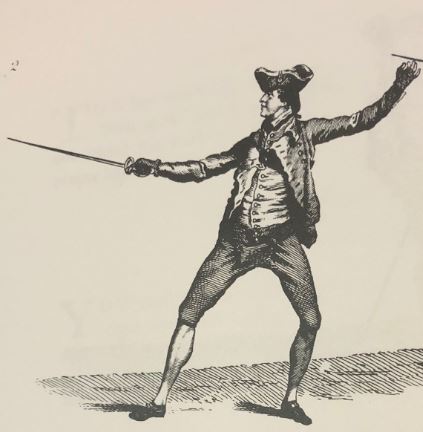
He then outlines the possible entries – “inside, outside, and low parts of both these.”
Next the advice on distance – which is similar to the advice from Capo Ferro – but he refines the language of the advance and retreat. The attention to footwork is like modern sport fencing: “To get within distance of your adversary without altering the regular position of your Guard, you must raise your right foot just above the ground, and carry it about a foot forward, in a straight line with your left heel, bending your knee a little, and at the setting down of the foot, you must follow with the left leg in the same manner and distance, keeping your left leg well bent, to support the body entirely on that side.” To retreat, the process is reversed with the left foot leading.
Because the small sword has no edge, the presentation of attacks is comprised entirely of variations on thrusts from each of the guards and counter thrusts.
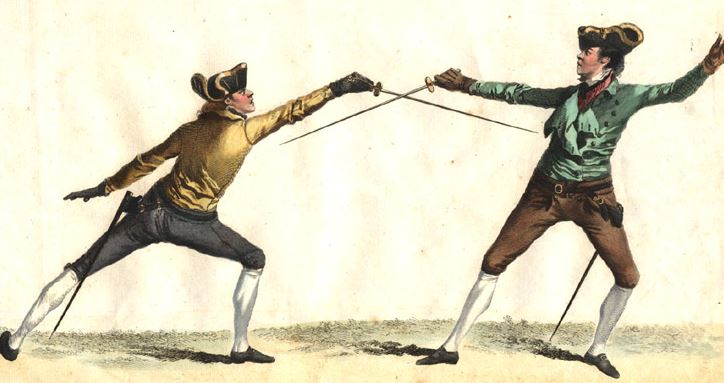
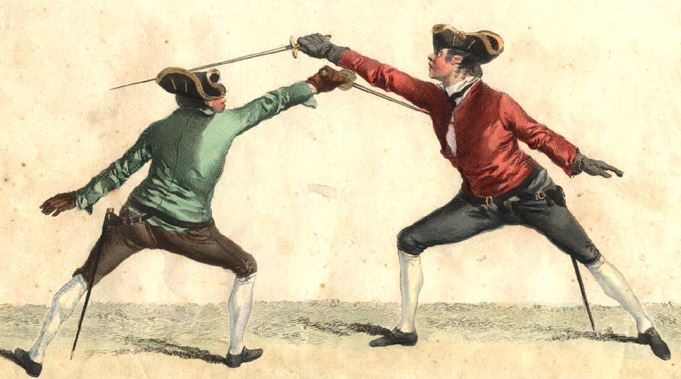
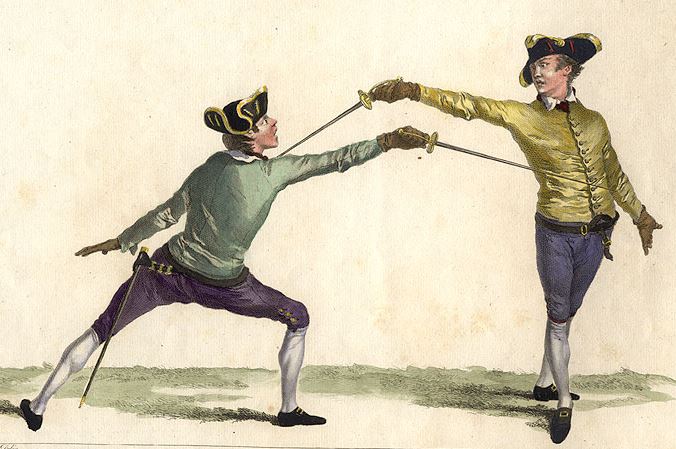
His technical review of each encounter is worth reading for its clarity.
Of note are the variations of wraps, traps, and disarms that will be familiar to FMA practitioners.[2]

Domenico presents the traps and disarms, but concludes with sober advice:
In my opinion, all those disarms which I have explained, are more brilliant and fine in a fencing-school, with a foil in hand, when very well executed, with the utmost precision and judgement, than they are useful sword in hand; nevertheless, they may be made use of against those who abandon their bodies after they thrust, and who do not recover with the quickness and care which is necessary. Sword in hand, I prefer the bindings and crossings of the blade, or the smart dry beat with the forte on the feeble of the adversary; by all these you run no risk; for if you dont beat the sword out of hand, you will always get opening thereby to throw in a thrust if you design it.
Dexterous disarms are possible, especially against a lesser opponent, but when your life is at stake, the safe route is to parry-riposte.
He provides sensible observations on left handed opponents:
It often happens that the right handed fencer is much embarrassed in defending himself against a left handed one, occasioned by the constant habit of fencing always with right handed fencers, which gives the left handed fencer a considerable advantage. You seldom have occasion to fence with a left handed man…
And practical advice:
To obviate this inconveniency, I am of the opinion, that a fencing master should accustom his scholars to fence with both hands.
Bilateral development.
Domenico then describes adjustments necessary when crossing swords with other Continential forms; German guard, Italian guard, Italian with sword and dagger, and Spanish. Interestingly, he asserts, “The dagger is never made use of in Paris” but much used in Italy, and “Naples is the city where these are most commonly used, and with most dexterity.”
A native of and originally schooled in Italy, Domenico asserts, “the superior talents of the French fencing masters; and, according to the knowledge which I have acquired, I believe them to be the best in the world…” In addition, he notes, that the minimum training to become a master was a six-year apprenticeship under one master followed with, a “public reception of a fencing master; when an usher has finished his apprenticeship under and able master, and is presented to the public to be received as a master, he is obliged to fence with several masters.” You have to prove to the public your abilities to be recognized.
And to prevail against several masters, a prospective entry into their ranks would need to know how to defend against all styles, including highwaymen:
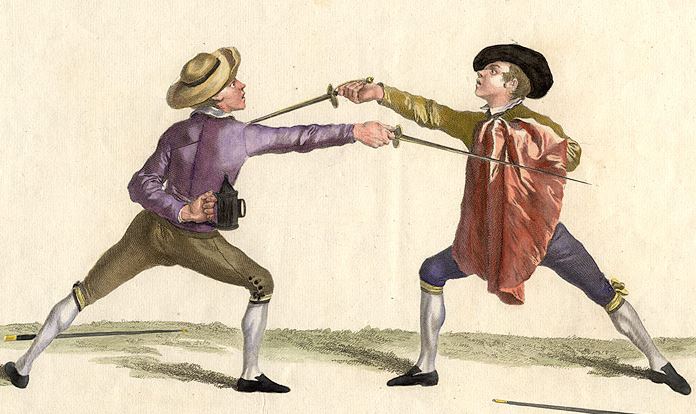
The use of heavy cloaks or coats to protect the “live” hand was common, and the use of a lantern to blind and parry acknowledges newer technology. Think the defensive use of flashlights.
The culminating chapter is a brief description on how to address a broadsword (and cut and thrust sword). The advice is terse and can be summed: “… you must resolve to close in, covering yourself as much as possible with your sword and the lap of your coat, and deliver your thrust where you see an opening to hit him.”
The images above are representative and taken from early editions. The more readily available version (although out of print) of The School of Fencing by Jared Kirby has plates in black and white.
Next up, Domineco’s grandson: Henry Charles Angelo.
______________
[1] The Chevalier d’Eon deserves to be better known.

Charismatic and talented, the Chevalier d’Eon inspired the production and circulation of printed images that celebrated that he lived openly as a man and as a woman at various stages in his life.
The Chevalier was born on 5 October 1728 to a minor aristocratic family in Burgundy. Smart and articulate, d’Eon served as a Captain in the French Dragoons and worked as a spy and diplomat for King Louis XV. He was sent to England as spy for the French court, but scandalously fell out of favor for having published an 18th century tell-all of his diplomatic dispatches. The publication made him a celebrity in England where he remained in political exile. By 1771, London bookies had begun to take bets on d’Eon’s gender as the public debate raged on. From late 1777 on the Chevalier began to permanently present as a woman.
Famous Impostors is a good introduction to the Chevalier. The book is public domain and is a fun read on famous hoaxes from Dracula author Bram Stoker as he covers cross-dressers, magicians, and concludes with the Bisley Boy conspiracy theory alleging that Queen Elizabeth I actually died at the age of 10 and was replaced by a young boy who bore a remarkable resemblance to the queen.
[2] Snake and vine disarms – remember the small sword had no live edge so the similarity to escrima and stick disarms are all directly applicable. These lessons from Master Lenderman:
 Protective Arts
3 thoughts on “DOMENICO ANGELO – small sword”