James Fenimore Cooper’s Leatherstocking Tales (1823-1841) is a five-part series comprised of The Deerslayer, The Last of the Mohicans, The Pathfinder, The Pioneers, and The Praire. (Mark Twain has a nicely acerbic essay on Cooper’s literary offenses.)
In the Last of the Mohicans (1992) movie, Col. Munro’s younger daughter Alice, grows weary on the escorted ride to Ft. William Henry, and as she lists in her saddle, notices a mountain lion in the bushes. She is the only one in the party who does.
I have been doing some trail hiking to replace the aerobic conditioning I would normally get from training. Because I was on a health-motivated hike, it was a forced march. So naturally, my thoughts drifted to Roman legionnaires and then flitted to Alice in that scene from the movie, reminding me that I need to see the beauty I am surrounded by and not just exercise in it.
After briefly musing on nature’s wonders, my mind wandered back to the movie and the fight scene in the woods. Mugua (played by the brilliant Wes Studi) initiates the surprise attack on the British column by the Huron raiding party. The disciplined British try a battlefield musket volley rendered entirely ineffectual by the dense forest, and the Huron close the gap with tomahawks to make short shrift of the British.
So many valuable lessons to consider! Make sure your techniques are adapted to the environment. The British were conditioned to open field combat – a continuation of the Western Way of War – seeking the decisive encounter. The Huron, by contrast, knew how to use cover, concealment and ambush. (These techniques are adopted by the Colonials and best exemplified by Roger’s Rangers during the Revolutionary War.) The Huron also use a tomahawk – an indigenous weapon that was co-opted by Colonists who copied the stone original to make metal variants. A tomahawk is a pragmatic frontier tool, able to chop small trees, hammer nails, as well as a highly effective close quarter weapon.
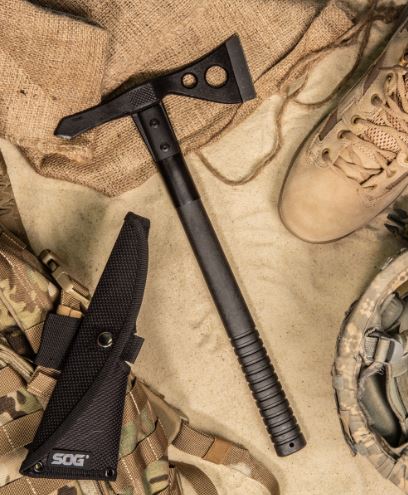
The featured image is from SOG, which replaces a hammer with a spike; a combat variant modeled after those carried by soldiers in Vietnam. There are many excellent versions available in the market to consider.
A tomahawk has multiple active surfaces and its longer handle and heavy head provide opportunities but also require technical adjustments. Mark Hatmaker shows the basic punch – notice the witik strike – and pay attention to the point of aim:
(Mark Hatmaker also has >these< additional observations on early American adaptations.)
Basic strikes start with the standard angles:
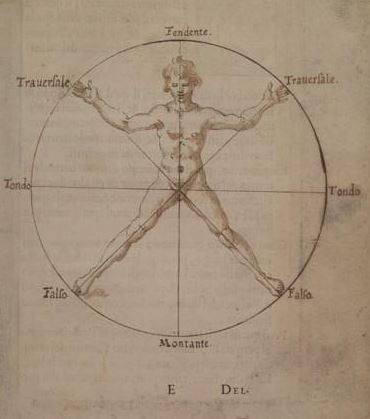
Peter Weckauf (SAMI Combat Systems) demonstrates the basics.
Doug Marcadia presents the tomahawk with a distinct FMA influence: because the head of the tomahawk has multiple planes of engagement, notice the improved hooks and traps that are possible. The handle (punyo) is also a passing, striking, and trapping device.
Integrating a tomahawk as a primary or secondary weapon in an FMA weave, a sinawali pattern expands the possible disarms.
The tomahawk is a great American weapon and a great way to augment the other classic American weapon, the Bowie.
Virtūs et Honos
 Protective Arts
One thought on “TOMAHAWK”