This article is a revisit and amplification of an earlier post: Ikkyo is Makiotoshi.
Makiotoshi is a capture followed with an oblique downward return along the line of attack to uke’s centerline. Essentially, the mechanics of the movement is a two-handed intercept while closing the gap to capture the attack, then the use of superior leverage and time to control the attacker.
Ikkyo as a functional technique has to close the gap in advance time to control the opponent’s triceps and forestall the attack: it is a JKD stop-hit.
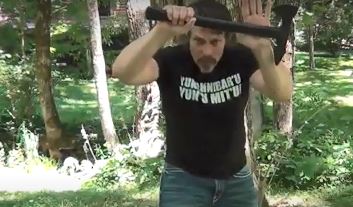
A comparison with combative cognates provides a better understanding of the range of potential in the movement pattern. At first blush, the movement pattern may not seem familiar, but look closely at Mark Hatmaker’s Lumberjack Jam:
There are superficial differences to be sure: Hatmaker drops to an athletic stance, makes a more compelling drive into the opponent and torques his body more than Aikido, but the essential movements are ikkyo. And because the tools are different, so are the specifics of the movements – the tomahawk ends with a raking draw as an attack, whereas Aikido is a defensive disarm of a swordsman – but the mechanics are the same.
Look at the potential of your movement patterns to move beyond the obscuring veil of techniques.
Virtūs et Honos
 Protective Arts
One thought on “IKKYO’S BUNKAI”