Restricted airways and ventilators are all too much in the public discourse because of Covid, and “I can’t breathe” is a sad social commentary on restraint techniques. Not being able to breathe is a frightening experience.
As a child I had a bout of croup. I still remember that feeling of suffocation, the abject fear of not being able to do something that until that moment I had never thought about; breathing is a subconscious, reflexive, event. Until it isn’t.
Breath exercises are part of the Aikido warm ups – and the exercises are designed to train the body to breathe while moving. Proper breathing with martial movements is critical for effective technique. But what is “proper” breathing?
I recall one seminar where Chiba sensei had us all practice breathing “naturally.” One student had the courage to ask what the crowd was thinking, “Sensei, what does that mean?” His response, “Like a baby.” Of course that answer implies one knows how a baby breathes, “with the belly.” In general, the pattern is in through the nose, out through the mouth, which is held “like you are holding needles in your mouth.” I still don’t know what that means exactly, but I will never forget the image. Perhaps this is an English translation of an idiom in Japanese that is more clear in the original? But the belly drives the motion of the lungs, not the chest.
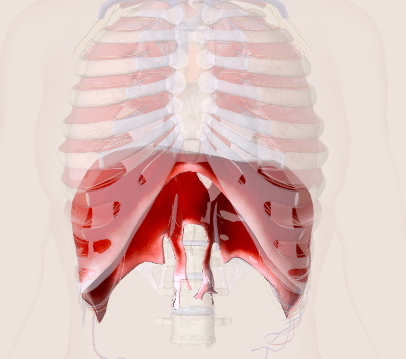
Belly breathing engages the diaphragm, draws the breath to the bottom of the lungs and focuses on the tanren. This is not a medical explanation, but should suffice to illustrate where your concentration is placed and to provide context for the exercises. A few of the key breath-integration exercises are reviewed below:
Funekogi Undo (Rowing Exercise)
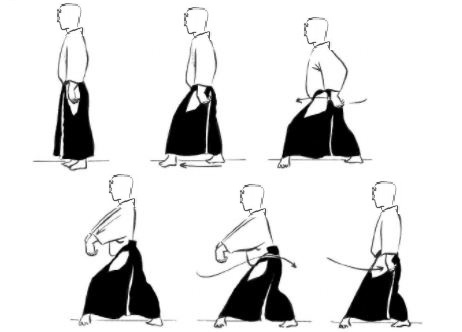
Starting in left hanmi, inhale “eh” while shifting forward and exhale “ho” on the shift back. For the right foot forward, “eh” and “sa” are the vocalizations that force correct breathing.
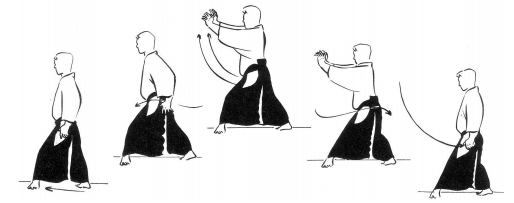
Ikkyo Undo (First Movement – Arm Lift)
Take a half-step forward driven from your hips, bend your forward leg and straightening your back leg, trunk straight and in full balance. With relaxed shoulders, and timed with the advance, swing your arms energetically forward and upward with extended fingers. Stop your arms at eye level. Then retract purposefully: reverse the motion, shift your hips back with your weight shifting primarily to the back leg, which will piston-bend and the front leg will straighten again. Swing your arms back to your sides, following your hip motion, fingers closing into half-fists.
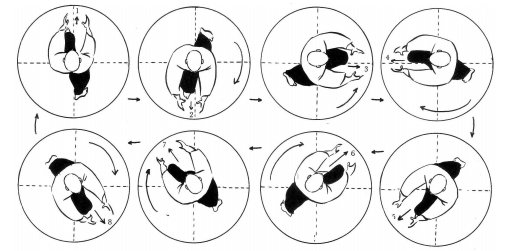
Happo Undo (Eight Direction Exercise)
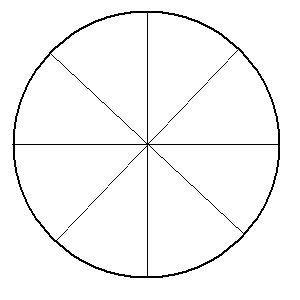
An amplification of the Ikkyo Undo exercise done in each of the four-cardinal directions, then rotated to the secondary four. Each individual direction is an independent action that is completed in full before moving to the next direction.
Tekubi Furi Undo (Hand Shaking Exercise)
Start palm to palm fingers up (prayer entry) and use palm-pressure to drive the arms up the center-line whilst inhaling, feet driving down. At the apex of the movement, raise onto the balls of your feet, heels up, press your breath to the tanren, then split the hands to either side, palm up and lower to shoulder level. Once the arms reach shoulder level, hold your breath momentarily, rotate the palms down and begin lowering both the arms to your center and your heels back to the earth whilst slowly exhaling, timed so that you empty your lungs fully as your hands come together at the bottom.
Once you have completed a few repetitions of the breathing exercise, at the final exhale, then clasp your hands, palm to palm at your waist for the hand-shake. With hands clasped at belt level, squeeze the palms together but keep the shoulders relaxed. Use the pressure of the palms to invigorate a shaking motion through the arms. The breathing component is to coordinate a relaxed deep breathing pattern while simultaneously using dynamic-tension with palm to palm pressure. Learn to feel the juxtaposition of tension vs relaxation in different parts of your body.
After some vigorous shaking, then unclasp the hands and unfold your arms to either side palms up whilst inhaling fully, and bring your hands back to your waist, knuckles together, whilst exhaling: open and close on inverse lines. Repeat for several clearing breaths.
Upon conclusion, then let your arms hang naturally at your sides, no tension in your shoulders. Shake your wrists rapidly to extend through the fingertips.
Zengo Jotai Shincho Undo (Raising to Heaven and Earth)
Stand with your feet shoulder-width apart and parallel to them, swing your arms up and over your head, bending as far back as possible and then as far forward as possible to stretch and open the diaphragm. Inhale through the nose on the upswing and exhale through the mouth as you dive between your outstretched legs.

[Illustrations by Oscar Ratti from Aikido and the Dynamic Sphere.]
_______________
Observations by Master Keating
Speaking of Breath Control and advanced concepts of breathing / IE: Chants, Cadences, Praniyama, Pneuma, Litany, Sutra & even Sleep! Yes, sleep! It was just this week that several sites broke the news about a new (new?) breathing technique that has already helped many insomnia sufferers find relief! So it seems timely that I had just done up my own piece on sound, vibration, breath and the overall control of it. (There are no coincidences amigo). Ok, Here, take a look at it: The breathing technique is called ‘4-7-8’ and is designed to help people calm down. Do you have the discipline to really do it, give it a chance? In Kung Fu, this technique may be seen utilizing the “Jade Well”. A well known technique amongst trained adepts to connect two major meridians. This then makes (completes) a entire ‘circuit’. A free flow of energy that can be used to accomplish many things. I can see how this works. I can say that such knowledge is only as good as the person who owns it is. Lazy man gets lazy man results. Sincere man gets greater results – such is why the term and practice of self discipline is such a big frigging deal in many martial arts and metaphysical paths. Without it, the knowledge is wasted. Pearls before swine. \ > More below to contemplate! “The Internal Martial Arts…such as the various styles of Tai-Chi, Pa-Kua, and Hsing-Yi…advocate placing the tip of the tongue on the roof of the mouth behind the front teeth…and also to keep the upper and lower teeth lightly touching while practicing any Chi-Kung/Qi-Gong method. Such placement of the tongue (jade well) and the teeth allows the intrinsic energy (chi/qi) which rises in the front and back centerline meridian channels to communicate with one another at their end points inside the mouth. The rear centerline channel (Governing Vessel/Tu-Mai) has its last energy point on the gumline of the upper jaw between the upper two front teeth. The chi energy in this line rises upward more easily than it can descend…and often has difficulty to rise as well. The front centerline channel (Conception Vessel/Jen-Mai) has its last energy point on the gumline of the lower jaw between the lower two front teeth. The chi energy in this line is usually capable of both ascending and descending with equal ease. Thus…when the upper and lower teeth are lightly touching and the tongue is properly placed….any energy which ascends in the back centerline channel to its last point on the upper gumline will be able to ‘communicate’ with and ‘connect’ to the energy which ascends in the front centerline channel to its last point on the lower gumline by way of the ‘energy bridge’ of the tongue and teeth. Then…when the energy of the front centerline Conception Vessel Channel descends and sinks back down to the perineum space below and behind the genitals…it will pull the chi from the rear Governing Vessel Channel through the mouth to descend to the perineum as well. This is called the Small Circle of Heaven….rising upward through the front and back centerline channels simultaneously…then both descending through the front centerline to the perineum again. This is a completed electromagnetic energy circuit which has to be fully functional in order to achieve the full benefits and skills of any good chi-kung/qi-gong practice.”
_____________
Delve Deeper
Stimulate your vagus nerve with breathing techniques
Deep regular breathing – even Harvard Business Review extols the benefits
James Nestor webpage – lessons from free-diving and the recognition that breathing is not simply getting oxygen into the lungs.
James Nestor interview with AOM
James Nestor New York Times, July 18, 2020
Crooked teeth and sleep apnea resulting from skull development – which are progressively smaller: even from only a few hundred years ago? Worth deeper investigation.
Revisit Human Frailty
Revisit Kiai
Revisit Isolation and How to Train
_______________

As of mid-September 2020, this post became ironic. The air quality has become the worst in the world because of smoke from the forest fires – exacerbated by strong easterly winds.
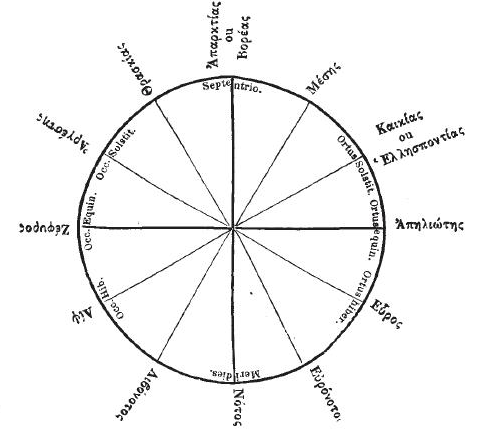
Anemoi (Gk. Ἄνεμοι, “Winds”). Of the four winds, the East wind, Eurus, has no place of prominence because it is not associated with the three seasons of ancient Greece. The Bible, however, associated the east wind with maleficence – and that has certainly been the case in Oregon of late, especially the correlation with scorching and fire:
Genesis 41:6, Then behold, seven ears, thin and scorched by the east wind, sprouted up after them.
Genesis 41:27, The seven lean and ugly cows that came up after them are seven years, and the seven thin ears scorched by the east wind will be seven years of famine.
Jonah 4:8, When the sun came up God appointed a scorching east wind, and the sun beat down on Jonah’s head so that he became faint and begged with all his soul to die, saying, “Death is better to me than life.”
Time to reconsider Strategic Relocation…
 Protective Arts
One thought on “BREATHING”