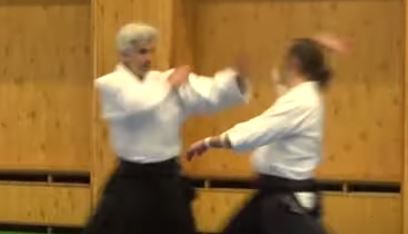
Cross-training is learning techniques from a different art or style to augment your understanding of the primary art you study.
Done poorly, cross-training leads to confusion – a hybrid system that misses the fundamentals of all – and that is all too easy to do.
Done properly, cross-training is a catalyst for clarity – breaking paradigmatic blocks and anal glaucoma.
For years I have struggled to impart yokomen uchi‘s proper form, a simple strike to the side of the opponent’s head (temple/carotid) delivered from the top of your head (jodan) at a sharply acute (less than 30-degree) downward angle.
Should be simple enough, yet it is all-too-common to see it done wrong. Here, an example from Nishio sensei:
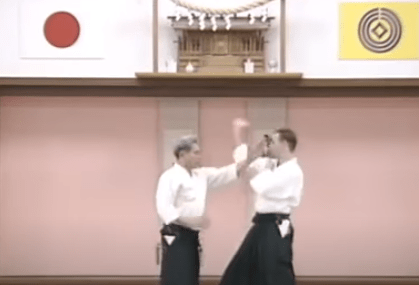
Uke has flaired his elbow and opened his center line – of course Nishio’s intercepting fist hits first. Uke invited the strike to the face with his piss-poor attack.
This bad example (more egregious because uke lists to the side) from a seminar with Bruno Gonzalez:
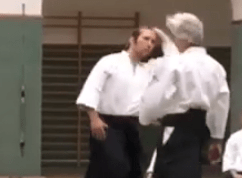
Alas, even Tissier sensei’s videos reinforce an image of a poor yokomen delivery.
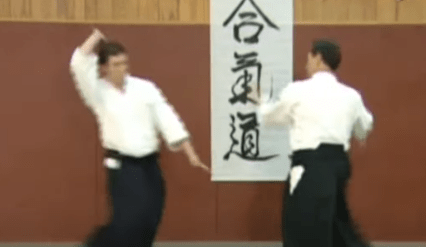
And these examples are from instructors whom I admire greatly!
Because Aikido is nage-centric, it emphasizes the response to an attack and minimizes the importance of first delivering the attack effectively – which is the very premise of the art! One cannot “blend” or “harmonize” with an ineffective strike because there is nothing, no committed energy, to use against the attacker.
As an artifact of training, Aikido has the unfortunate habit of teaching yokomen as a ki-no-nagare (continuous flow) which often results in a circular path for both nage and uke. Uke thus develops a conditioned habit of striking wide and oblique in order to better carry the momentum along the circumference of the circle. Training reinforcing a bad habit born out of convention.
As I have mentioned in a prior post, Shibata sensei delivered the moment of clarity to me when I had the frightening pleasure of training with him at a seminar. He was on the mat training while Yamada sensei was leading the class. I had jumped at him and thus had him as my partner. Shibata sensei’s yokomen came sharp and fast – nothing like what I was used to – the speed wasn’t just his vigor, but also the angle of approach. Little telegraphing action, no wind-up, just attack! The “aha” realization that yokomen was a very effective attack and the sobering realization that mine was not. I had been delivering the strike incorrectly as a convenience to nage. Shibata sensei was not about to convenience me – or any one else.
If the form of attack is patently simple, the key question becomes, how do we teach the attack correctly?
Mulligan sensei imparted a lesson he took from iaido, which is: while holding towels under your armpits,you must raise the sword jodan and it must reach the apex without the towels falling: the armpits must not be opened, nor are the elbows allowed to flair. A good image and exercise, but this two-handed lesson that does not translate well to the one-handed variant.
The next cross-training tip is from Coach Tony Blauer – his “magic wall” drill – an amazingly simple, yet highly effective conditioning method. Simply line your shoulder perpendicular to a wall, touch the base of it with your foot. From that “impinged” starting point strike yokomen. The beauty of the drill is that you will have immediate feedback – both negative and positive – to reinforce your body mechanics. It will be impossible to deliver the strike incorrectly from that position. Done properly, your strike will start by raising your hand up your center-line to jodan, then briskly angled to the opponent who is directly in front of you. Done improperly, you will bash your elbow against the wall. Brilliantly simple!
I recommend Coach Blauer’s Spear System for other very useful training tips and lessons on neuro-programming to enhance your training and overall efficacity.
Virtūs et Honos
 Protective Arts