
The feature image – used on the Resources page – doesn’t begin to capture the size of the library Borges imagined in his short story The Library of Babel, a library with unimaginable mathematics.
What would the card catalog system for such a physical library be like? The Central Social Institute of Prague (1937) offers insights. It housed the world’s largest vertical file cabinet containing 3,000 drawers (each ten foot long) stacked floor to ceiling across 4,000 square feet. Elevator operated desks allowed clerks to ascend or descend, glide left or right, to reach the desired drawer.


Baroque architecture seems fitting to augment Borges’ mathematical complexity:
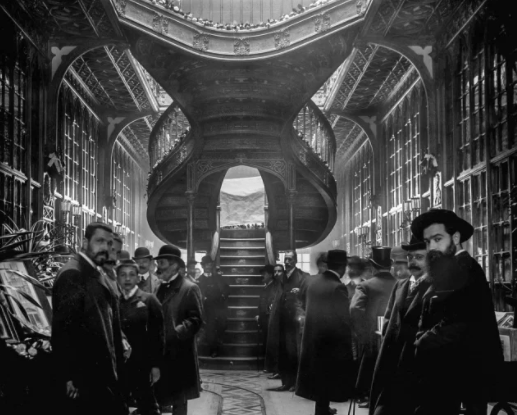
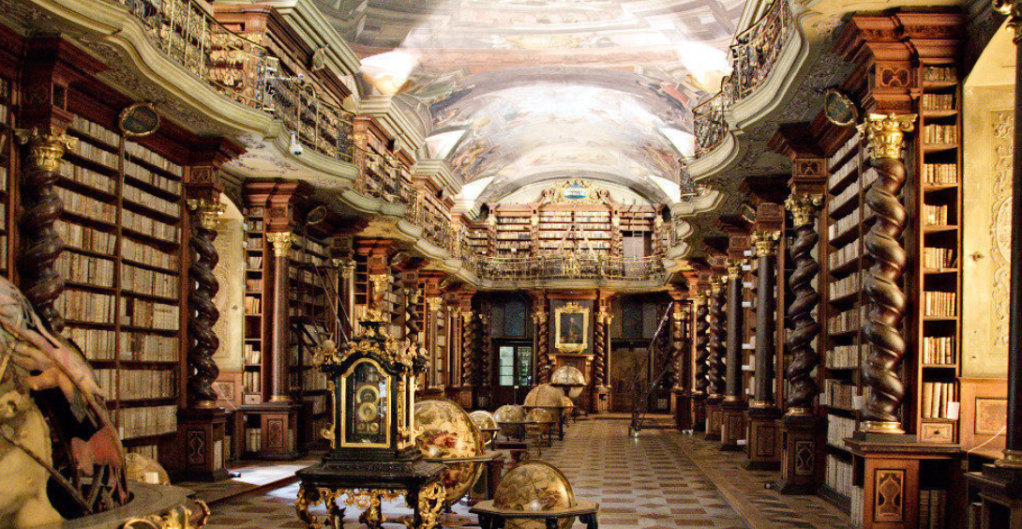

Closer to home is Harvard’s Widener Library which has a great virtual tour.
While I will always prefer a physical library and believe books are still the most durable and proven medium for preserving information, the internet remains a marvel of access and interconnection. The hyperlink allows a single post to achieve massive intertextuality. The challenge is that the amount of information can be overwhelming even as it inspires.
Why libraries? The following from Umberto Eco: “Let us start with an Egyptian story, even though one told by a Greek. According to Plato in Phaedrus when Hermes, or Theut, the alleged inventor of writing, presented his invention to the Pharaoh Thamus, the Pharaoh praised such an unheard of technique supposed to allow human beings to remember what they would otherwise forget. But Thamus was not completely happy. “My skillful Theut,” he said, “memory is a great gift that ought to be kept alive by continuous training. With your invention people will no longer be obliged to train their memory. They will remember things not because of an internal effort, but by mere virtue of an external device.” … Plato’s text is ironical, naturally. Plato was writing down his argument against writing. But he was also pretending that his discourse was told by Socrates, who did not write (since he did not publish, he perished in the course of the academic fight.) … Books challenge and improve memory; they do not narcotize it. However, the Pharaoh was instantiating an eternal fear: the fear that a new technological achievement could kill something that we consider precious and fruitful.”
Libraries contain the compounding knowledge hard-won by our forebears.
 Protective Arts