
Josh Gold is doing a yeoman’s job at keeping Aikido Journal (AJ) both timely and relevant (including an article by our own Mulligan Sensei). Nevertheless, the devaluation of Aikido’s currency is pronounced and continuing.
The 2019 (pre-Covid) results of a AJ survey show that the typical Aikidoist is older (81% > 40 years), white, male, and has been training for more than 20 years. This is an insular audience, talking to itself, and quickly aging out of martial relevance. (And to be clear, that description fits me.)
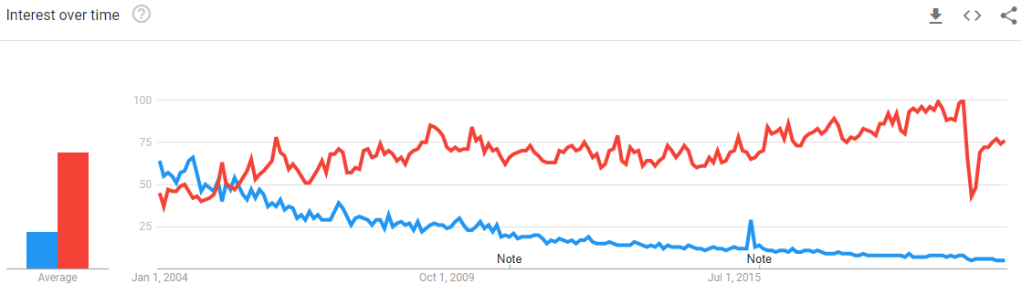
The AJ article used a Google trends graph to show the 93% decline in interest in Aikido as a search parameter – representing the decline in interest in the art. I can think of several challenges in using Google trends, but this is probably the most robust and readily available data set.[1] The decline is sharp, but the more critical question is, a decline in interest relative to what?
In Selling Aikido, I proffered some ideas on the challenges of marketing Aikido to the key demographic (young, active males) and pointed to BJJ and MMA as key competitors. Google trends corroborates my thesis. The graph comparing the decline in Aikido against the rise in interest in BJJ is telling:
Then there is the comparison against MMA:
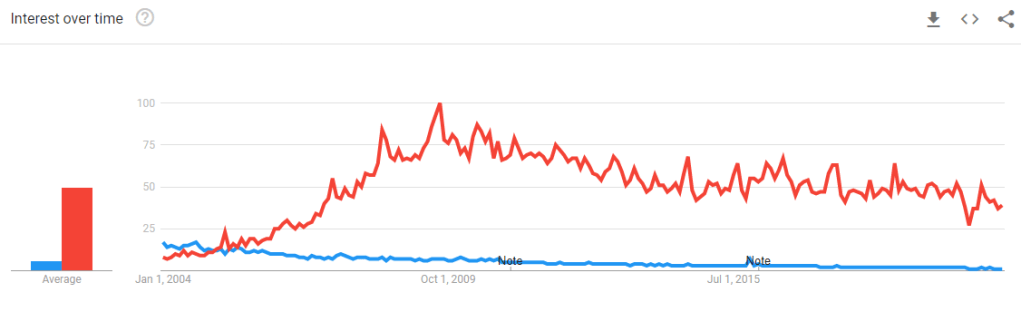
Look closely at the scale – the relative popularity of Aikido is negligible compared to MMA.
Scale BJJ against MMA and its dominance is pronounced again:
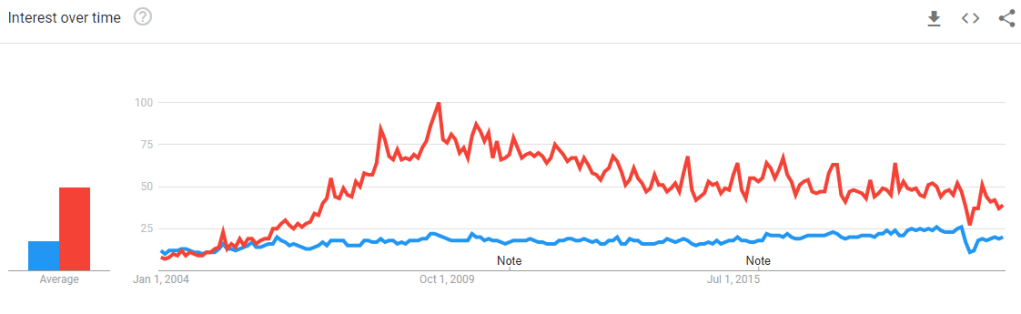
It is clear that Mixed Martial Arts is where the interest – and demonstrably – all the younger potential students migrated.
Those data set comparisons were all specific to the USA. Looking worldwide, the story is similar and not terribly encouraging. The global interest in martial arts has been on a steady decline.
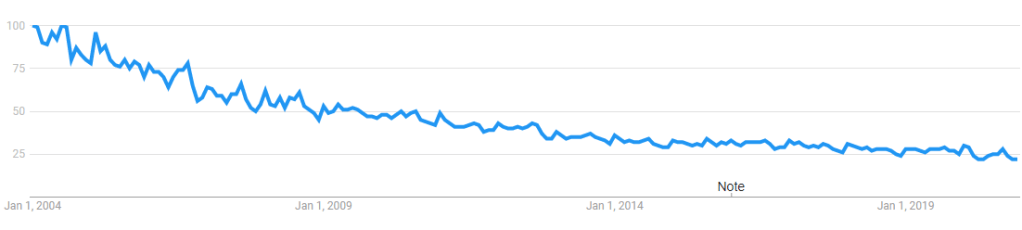
Add Aikido to scale against the overall interest in martial arts:

The general decline in interest in the Martial Arts and the decline in interest in Aikido appear in lock-step worldwide.
MMA remained an outlier with a peak rise in late 2009 and early 2010, but it too appears to suffer a steady decline thereafter.
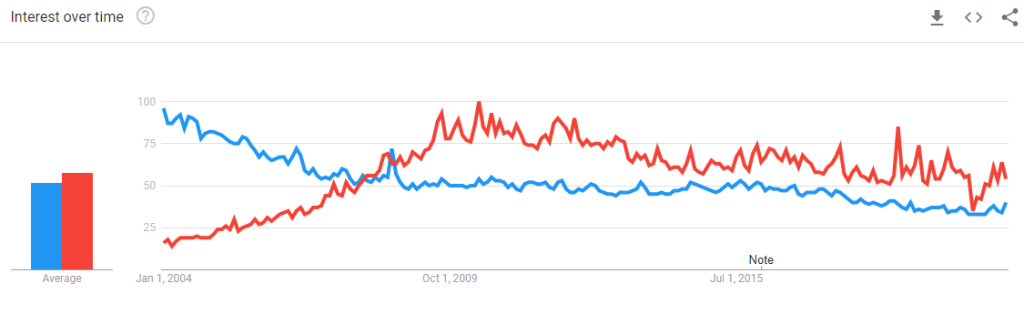
Nevertheless, worldwide, the interest level is pronouncedly weighted in favor of Mixed Martial Arts.
A layered comparison against the more familiar arts of Karate and Taekwondo and Aikido shows:
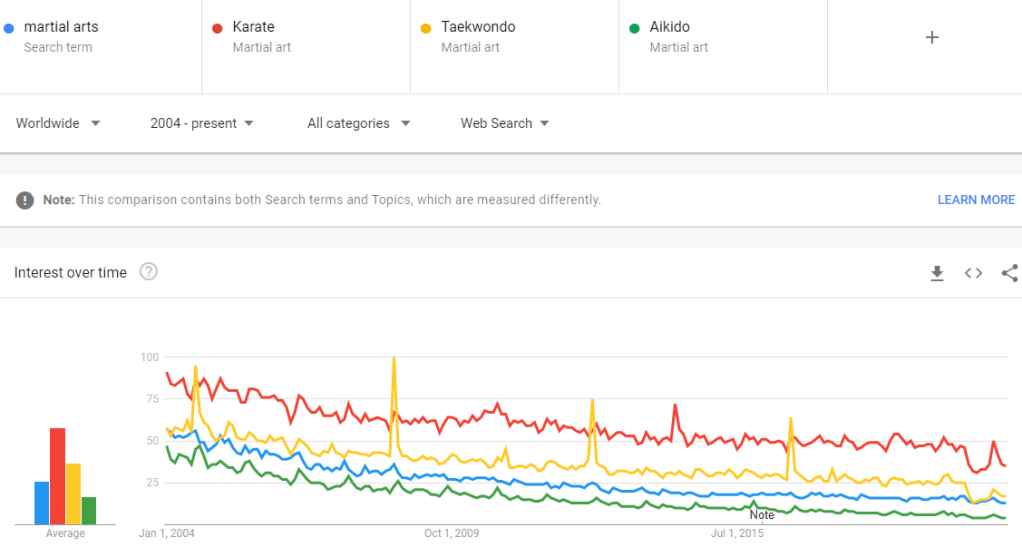
TKD has an annual spike each August, I assume with some international competition, but visually remove that noise and all the traditional martial arts show the same linked decline. But add MMA to the comparison:
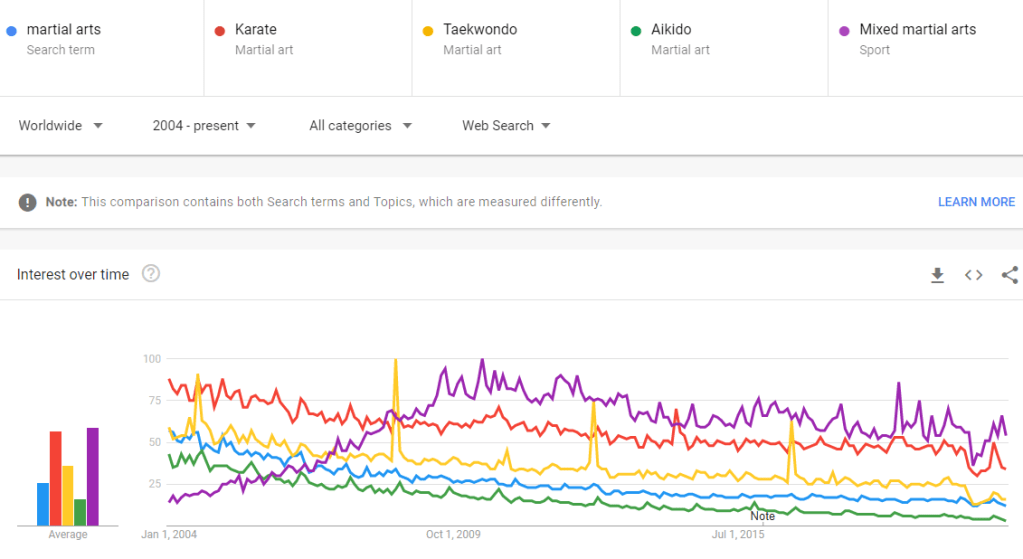
And we have a clear winner in the martial arts world: MMA.
These simple search graphs are probably a good proxy for participation rates absent any hard data. In the earlier post I used revenue data and contrasted the value of the martial arts market vs. yoga’s sales where yoga dominates. Google trends shows a similar pattern, interest in Yoga dwarfs that in the martial arts:
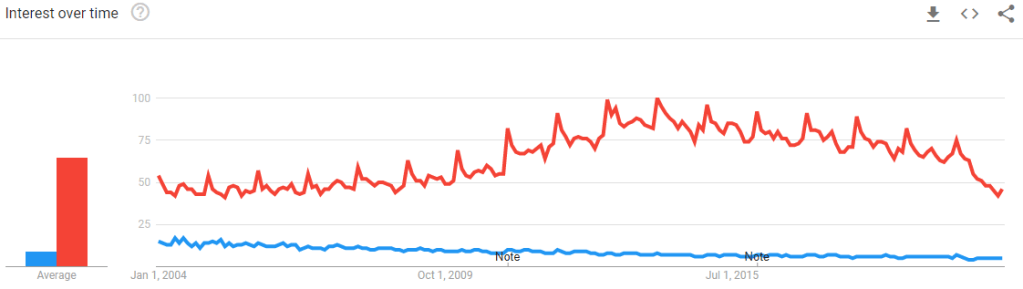
Contrast that interest against any specific martial art and the divergence is similar. The overall currency of martial arts relative to the yoga is de minimis.
Participation rates are difficult to find. Martial arts compete against each other and against the boutique fitness industry in general for its members. A Sports and Fitness Industry Association report summary from 2019 suggests that there are 5.8M practicing martial artists in the USA and of that total 31% are 8th grade or younger. While that is a good market for after-school revenue, I discount that group from the pool of serious martial artists. That leaves 69% of 5.8M available, or 4M practitioners across all martial arts. I am not willing to spend the cash to see how the report breaks down the data. Nevertheless, we can extrapolate from United State census data. If the report data is consistent across the population, the adult participation rate is about 2-percent.
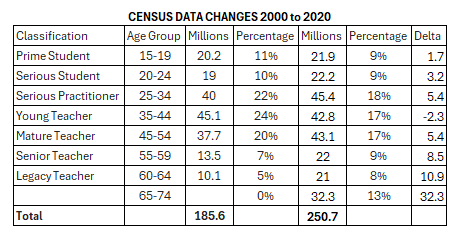
Based solely on my experience and opinions, I categorize the general practitioner along these census age cohorts (USA population data) as follows:
| Classification | Age Group | Millions | Percentage |
| Prime Student | 15-19 | 20.2 | 11% |
| Serious Student | 20-24 | 19.0 | 10% |
| Serious Practitioner | 25-34 | 40.0 | 22% |
| Young Teacher | 35-44 | 45.1 | 24% |
| Mature Teacher | 45-54 | 37.7 | 20% |
| Senior Teacher | 55-59 | 13.5 | 7% |
| Legacy Teacher | 60-64 | 10.1 | 5% |
| Total | 185.6 |
The key group to focus on is between the ages of 15 and 24 which are the years when serious training can take place – when the practitioner is near physical prime and usually before serious family and career limitations. Those are the years to be a Prime and Serious Student. Given the training time required to achieve shodan rank (between 5 and 7 years) that provides the requisite time to create a Serious Practitioner who can progress through the ranks to become a Young, then a Mature Teacher.
Given the potential pool of 4M practitioners in the USA – the table can be expanded:
| Martial Art | Years | ||||
| Classification | Age Group | Millions | Percentage | Population | Training |
| Prime Student | 15-19 | 20.2 | 11% | 435,345 | 0 |
| Serious Student | 20-24 | 19.0 | 10% | 409,483 | 5 |
| Serious Practitioner | 25-34 | 40.0 | 22% | 862,069 | 15 |
| Young Teacher | 35-44 | 45.1 | 24% | 971,983 | 25 |
| Mature Teacher | 45-54 | 37.7 | 20% | 812,500 | 35 |
| Senior Teacher | 55-59 | 13.5 | 7% | 290,948 | 40 |
| Legacy Teacher | 60-64 | 10.1 | 5% | 217,672 | 45 |
| Total | 185.6 | 4,000,000 |
Based on the AJ survey data, Aikido has a participation rate of just 2% below the age of 24, when it should have at least 21% to keep pace with demography. Currently, the art has no pool to develop serious students. And if the average practitioner doesn’t reflect or inspire the target audience … Compounding the issue is that 19% are 65 and older, a group that is a social nicety, but a group that needs be discounted wholesale from a practical perspective: it is a legacy category. Who wants to train with their grandparent? This leaves Aikido in a state of demographic crisis.
_____________
**UPDATE – with the release of 2020 Census Data, the analysis does not improve. I expanded the upper age limit to account for the continued aging of the population and was more generous in raising the upper limit of Legacy Teachers to 74. The net result is to exacerbate the aging problem. And the ensuing years have done nothing to increase the market share of prime students attracted to Aikido relative to the other options available.
_____________
Diagnosing the problem points to a necessary course of action. The goal of every children’s program must be to cultivate Prime Students. The challenge there is participatory burnout – after years of parentally-forced attendance – as this group becomes teenagers they likely will be bored with the curriculum and have better things to do. The ideal target would be a new participant in the 15-19 bracket who could find the curriculum fresh and invigorating. And it is the teacher’s responsibility to make it thus and cultivate an environment where vigorous training is possible. A college program would be ideal but that would have four-year duration unless the student stays local after graduating. Because the average age in the typical dojo is decades older than the target audience, there will be a disparity in endurance and physicality that will make challenging and retaining this athletic cohort difficult.
Of course the largest challenge will be to get them in the front door at all.
________________________________
(1) Caveats. I have not taken any time to dig into the data behind the Google snapshots, but the value and limitations should be clear. First, the data set is limited to those who have access to a computer, the data set starts circa 2004 (past the peak interest in Martial Arts in general I suspect), and the value scale represents only the popularity of the search term: “Numbers represent search interest relative to the highest point on the chart for the given region and time. A value of 100 is the peak popularity for the term. A value of 50 means that the term is half as popular. A score of 0 means there was not enough data for this term.” Hence critical questions remain: What is the total number (n) of unique searches given that adoption and access to computers has continued to expand and importantly, how well does search interest and participation correlate?
 Protective Arts