In July 1950, Hayahi Yoken, a 22-year old novice monk, set fire to Kinkaku-ji, 金閣寺, the Golden Pavilion.
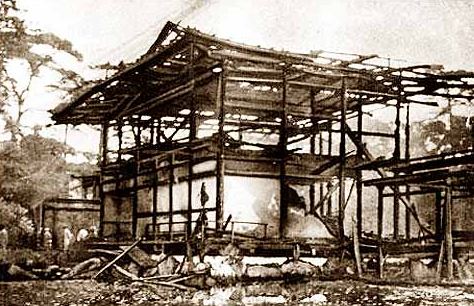
In the smoldering aftermath, Japan confronted the unnerving question: why destroy beauty?
At his trial, Yoken showed no remorse, saying only that his “hatred of all beauty” compelled him. Yukio Mishima seized on this confession for his 1956 novel The Temple of the Golden Pavilion, a meditation on the tension between aesthetic perfection and human frailty.
Okamoto Sensei first introduced me to Mishima. We were discussing literature, I praised Kundera’s irony; she countered with Mishima’s intensity, and handed me a copy of The Temple of the Golden Pavilion. Even in translation, each sentence gleamed. In Japanese, I am told, his prose is pure sculpture. The novel fuses Mishima’s lifelong obsessions: pleasure and pain, beauty and decay, body and spirit.
Who was Yukio Mishima?
Born Hiraoka Kimitake in 1925 to an old samurai family, Mishima was raised almost entirely by his aristocratic grandmother, who forbade him rough play and insisted he speak in feminine language. He came of age during WW2 and was taught, along with the nation, to sacrifice the most beautiful thing they had – their lives – for the emperor. Mishima had always been physically frail, and he failed his military medical exam and did not serve in the war. Frailty haunted him. Rejected by the wartime draft, he turned inward. Then, after a 1952 trip to Greece, outward to the body. Inspired by the statues of antiquity, he began forging himself into one. His training was not vanity but ritual preparation: an aesthetic discipline for a final sacrifice.[1]
Mishima made himself an artwork. He acted in films, modeled, and sought spiritual illumination in India a year before the Beatles. His wit, elegance, and physical perfection drew acolytes. His life itself became a performance piece.
Yet Mishima remained enthralled by the past, dismissing the postwar era as “an age of disgusting frustration.” He was deeply disappointed in Emperor Hirohito for renouncing his claim of divinity because it meant the Japanese soldiers who sacrificed their lives for a god-emperor had died in vain. His ideal, he told a hall of students in 1969 was how the word “emperor” had once “prefaced all intentions” (Mishima: The Last Debate).
For him, beauty was a moral act, and art found its highest expression not in words but in decisive, even violent, action.
“Perfect purity is possible, if you turn your life into a line of poetry written with a splash of blood”
Runaway Horses, 1969
For Mishima, the act outweighed the word. Or perhaps, knowing words too well, he grasped their insufficiency. Beauty had to bleed to be real.
On November 25th, 1970, Mishima led his private militia, the Tatenokai, into Tokyo’s Ichigaya garrison. Their “coup” was more theatre than revolution. Successfully taking the commander hostage, Mishima stepped out onto the balcony to implore the soldiers below to tear up Japan’s pacifist constitution imposed by American occupiers. “If you are samurai, why do you defend a constitution that rejects you?” The soldiers jeered him away. Words had failed him. Firmly rejected, and aged 45, Mishima returned inside to commit seppuku. His designated kaishakunin botched the decapitation so a second had to deliver the final cut.
Mishima died a nationalist’s death but lived, and died, as Nietzsche’s disciple. His seppuku was less a political protest than a work of performance art: an aesthetic consummation. The war and emperor Mishima so passionately supported were already ghosts and he must have known his death would do nothing to resurrect that past. His death was not a restoration of the past but an attempt to arrest decay. Art as last resistance to entropy. He was already five years past his self-defined limit, “When a man reaches 40, he has no chance to die beautifully. No matter how he tries, he will die of decay.”

_________________
“The average age for men in the Bronze Age was 18 and, in the Roman era, 22. Heaven must have been beautiful then. Today it must look dreadful.”
Yukio Mishima [2]
Mishima’s suicide and Nietzsche’s collapse feel to me like twin sacrifices; each consumed by the art they served.
“Another image comes to mind: Nietzsche leaving his hotel in Turin. Seeing a horse and a coachman beating it with a whip, Nietzsche went up to the horse and, before the coachman’s very eyes, put his arms around the horse’s neck and burst into tears.
That took place in 1889, when Nietzsche, too, had removed himself from the world of people. In other words, it was at the time when his mental illness had just erupted. But for that very reason I feel his gesture has broad implications: Nietzsche was trying to apologize to the horse of Descartes. His lunacy (that is, his final break with mankind) began at the very moment he burst into tears over the horse.”
Milan Kundera, The Unbearable Lightness of Being
________________
[1] Mishima wrote The Sound of Waves after visiting Greece, but I suspect a deeper infection – one that mirrored Nietzche’s enduring philological studies – which is explicitly made bare in Sun and Steel (1968) and Mishima’s analysis of the “language of the flesh.”
[2] The case for the exaltation of the young is made in Wordsworth’s “Intimation of Immortality,” with its idea that human beings are born with great wisdom from which life in society weans them slowly but inexorably. Plato promulgated this same idea long before: For him we all had wisdom in the womb, but it was torn from us at the exact point that we came into the world. Rousseau gave it a French twist, arguing that human beings are splendid all-round specimens – noble savages, really – with life out in society turning us mean and loutish, which is another way of saying that the older we are, the worse we get. We are talking about romanticism here, friend, which never favors the mature, let alone the aged.
________________
How Japan’s modern literature came under Nietzsche’s spell
Aug 3, 2019
Wine, dance, frenzied rapture and theatrical performance. These are just some of the characteristics of the god Dionysus, who, in Euripides’ masterpiece play of ancient Greece, “The Bacchae,” arrives in the city of Thebes, determined to exact a terrible vengeance on Pentheus — the ruler of the city and representative of stern rationality and order — for having refused to recognize his ancient divinity.
Partly inspired by the play, the great German philosopher Friedrich Nietzsche crafted his first major work, “The Birth of Tragedy From the Spirit of Music,” arguing that the beauty of art rises not out of mere rationality, but out of the balance between Appoline and Dionysian elements.
After a working life spent producing works that overturned traditional Christian morality and challenging the haughty sense of imperial order of the 19th century, Nietzsche succumbed to mental illness in 1889 after producing his supreme masterpiece, “Thus Spoke Zarathustra.” In his subsequent letters, he frequently signed himself simply as “Dionysus.”
Japan at the turn of the 20th century was like a modern-day Thebes: a state which, 32 years earlier, had, with the Meiji Restoration, embarked on a wholesale program of modernization and rationalization and a casting aside of ancient ways and beliefs. The new Japanese rulers paraded themselves in tailcoats and stiff collars to claim the nation’s place among the great imperial powers.
It was into this unsuspecting world that, like a barefoot Dionysus arriving to wreak unsparing retribution, the radical ideas of Nietzsche made landfall and began ripping to shreds the aspiration for enlightened, “civilized” modernity.
The first ripples of dissent came with the “On An Aesthetic Lifestyle” debate, triggered by literary provocateur Takayama Chogyu, which raged among literary circles in Japan for two years from 1901.
Soon, the entire Japanese literary world began engaging with Nietzsche’s ideas, attracted to his powerful critique of Western culture, his aestheticism and his call to break into the irrational side of the human mind. “This is Oriental,” the greatest literary figure of the day, Natsume Soseki, wrote in English in the margin of his heavily-thumbed copy of “Thus Spoke Zarathustra” at the time he penned “I Am a Cat” in 1905-06.
Soseki attempted in his central novel, “The Gate” (a title taken directly from “Zarathustra”), to link Nietzsche’s embrace of the irrational with Japan’s native traditions of Zen and koan riddles. The potential to reconnect through Nietzsche with many of Japan’s buried age-old customs and mythologies was not lost on a new generation of young writers in Japan for whom Nietzsche represented a vindication of Eastern ways and a door into a world of suppressed sensuality and desire.
Ryunosuke Akutagawa wrote stories like “The Smile of the Gods,” in which the Japanese gods are placed, Dionysus-like, in stark opposition to the Christian God, and in his collection of blackly humorous aphorisms, “Words of a Dwarf,” Akutagawa put to good use his deep love of “Zarathustra.”
When a student, Akutagawa’s great contemporary Junichiro Tanizaki had edited a journal with Tetsuro Watsuji, later to become a leading philosopher and Nietzsche scholar. Tanizaki’s fearless probing into the taboo world of obsessive desire, in works such as “Naomi,” and his overturning of the Meiji Era (1868-1912) “enlightened” thinking with his classic work of 1933, “In Praise of Shadows,” are impossible to comprehend without grasping the intense influence of Nietzsche on Japanese culture in the Taisho (1912-26) and early Showa (1926-89) eras.
By the 1930s, 12 volumes of Nietzsche’s complete works had been translated into Japanese and the lofty rational ideals of the Meiji Era had been replaced with the lure of the macabre, perverse and erotic.
In the mind of a shy, precocious 20-year-old, seething with inner turmoil and frustrations, the discovery in 1945 of “The Birth of Tragedy” was to become a never-to-be-forgotten moment of epiphany and liberation. Yukio Mishima’s bond with Nietzsche was described by Mishima’s father after his son’s death as of an intensity beyond imagination.
Mishima’s probings of the darkest recesses of the human psyche and sexuality in “Confessions of a Mask” (1949) would have been quite impossible without Nietzsche, and just about all the directions that Mishima subsequently took connected to Nietzsche in some form or other. The “Greek fever” that assailed Mishima in the early 1950s, drawing Mishima to visit the ruins of ancient Greece and to explode into voluminous play-writing productivity, was intimately connected with Mishima’s reading of Nietzsche’s “Birth of Tragedy.”
Mishima’s quest for the beautiful and transcendent and his rejection of traditional morality in works such as “The Temple of the Golden Pavilion” (1956) connected him to the Nietzsche-inspired “On An Aesthetic Lifestyle” adherents of the early 20th century. Mishima indeed transferred Nietzsche’s ideas about the “death of God” and applied them to Japan, arguing that Japan itself had suffered the same when the Emperor renounced his divinity in 1946, triggering an existential crisis, which he describes at length in works such as “Kyoko’s House” (1959).
Mishima didn’t just explore the dark irrationality of humanity, he also wished to effect a revival in the Japanese spirit like that produced by “The Birth of Tragedy.” But the curse of Nietzsche — madness — a curse that afflicted Soseki and Akutagawa, began to gently settle over Mishima.
Nietzsche-as-Dionysus had claimed a chilling retribution on the modernizing, enlightening tendencies of modern Japan. Yet to truly understand some of the century’s most iconic works — often thought of as being quintessentially “Japanese” — you have to see them in the context of a long-running “Dionysian” revolution in Japanese literary thought.
________________________
Bodybuilding as sculpture and the preparation for death:
Mishima’s biography – starting with his death:
 Protective Arts
One thought on “KINKAKU-JI”