The esoteric aspects of martial arts training are beyond my expertise. I am a boring rationalist wearing a square hat. But the mysteries of martial arts run deep. I have seen masters perform minor miracles so – skeptic that I am – my mind remains open to the potential.
Kuji-in is not directly within the Aikido tradition, but it is an important part of classical Japanese martial arts. With Covid still preventing hands-on training, I offer this as a primer that may foster solo practice and a meditative tradition.
Katori Shinto-ryu: The Warrior Tradition (Otake, Risuke 2007) covers Kuji-in as part of the inner-teaching of Heiho, the art of war.
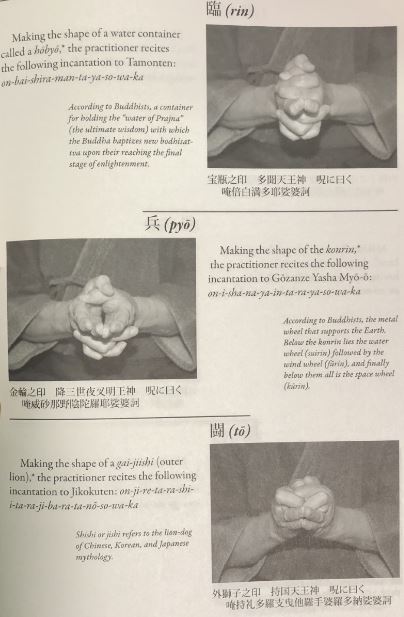
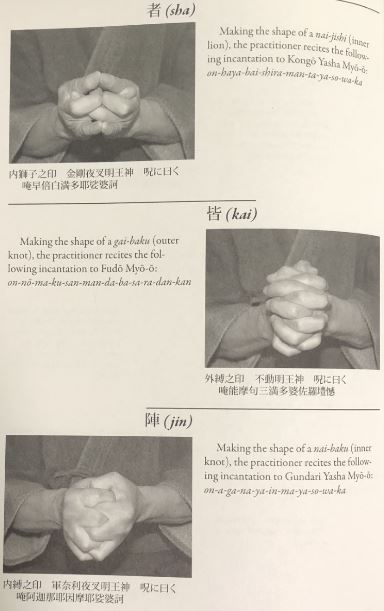
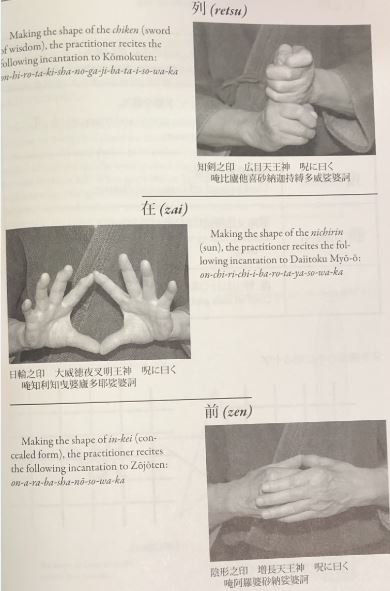
Ninjutsu as promulgated by Masaaki Hatsumi follows the Buddhist traditional mudra.
Kuji-In, “Nine Syllable Seals,” is a form of meditation that encourages the development of the spirit, mind and body. It links hand postures – mudra – with chants – mantra – to enhance the practitioner’s focus. The following are the nine Kuji-In, their Japanese names and the developmental benefits:
RIN – Reinforces the positive aspects of the physical, mental and energetic planes.

Hands together, fingers interlocked. The index fingers are raised and pressed together. Sanskrit incantation is On baishiraman taya sowaka. The name of the mudra is dokko, “seal of the thunderbolt.”
KYO – Increases the healthy flow of energy.

Hands together, little fingers and ring fingers interlocked (often on the inside). Index finger and thumb raised and pressed together, middle fingers cross over index fingers and their tips curl back to touch the thumbs’ tips, the middle-fingers’ nails touching. Its mantra is On isha naya in tara ya sowaka. Daikongo, “seal of the great thunderbolt.”
TOH – Enhances your positive relationship with the universe, resulting in improved harmony and balance.

Hands together, index fingers cross each other to touch opposite ring fingers, middle fingers crossed over them. Ring and pinky fingers are straight. Tips of ring fingers pressed together, tips of pinkies pressed together, but both sets of ring and pinky fingers are separated to form a V shape or bird beak. The mantra is On jite rashi itara jiba ratanō sowaka. This is the “seal of the outer lion.”
SHA – Develops enhanced healing, regeneration.

Hands together, ring fingers cross each other to touch opposite index fingers, middle fingers crossed over them. Index finger, little finger and thumb straight. The mantra is On haya baishiraman taya sowaka and its name means “seal of the inner lion.”
KAI– Develops foreknowledge, premonition, intuition, feeling.

Hands together, fingers interlocked. The mantra is On nōmaku sanmanda basaradan kan. The mudra is “seal of the outer bonds.”
JIN – Increases skills of communication, and knowing, and by extension telepathic ability

With your hands together, fingers interlocked, with the fingertips inside. Mantra is On aga naya in maya sowaka. Mudra is “seal of the inner bonds.”
RETSU – Enhances the perception and mastery of space and time.

Left hand in an upward-pointing fist, index finger raised. Right hand grips index finger, and thumb is pressed onto left index’s nail. Mantra is On hirota ki shanoga jiba tai sowaka. Mudra is “seal of the wisdom fist,” also known as “seal of the interpenetration of the two realms.”
ZAI – Fosters a relationship with the elements of creation.

Hands spread out in front, with thumb and index finger touching. Mantra is On chirichi iba rotaya sowaka. The mudra is “seal of the ring of the sun.”
ZEN – Results in Enlightenment, completeness, suggestive invisibility.

Hands form a circle, thumbs on top and fingers on the bottom, right hand overlapping left up to the knuckles. The mantra is On a ra ba sha nō sowaka. This mudra is “seal of the hidden form,” or more simply the “meditation mudra.”
Master Keating puts it all in proper perspective
_________________________________
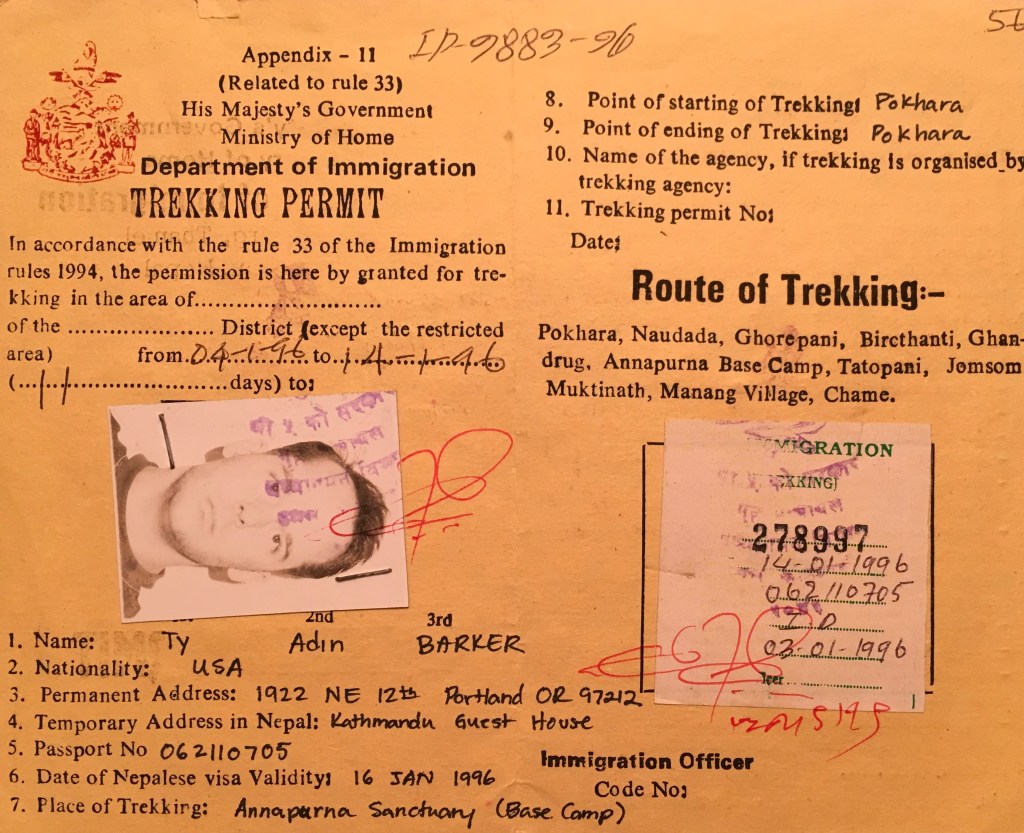
I flirt with mantras and admit a slight fear of their power. While trekking in Nepal (1992), I purchased a ring I still possess, with the protective mantra written in Sanskrit – Oṃ Maṇi Padme Hūṃ – I was taught the mantra and recited it while hiking the Annapurna Circuit.
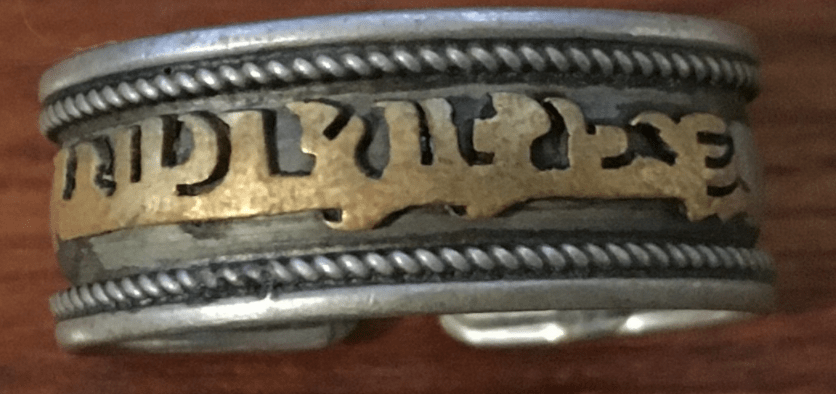
The ring is of rather crude craftsmanship and I purchased it in Pokhara before embarking on the journey.
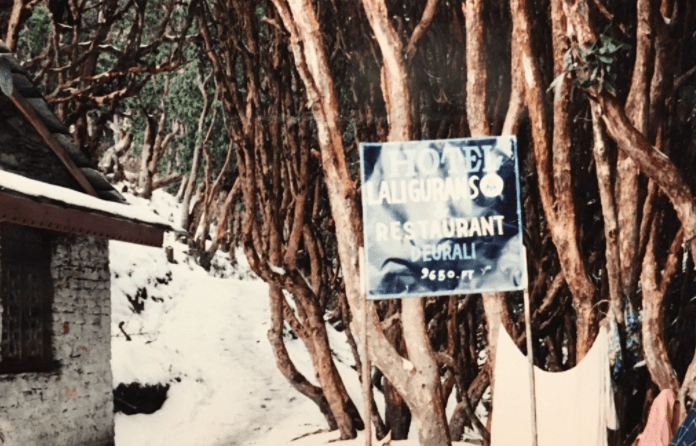
The mantra purifies – om reduces pride and ego, ma jealousy and lust, ni desire, pad ignorance, me greed and possessiveness, and hum aggression. I was fresh from training at Hombu and was in prime physical condition so trekking the Himalayas carrying a 70+ lb pack seemed a minor effort. But I did not recite the matra effectively. My pride exceeded the strength of my ligaments. Traversing the Modi Khola ravine between Landrung and Ghandrung, my left knee gave out.
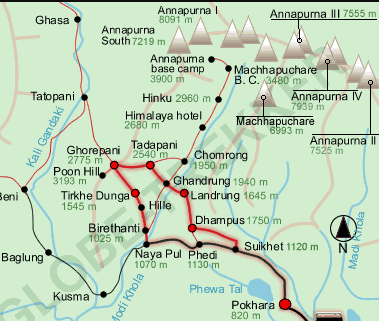
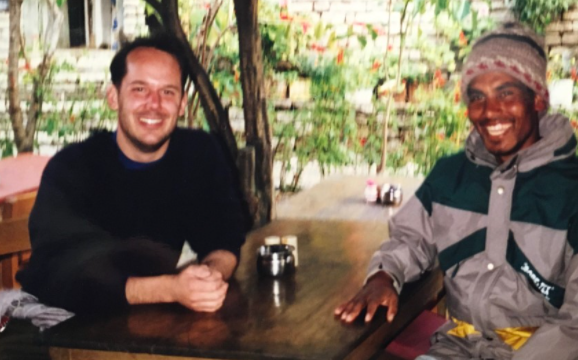
In Ghandrung a Nepali woman gave me “Nepali medicine” to help my knee. She set a pan of salt water on a stove in which she soaked a rag and then bare-handed it on my knee. It was scalding! She laughed as I winced in pain – her hands inured to the heat from years of cooking. The treatment helped, but I could no longer carry my pack, so I hired a sherpa to carry my gear to Tadopani.
Tadopani is “hot water” and a natural hot spring where I convalesced; soaking daily to recuperate my injured knee. Tadopani is a popular resting point – still low enough on the “apple pie trail” to have fruit provided by the mule trains and the hot spring is popular with the European travelers who soak immodestly, which attracts the young Nepali boys who flock to the pools to watch.
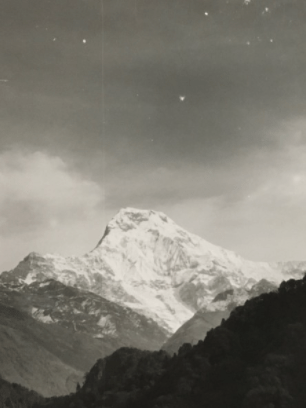
Tadopani is also close to the Kali Gandaki river. I had carried a commemorative coin from Gilbert High School, where my father taught, and threw it into the river so a part of Connecticut history may now be flowing to the Ganges in India.

My trekking permit was set to expire and I had a scheduled flight to France, so I limped back to Pohkara and then back to Kathmandu. I never made it to Annapruna base camp.
 Protective Arts
One thought on “KUJI-IN, MUDRA, and MANTRA”