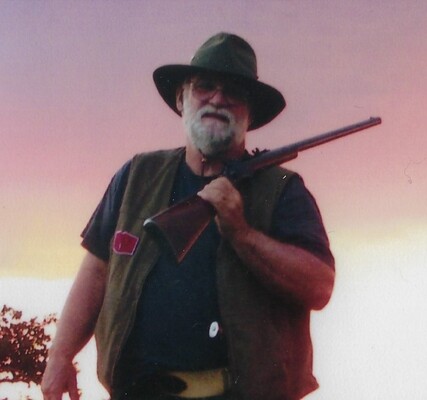
Japanese swords and smiths have an aura of the exotic, but the truth is a master smith in every culture is a wizard. The skill to transmute and forge raw materials into something beautiful and deadly is marvelous and magical.
Bill Bagwell was an American mage of blade craft. He died February 17, 2021. The king is dead. Long live The King of Bowies!
Bagwell started his craft early. He made his first knife at the age of 10 from an old saw, began forging knives in industrial arts class in high school (is that still a thing?), and by 15 he was forging hunting and Bowie knives as a hobby. He began selling knives while he was in college and became a full-time professional bladesmith in 1969. Bagwell is credited as the second modern smith to make Damascus blades in 1973, after six months of trial and failure.
In early 1976, along with Don Hastings, B.R. Hughes and Bill Moran, Bagwell became one of the founding members of the American Bladesmith Society. He wrote the original charter for that organization.
Bagwell was both a smith and a knife man. He authored articles on knife fighting for Soldier of Fortune and Tactical Knives. His book: Bowies, Big Knives, and the Best of Battle Blades (2000) is a must own.
Bill Bagwell as knife maker:
He is best known for his iconic Hell’s Bells Bowie:
I have not been able to find (and likely cannot afford) a custom Bill Bagwell Bowie, but I have managed to acquire a Bill Bagwell Ontario “Fortress.”
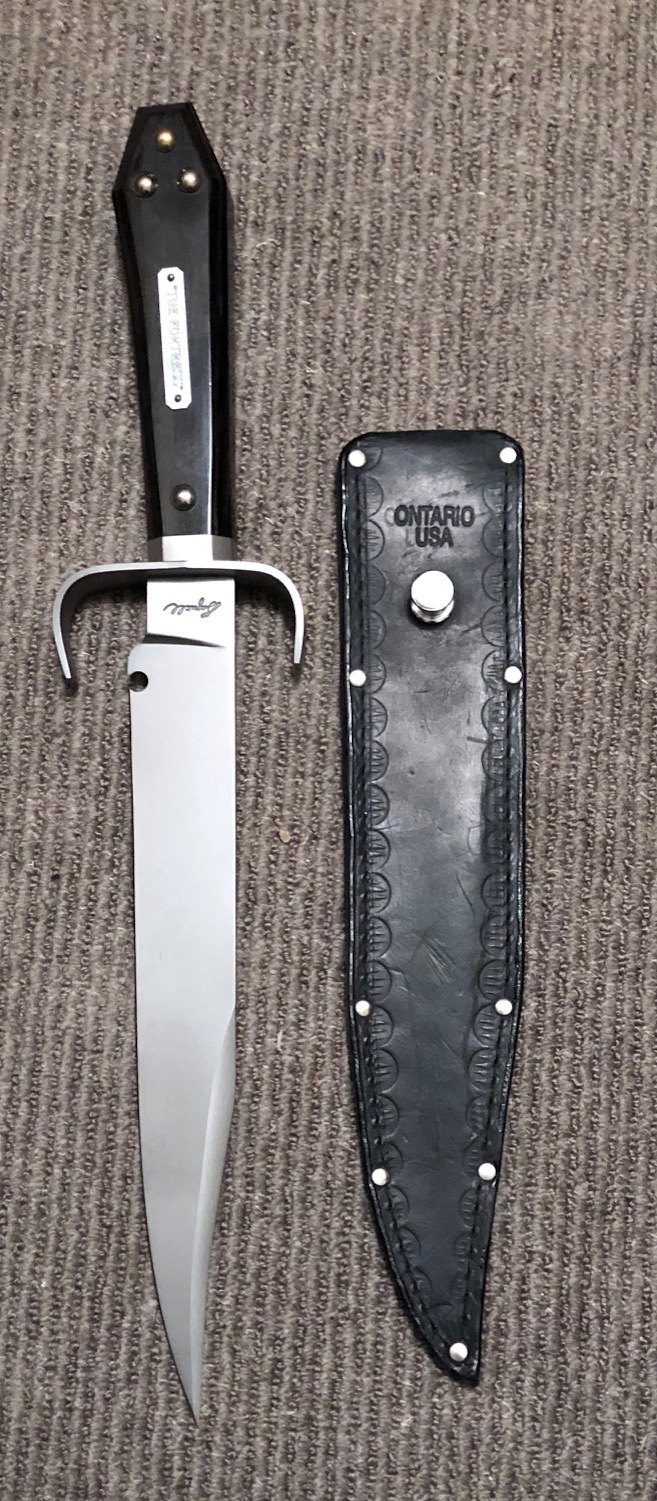
The Fortress
Although not a custom piece, this teaming up with Ontario Knife Company represented the peak of mass produced fighting knives. The blade is just over 10″ long but it is amazingly quick – far nimbler than my comparably sized Cold Steel Laredo. The Ontario version features QS13 proprietary steel, exquisite balance and finish, coffin-shaped handles, an engraved escutcheon plate, and a shaving-sharp edge.
I am envious of those who own a custom knife, properly fitted by Bill Bagwell.
Bill Bagwell made a custom Bowie knife for Master Keating who told me the following story:
“Bill Bagwell and I were at the Soldier of Fortune convention in Las Vegas and after dinner one night Bill asked me how my Bowie was holding up. He had made that knife for me several years prior. He took a professional interest in his products and their proper maintenance. I drew the Yellow Eagle (that’s my name for it because it has a golden colored Bodark wood handle in the form of an Eagle head) and handed it to him. The blood red sheath showed little wear and that seemed to please him some. But when he inspected the blade, his assessment was that my knife was a tad bit dull. I was a bit surprised, since I know the importance of carrying a sharp knife and know how to treat an edge. Nevertheless, Bill is the master. Since there was no sharpening stone in our hotel room I asked Bill how he was going to remedy this issue. He said it was easy and asked me to sit down so we could talk a while. Bill took that scary sharp knife and began running it over the palm of his left hand. Every now and then stopping to “feel” the edge. Then he started again, that slow, deliberate stropping process against his tough smithy’s hand. Maybe eight minutes later he said to me, “feel this now Keating.” Holy shit, it WAS sharper! That was amazing. Only a man who lived and breathed Bowie knives could or would do something like that.”
 Protective Arts