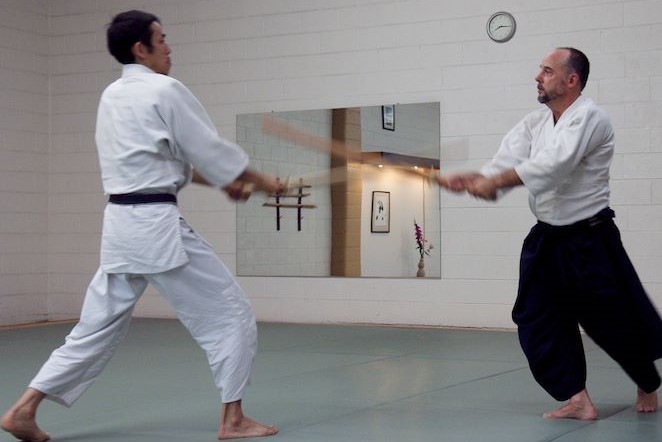
Over the last two classes, we covered the foundational suburi (sword forms) for bokken which are derived from Chiba sensei’s curriculum. We will continue to refine and expand the conceptual movements over the next several classes.
To provide video references between dojo sessions, here are the eight basic suburi as demonstrated by Hori sensei:
And this presentation from Brady sensei who was an early student of Chiba sensei’s when he was in England:
These forms are simple patterns.
Numbers 1 and 2 are essentially the same, with the only difference being the maai of the opponent, forcing nage to either retreat (#1) or enter (#8) to close the distance. Numbers 3 and 4 are linked, with #3 as a tenkan and #4 a draw cut, but again the same pattern with either a retreat (#3) or closing movement (#4). Numbers 5 and 6 address a flanking opponent and the close or more distant maai. Number 7 contemplates an opponent immediately to the rear (check your 6 o’clock!) and number 8 is similar to 5 and 6 in addressing the flank but this time the inside line rather than the outside.
As I have alluded in class, these sword forms are the basis for empty hand throws. This example from Chiba sensei demonstrating an #8 as shihonage.
When we get back to empty-hand contact training, the shihonage forms in #3 and #4 will be easily recognized and felt.
Because the suburi can be practiced solo, they are immensely beneficial to augment your Aikido training during the time of Covid. Focus on developmental precision – remembering only perfect practice makes for perfect form.
Hints. Use a fixed starting marker for your right big toe. As you move through each of the eight suburi, at the conclusion of each, your toe should hit the same starting mark. To ingrain precision, make sure all cuts remain on the same line, you are hitting only the four cardinal directions: For suburi 1, 2, 3, 4, and 7 you only cut north and south (zero and 180-degrees) and suburi 5, 6, 8 cut east and west (90 and 270-degrees). Once you develop familiarity with the footwork necessary to perform these eight suburi and can move smoothly through the patterns, the next level of development is conceptual. Meaning, these cuts and the associated footwork appear to cover only four angles, simply rotate these four 45-degrees and now all eight are addressed.
Slow is smooth, smooth is fast. While demonstrating, I will often break the continuous movement of the sword at check points. I do this to provide visual markers so you can verify that the sword position is correctly oriented. But once you can hit each mark with precision, then it is time to work on continuity of motion. Remember, the sword cuts with velocity, with continuous motion, not with muscular force, so keep the shoulder joints freely moving!
Transitions are critical. Moving your body around and under the sword so that you do not slow its motion is key. This is easier to demonstrate in class than it is to describe in writing, but the general reminder is that each time you turn your body, it should be under the sword to avoid ‘cavitating’ the blade. The sword should be moving in continuous arcs on the vertical axis only throughout these eight suburi.
Keep training!
 Protective Arts
3 thoughts on “CLASS NOTES – Eight Ken Suburi”