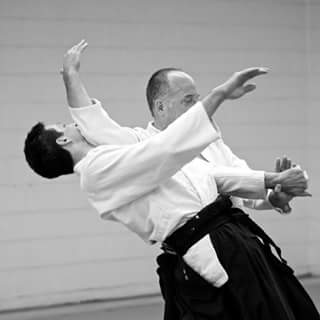
A class outline for progressive techniques from static gyaku hanmi katatae dori
Gyaku hanmi katatae dori: what is it? A hand grab. Why? Uke stop-hits a thrust, taking control of nage’s knife hand. From the grab, each player needs to match extension to create the dynamic tension necessary for a static encounter.
Nage’s focus is on tension-release. Solve the basic problem of moving around the fixed point (axis) of the encounter. The basic (kihon) resolution is tenkan.
From tenkan how does nage extract the knife/free the grasped arm? By simply raising his arm like bringing a sword to jodan. Nage needs to keep his arms close to his center and with a slight camming action of the grasped arm – from knuckles to the mat to shyuto to the mat – while raising the sword to jodan. Two variations here on footwork (ashi-sabaki): last night I demonstrated a simple slide entry rather than a full irmi-tenkan, both are possible. From jodan, turn the hips toward uke’s center then drop your arm for kokyu stretch.
The bunkai (application) is to grasp uke’s obi (belt) with the free hand and then break the back over your knee by driving the grasped hand down over the neck. In polite Aikido grabbing the obi facilitates leading uke’s center forward. As uke, keep your belly muscles engaged, do not simply “limbo” through the stretch. If nage raises their arm, advance toward it to keep contact (don’t create a gap); when nage lowers the arm, keep positive pressure against it. Any gap in contact is an opening to strike: close the spaces to avoid atemi.
From the stretch, a breath throw is possible: kokyu-ho. I demonstrated both the basic and the dynamic variation which replicates the sword raise to an immediate turning cut. The important body mechanics are the same however: from the grab, slip to the flank while allowing uke to keep the initial grab, raise your sword, turn your hips back toward uke’s center, drop your arms heavily and dynamically straight down (cut with your sword) as you advance with your hips through uke’s position. The throw is a physical displacement of uke’s body augmented with the arms – the arms must break the balance (i.e., manipulate uke’s jaw/head) but the impelling force is from nage’s lower body and hips.
Progression: from kokyu-ho to kokyu-nage. If uke is resolute in their contact, or starts a reversal, nage must solve that new problem. Uke does not allow nage to raise to full jodan extension and keeps their weight forward, so nage now must change vectors. Do not continue to go through uke (against their weight) but rather find the path of least resistance and go with the flow – so execute a snappy turn of the feet, blend with the incoming force (face the same direction as uke) and throw forward. Nage’s arm movement is a cut down and I demonstrated with a bowie-knife trainer to make the camming action of the arm visible. Nage executes a C cut (from migi-hanmi [right] and a reverse C from hidari [left]). The final position of nage’s arm is shyuto toward the sky with a positive (forward extension) energy toward uke.
The tanren-geiko (body development) version requires solid connection to the mat and deep muscular action in the belly. To provide a fluid image, I then moved to ki-no-nagare presentation – a “two finger” throw. This is a visual presentation to show the dynamic fluidity of the motion. From a distance (increase maai) uke approaches. Nage presents two fingers to ensure lighter contact and flows in a continuous motion, drop weight (break uke’s balance), blend, raise, cut. Same principle motions now just done for continuity of motion – capture the timing to effect the throw.
Then back to more body development. What if uke holds on at the terminal motion – isn’t thrown? Uke starts to turn back to continue the fight, so nage has a new problem to solve. Before uke can punch with his free hand, nage must slip to the flank, grasp uke’s hand that is controlling nage’s knife hand and free it. This is otherwise called, gyaku-hanmi ikkyo. The ashi-sabaki is key to avoiding uke’s counter punch – don’t stay in a horse-stance where your nethers are exposed to uke’s snap kick. As you move off line, keep your grabbed hand low as you cam it from palm up to palm down, rotating against uke’s thumb. As uke’s thumb is exposed, break the clutch with your free hand – ensure your counter-grab is thumb over thumb. As you strip uke’s grasping hand you need good hand strength to compress uke’s metacarpals and rotate the small bones away from your center, which causes uke’s elbow to lock (bone-locking!) and rotate up. Facilitate all this with dynamic physiology – move your body toward uke and you can use your forward shoulder to augment the power of your counter-grab/stripping hand. If your hand strength is insufficient to rotate uke, then you need to use your full body weight to advance, compress uke’s hand against your shoulder/clavical and force uke’s elbow up.
Once you see the elbow point-up to the sky, that is the key. Nage uses their newly freed hand to eagle-claw uke’s elbow and cut straight down in order to continue the lock into uke’s shoulder. From there – execute the pin – inside knee to the ribs, shoulder driven straight down to damage the bursus, keep uke’s arm as vertical as possible. Then inside knee down, outside knee/thigh used as a brace point and as you advance to kiza, forward pressure with the outside knee to keep uke’s arm above the line of their shoulders. Nage should still have a firm/compression grab on uke’s hand which must be manipulated shyuto down toward the mat. Remember the key is uke’s index finger to make the pin effective! This ikkyo pin (flat on the mat) more closely resembles nikkyo’s hand control.
But what if uke is too strong to drive through to execute ikkyo? Making sure that you retained solid control over uke’s grasping hand, keep the rotation on and slip to uke’s rear – nage’s chest slides along uke’s back. This requires split coordination. Nage’s controlling hand leads uke away (and rotating) while nage’s free hand thrusts forward and leads nage’s bodily advance to uke’s rear. Imagine a fencer’s thrust, the limbs are moving in opposite directions. Nage’s goal is to get his free hand to uke’s neck. The counter ikkyo leads to irimi-nage.

From uke’s rear, nage can firmly grab uke’s neck – pressure points and mastoid muscle, then with a turning drop, bring uke to the ground. From there, nage can exert neck control, but as uke raises to escape, nage remains “in the pocket” behind uke to execute a throw (strike to the jaw). The polite Aikidoist will ensure that nage always maintains a close control on uke’s neck – firmly attach it to nage’s shoulder – so that the throw is a rotational control and not a strike. Nage’s arm appears to windwill for the throw, but that is to avoid the live edge. Nage is using the false edge to trap and throw rather than decapitate.
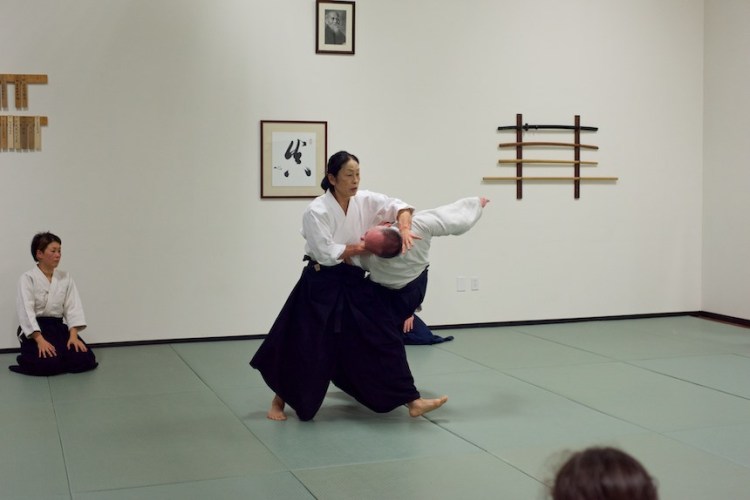
Gyaku-hanmi -> kokyu stretch -> kokyu ho -> kokyu nage -> ikkyo -> irimi nage.
Just one possible progressive technique sequence to demonstrate the dynamic nature of Aikido.
 Protective Arts