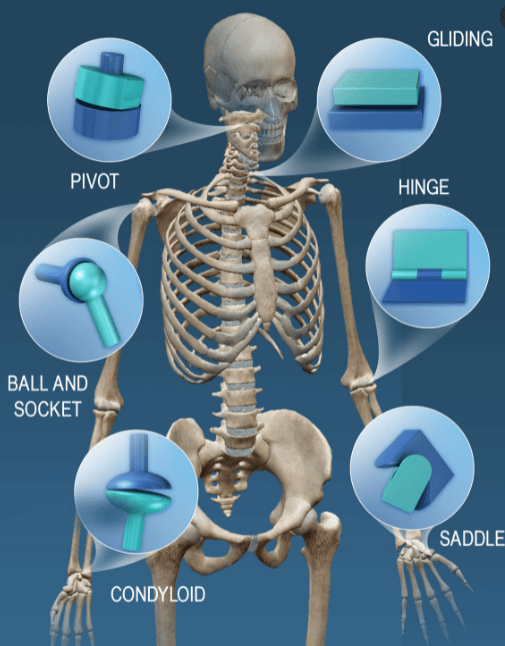
Any martial artist must study the use and limitations of the body; its structure and mechanics – and specifically its joints. (The banner image shows the major synovial joints of the skeletal system.)
In Aikido, we are principally concerned with the control of the opponent’s “center” but the techniques achieve this by working from the outer joints toward the inner joints:
[Fingers] -> Wrist -> Elbow -> Shoulder -> [Hips] -> Neck / [Head/Spine]
I [bracket] those parts of the body that are used but not always given the primacy of focus that they merit. The joints of the lower body, foot, knee, to hip are subject to the same manipulation as the upper body, but they are not the primary focus of Aikido.
Fingers/Wrist
The fingers are not explicitly discussed as often as they should be. Aikidoists usually discuss the tekubi (wrist) as if nikkyo/sankyo/kotegaeshi were just “wrist” manipulations. The progression starts small bones to larger bones.

Nikkyo as a wrist lock only works when the thumbs are aligned so as to compress the metacarples and the power of sankyo is amplified when the phalanges (fingers) are captures and torqued. Kotegaeshi as a proper knife strip must control the thumb first before the turn of the wrist. And knowing that the wrist is a condyloid joint (a limited hinge) allows us to manipulate the elbow through the wrist by applying pressure along uke’s shyuto during the throw.
It is important to know that the hand is holding the weapon and therefore a critical target to manipulate and disable.
During our warm-ups, we self-manipulate our wrist joints. Too often this becomes a rote activity, done so often it becomes perfunctory and devoid of real value. Slow down and really manipulate your body to learn to better manipulate others.
Ikkyo – compress your wrist joint tightly, fold your fingers to your inner forearm, yes, but then isolate the fingers while the wrist is bent to compress them individually. Can you get your thumb to touch your inner forearm? Feel how your index finger is more painful to compress – that is the extensor indicis proprius (EIP) tendon.
Nikkyo – fully grasp your own hand to compress the metacarpals and position them 90-degrees from your own wrist and only then crank them, little finger leading, toward your nose. You should feel a strain in the muscles in your forearm and your elbow should lock. Lock small joints to control larger ones closer to the core.
Sankyo – this is the clearest example of small bones locking to control larger ones. While we usually grasp palm to palm so our controlling hand had thumb around tekubi and fingers around the opposing thumb, try grasping your fingers instead and then applying the outward torque. You should feel your fingers lock wrist then wrist lock elbow to then drive the forces into your shoulder.

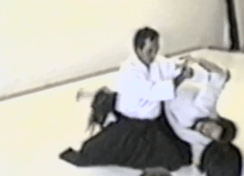
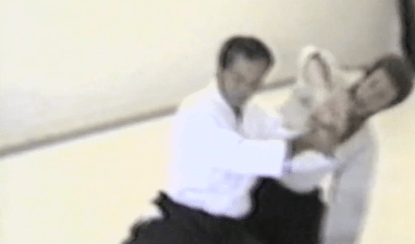
Yonkyo – is a nerve and tendon manipulation foremost, but it requires a torquing action on the wrist to expose the median nerve and make it easier to manipulate.
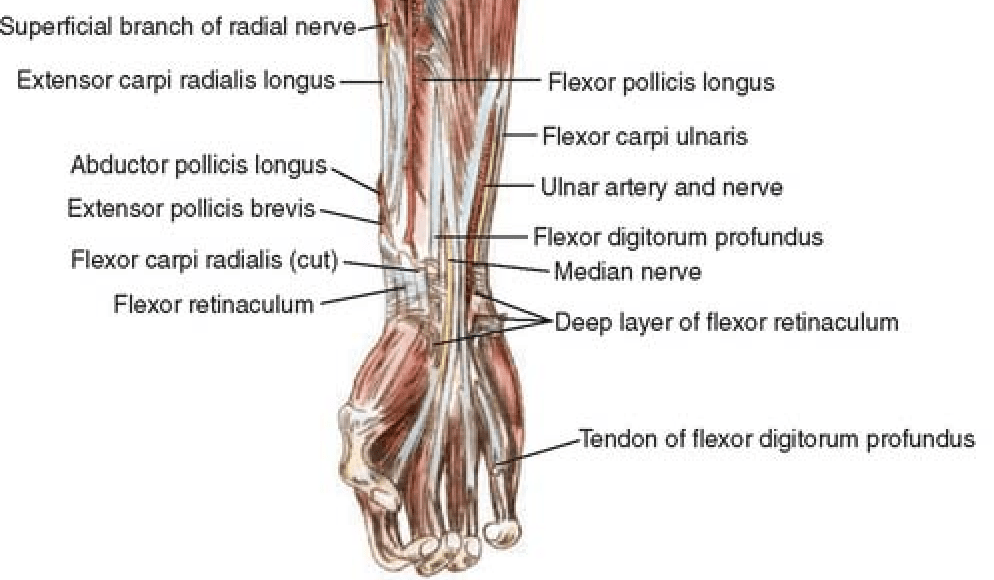
Any yonkyo’s failsafe is to crank the wrist in a two-handed grab to lock the elbow, brace uke’s shoulder on your lead knee and then drive into uke’s shoulder for the control.
Gokyo – requires the same hand control and manipulation that nikkyo does, but it is taught as a gross-motor, stop-hit first. Neglect the hand control at your peril.
The fingers are the key to wrist control, and the wrist is the key to locking the elbow.
Elbow
The elbow, or hiji is a primary target for Aikido. Both hiji-kime-osae and ude-kime-nage name the elbow explicitly, but the anatomical target of shiho-nage, ikkyo’s pin, figure-4 locks are all the elbow. Lock and break the elbow with a direct force against the hinge and the arm is rendered combat-ineffective.

With longer two-hand weapons like the sword and spear, the elbow is relatively inert when compared with one-handed blade use. In pugilistic arts, the elbows are direct extensions of the body structure and act to transmit power from the spine to the hands via shoulder/hip rotation. Likewise, manipulating the opponent’s elbow creates a direct path back to the the head/neck/spine via the shoulders.
I have covered ikkyo in several posts to cover aspects of this ‘basic’ technique but here it is important to see ikkyo as an elbow manipulation because it is an accessible contact point, proximate to the body and below the threat of uke’s weaponized hand. The intercepting contact with the forearm is really a stop-hit at the triceps to better access the elbow in order to take uke’s balance and control them.
Understanding how the elbow is manipulated, we should learn how to defend against – or limit the exposure – we have in the offense. The shape of the ‘unbendable arm,’ exercises like hiriki no yosei and the jodan blocks in karate all emphasize the connection between the elbow and the core.
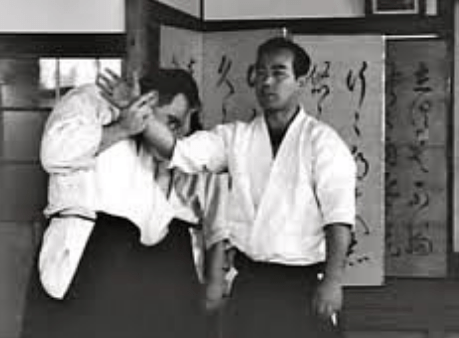
The physiology is simple: keep your elbows ‘soft’ (don’t lock them, keep a slight bend at all times) and keep your armpits closed. As soon as your elbow breaks the horizontal plane, it will be used against you to control your balance.
The offensive use of knees and legs are not part of the overt curriculum in Aikido, but note that your elbows and knees are essentially the same joint type. And where the elbows connect to the upper body to spine (center), the knees of course connect to the lower body in the same manner. Therefore, they can be used to disrupt the hip line and the opponent’s spinal integrity from the bottom up.
It is also vitally important to understand how knee alignment is to effectively transfer power from the hips; and not just for muscular transfer from kicks, but also for delivering upper body strikes, throws and fa jin projections as well. The knees and feet should point in the same direction and be aligned the the top of the sacrum to allow for maximum rotation and energy transfer from the feet into the spine via the hips. We keep this connection by use of the sliding step (suriashi) and by flexing bodyweight onto the balls of the feet by bending the knees and pointing them into the target.
Shoulders/Hips
The shoulders and hips are identical ball joint structures on the high and low lines and are responsible for transferring power from the spine to the extremities (arms and legs). As such, learn to use your peripheral vision tuned to the shoulders/hips to read your opponent’s intent and respond accordingly. Stay ahead of your opponent’s OODA loop! Aikido teaches that the hips are the body’s primary driver of momentum and power generation.
The shoulders are a key area of focus, both offensively (in using a sword) and defensively. A simple example is counter-yokomen, where nage strikes to the front of the shoulder to check the opponent’s arm while entering. The vast majority of Aikido’s locks and controls are applied to the shoulder in order to dislocate it or to secure the lower arm and weapon.
Entering to control the shoulders and hips is done to ‘control the center’ and more honestly, to get easier access to the head/neck/spine.
Head/Neck/Spine
The head appears to be an easy target, but it is encased in bone (skull) designed to protect the brain. While weapon strikes to the head (especially heavy blunt force) can be very effective, closed-fist strikes will usually do more damage to the assailant unless they know precisely where to strike. There are soft tissue targets on the head, such as eye sockets/temples and ears, but these are small targets and we all move our head reflexively to protect them. If, however, you have properly moved up the chain, locking hand to elbow to shoulder to gain access to the head, neck and spine, you now have several handholds (ears/hair/eye sockets/mouth) that are easy to grab and manipulate. Polite Aikido ignores most of these natural handholds, but the bunkai of irmi nage will still employ nerve control on the mastoid.
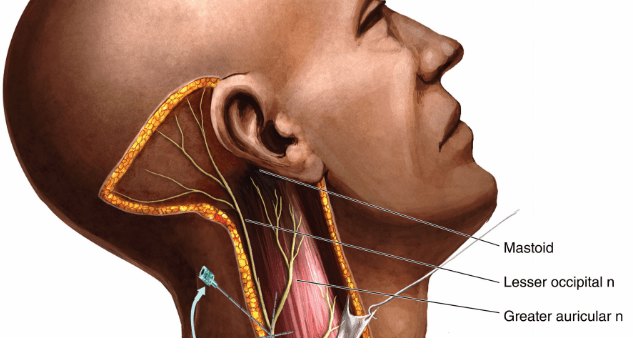
The neck is the most vulnerable part of this chain since it is without a protective bone structure such as the ribcage and skull, so the soft tissue and nerves are exposed and vulnerable to direct manipulation or attack.
For the spine, it is usually well protected by muscles of the back and can be hard to attack. The tailbone is a notable exception and can cause disruption through the whole spinal chain when damaged. This can be done using strong, direct knee strikes or also by causing the opponent to land heavily when sitting down backward from a sweep or drop.
_____________________
This article should be reviewed in conjunction with Human Frailty as well as Will To Win, both of which review physiology, and Thrusting Triangle which shows proper targeting, all of which takes place within the box containing our larger vital organs bracketed by the four points of both shoulders and both hips.
 Protective Arts