Molly Young covered the topic of disgust in her December 27, 2021 article in The New York Times Magazine, “How Disgust Explains Everything.” Her protagonist is Paul Rozin, a professor of psychology at the University of Pennsylvania. Young’s article is a quick introduction to the topic and Rozin’s work is important as an expansion of the individual’s understanding:
Rozin also elaborated what he called the “animal reminder” theory, which posits that disgust is a way to strenuously ignore the mountain of evidence that humans are, in fact, mammals who eat, excrete, bleed, rut and die just like every other mammal. Our hygiene laws require that we avoid playing with our own feces, as dogs do. Our sexual laws require that we refrain from having sex with our siblings, like cats, or copulating with the dead, like certain snakes, or cannibalizing our children, like rabbits. Adhering to such purity rules goes a long way toward minimizing awareness that our bodily temple is only a meat suit. One of Rozin’s most intriguing theories is that disgust operates as a foreshadowing of our own deaths. Every encounter with moldy meat is a sneak preview of the fact that we will all, at some point, become moldy meat ourselves.
Molly Young, How Disgust Explains Everything
We are inescapably mortal animals. The internalization of these biological prohibitions evoke a visceral reaction like disgust.
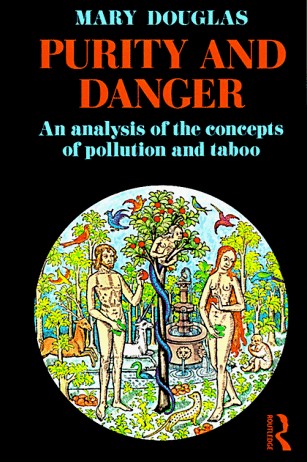
The implied functionalist argument, that our disgust is a reflection of a deterministic need to avoid certain behavior or food, being grounded in individual psychology seems a more granular exploration of the much earlier work by Mary Douglas in her (1966) Purity and Danger.
The anthropological perspective that Douglas provides show that disgust is a reaction to violations of purity. Understood broadly, purity is boundary maintenance: a means of demarking necessary separations. Her brilliance was distilling ethnographic details into a general understanding of the differences between the sacred, the clean and the unclean in different societies and times, to show that distinctions of purity denote areas where boundaries are important.
The clearest example is that Kosher laws are not rudimentary health-regulations or capricious mandates God, but rather a means of boundary-maintenance, a means of group-identification.
Evolutionary psychology and human sociobiology often reject the mere possibility of symbolic causality. Conversely, theories in which symbolic causality plays a central role tend to be both anti-nativist and anti-evolutionary. This article sketches how these apparent scientific rivals can be reconciled in the study of disgust. First, we argue that there are no good philosophical or evolutionary reasons to assume that symbolic causality is impossible. Then, we examine to what extent symbolic causality can be part of the theoretical toolbox of the evolutionary social sciences. This examination leads to the conclusion that it is possible to make evolutionary sense of Mary Douglas’s theory of disgust, and that her view of symbolic causality can and should inform evolutionary theories of (sociocultural) disgust.
Why Darwinians Should Not Be Afraid of Mary Douglas—And Vice Versa: The Case of Disgust
 Protective Arts