PROCEED WITH CAUTION! [1]
A knife is a deadly weapon. It is easy to obtain, nearly instinctive to use, and is by far the most deadly weapon most of us will encounter. Therefore, please understand that tanto dori is an historical artifact more suitable to the dojo than the street. The attacks we defend against are predicated on the presence of body armor and thus do not represent how assaults will actually occur.
Even in the dojo, knife disarms are more challenging than either jo or bokken because they are smaller and faster. A knife is faster because it is manipulated by more joints in the body and because they are used at close range, thus the reactionary gap is small and the potential vectors of approach are greater.[2]
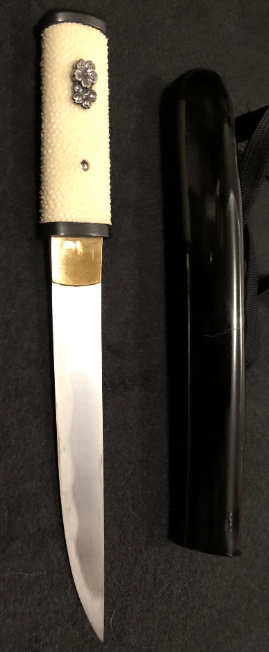
Aikido has the “advantage” of being culturally constrained in its use of the knife. First, the knife is a tanto. The design changes slightly throughout it history, but in general a tanto should have a single live edge and a blade length of 10″ (~ one shaku), which is longer than the truncated version used in the dojo. (The typical dojo tanto is closer to a kaiken in length.) Second, tanto attacks in Aikido presume limited targeting dictated by the historical use of armor and its use as a weapon of last resort. Presuming a protected target, Aikido’s offensive use of the knife focuses on the direct upward thrust (tsuki), the direct overhand (shomen), and the oblique highline (yokomen). Finally, the presumption is that the first attack is the final strike; there are no sniping attacks, feints or deceptive uses of the blade before the terminal attack is given.
The use of the tanto
Techniques are usually demonstrated when uke already has a naked blade, they are without the full context of a draw. Chiba sensei was rare in actually training from the draw. Because the tanto was carried blade up (like the katana and wakizashi), the natural draw would place the live edge up for a thrust. However, the draw can place the blade in either the edge up or down position – it depends entirely upon the initial grasp. If uke grabs the handle knuckles facing out the blade will be up, and if the grab is with knuckles up (as in iaido) then the blade will be down.
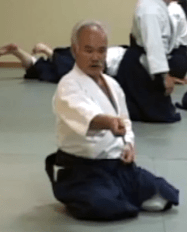
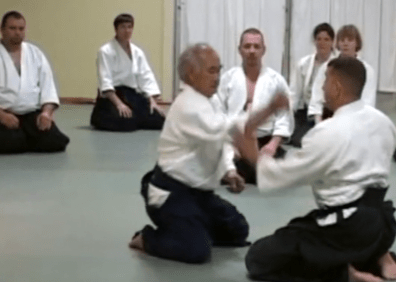
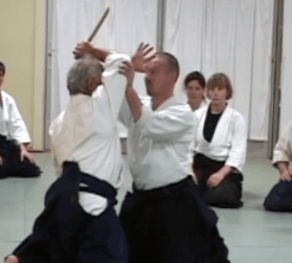
Chudan Tsuki is direct thrust to the abdomen and usually demonstrated with the live edge down. Historically, however, it was probably more often delivered blade up from a close quarters draw. The blade up thrust also has the advantage of keeping the cutting edge in line with the rising arc of a low to high delivery to rip through the abdominal viscera. Regardless of the delivery, the chudan tsuki thrust targets the abdominal region under the cuirass – dō (胴(仏胴) – centered on the line of the navel.[3]
To puncture the natural armor of the skull, both shomen and yokomen strikes are delivered from an ice-pick grip – the live edge is out and the tip is point down. These are power strikes designed to puncture not slash.
In short, because Aikido is focused on defending against the terminal, killing thrust. The actual mechanics of a knife fight with feints and warding slashes are largely ignored as mere preambles. This reflects the historical use of the tanto as a ‘minor weapon’ rather than a primary tool of offense or defense. Therefore, both the attacks and the defense against those attacks are severely limited and need to be appreciated with the appropriate context.
Historical Techniques
Budo (1938) is a compendium of techniques, photographed by an army film crew, O’Sensei taught to his pre-war students and there are precisely three knife defenses; two shown from chudan tsuki and one from shomen uchi. I encourage all serious students to acquire the book, which is readily available as a download (along with Saito sensei’s commentary) from Aikido Journal.

Tsuki -> irimi nage; tsuki -> kotegaeshi; shomen uchi -> gokyo and that is it!
Saito sensei’s explications of Budo are useful, but also show the simplicity of the responses:
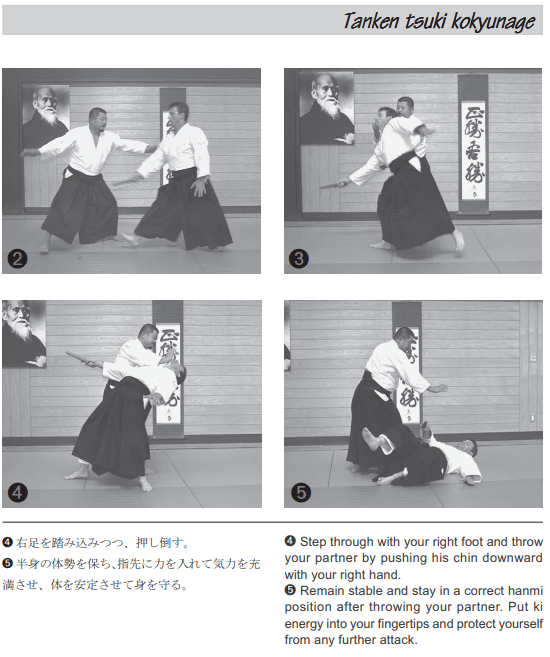
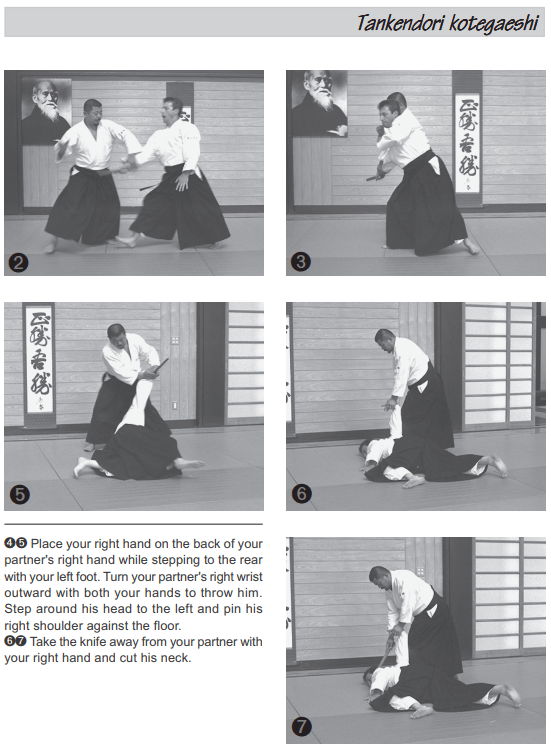
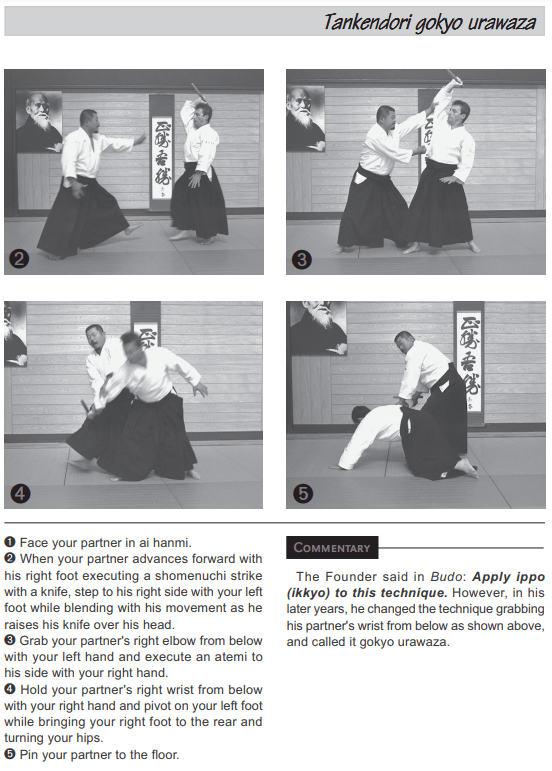
While the responses to a knife attack are limited, Budo does show a greater number of responses against sword and bayonet (juken) which have been adapted to tanto.

For example, rokkyo is easily adapted regardless of what weapon is used on for the thrust:
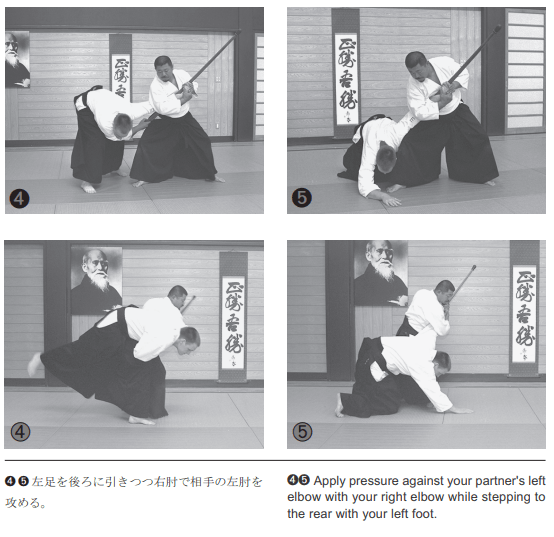
Never forget the seriousness of these techniques. O’Sensei was teaching soldiers with the explicit understanding that they were learning to kill.
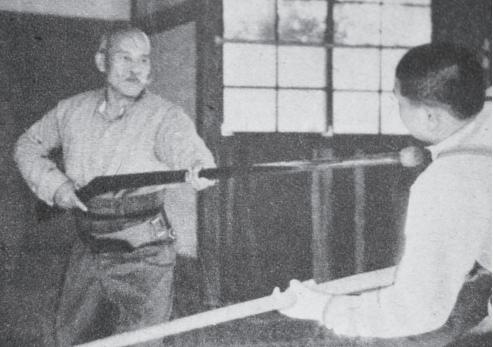
O’Sensei focused on techniques and weapons that were likely to be used in active combat. The Budo of 1938 is more focused and shows far fewer techniques that his Budo Renshu, published in 1933 that consisted of line drawings showing over 200 techniques. Because the 1938 techniques were selected with the battlefield in mind, they preference primary weapons – sword and bayonet – and provide only cursory techniques for the knife; a weapon of last resort for a soldier.
Modern techniques
Tanto dori has been expanded to fit within the matrix of standard Aikido techniques.
| tsuki | shomen | yokomen | |
| ikkyo | inside | direct | |
| nikkyo | inside | direct | |
| sankyo | both | direct | |
| yonkyo | |||
| gokyo | outside | ura | |
| rokyo (hijikime) | outside | outside | |
| kokyuho / kubishimi / figure 4 | outside | outside | blend |
| iriminage | both | both | blend |
| shihonage | both | inside | blend |
| kotegaeshi | outside | inside | blend |
| udekiminage | outside | outside | blend |
This is a useful cognitive structure, a framework to complete, primarily as an exercise to ensure you know how to perform each of the actions in the dojo.
Dangers of the dojo
I cannot stress enough the seriousness of knife disarms because a knife attack is the one form of attack we may encounter outside the safety of the dojo. Therefore, zanshin, active awareness, is critical and I strongly advocate for efficacity over form. To ensure there is some practical foundation in our response to a knife, the initial striking and trapping contact against uke will be emphasized. I teach tanto dori from axiomatic principles.
First principle: don’t get hit. Second principle: don’t allow uke to reset (strike twice). Third principle: keep it simple stupid. Thus, the axioms: move off the line, control the limb wielding the knife, take the knife. Based on these principles, I stress a modified matrix and preference fewer techniques and I preference techniques that result with nage directly controlling the blade.
Chudan Tsuki – Outside Line – Stop Hit
Meet on the outside line with limb destruction.[4] Nage must strike with the lead hand to uke’s radius bone with the intent to crush the radial nerve and stop the thrust before it achieves full extension. From this stop-hit, nage’s lead hand flows to uke’s knife hand to grasp the thumb with the intent to strip it off the handle.
After establishing this master grip, nage can now execute the primary techniques.
Kotegaeshi. Nage’s stop hit allows nage’s striking hand to control uke’s knife hand. Nage then uses his second hand to firmly close uke’s hand on the knife, and with an entering move forces the blade towards uke’s throat, forcing uke’s center back and up. Nage can then apply a standard wrist turn to a standing pin.
Sankyo. From the stop hit, nage covers uke’s knife hand from the top with the free (back) hand and shifts the stop hit hand to the bottom to fully encase uke’s hand on the knife. Nage then drives the blade back to uke’s center and as uke responds turns under uke’s arm to rotate toward uke’s neck with the blade.
Return to sender. From the stop hit, nage controls uke’s knife hand thumb and pulls uke’s center forward. Simultaneously, with the free hand, nage strips and turns the blade to extend toward uke’s center such that uke is impaled on their own knife.
Chudan Tsuki – Inside Line – Shield
The inside shield needs to be done with rapid succession to avoid uke chambering after the first thrust. Meet on the inside line with a shield, fingers pointed down while delivering a counter thrust to uke’s throat. From that spear hand to the trachea, nage traps uke’s knife hand against the shielding arm. From this position nage grasps uke’s knife hand (with focus on the thumb) and can execute gyakuhanmi katate dori techniques: primarily, ikkyo and nikkyo (each distinguished based solely on the pin), sankyo.
Chudan Tsuki – pass
The pass is an advanced play because it doesn’t immediately control the knife hand.
Returning the knife
Never hand the knife back to your opponent! Training to hand the knife back can lead to suicidal operant conditioning. Especially with tanto dori, apply all techniques with maximal bone-locking, constant pressure, effective pins, and make sure to retain control of the knife. To return the knife, make it a ritual to back away while holding the knife in a warding position. Once you establish a safe distance (maai), place the knife on the ground and force uke to retrieve the blade to start the sequence anew.
Reference Videos
Reference Books
Classical Fighting Arts of Japan, by Serge Mol
Tanto: Japanese Knives and Knife Fighting, by Russell Maynard
But there is no substitute for hands-on training and I strongly recommend James Keating for serious knife work and counter knife training.
___________________
[1] The links in this footnote are graphic and a reminder how seriously deadly a knife is – do NOT underestimate its lethality. >This< one from Australia and >this< from NYC (which has the added bonus of learning how f’d-up the DA is in NYC). There are numerous other graphic video reminders online and you should learn from the pain of others so you do not suffer it yourself!
[2] Angles of approach: the basic pattern for the sword has 8 cuts (and 1 thrust) whereas the knife has 12 (9 cuts and three thrusts).
[3] Following the line along the bottom of the cuirass, Sayoc will slash rather than stab, to release the small intestines – “the blue worm.”
[4] Chiba sensei told the following story that emphasized the importance of the stop-hit and limb destruction:
[On a voyage from Japan at sea]…we had a party on the ship when we crossed the equator, and I was asked to demonstrate. So I agreed, however there was no-one on board with any Aikido experience to act as my partner.
So one of the ship’s crew was asked to assist me, and he attacked me with a knife. At Hombu Dojo, in knife work, we made a positive attack with a Tanto (a dagger). But this guy was crouched low, moving around me, changing the knife from hand to hand. This was difficult, as when he made his attack I would not know which hand had held the weapon. So when he came at me I made Gedan Barai (the low sweeping block) with both arms, and I was able to deflect his attack. The point of his blade actually went through my Obi (belt) and just touched my flesh. From Gedan Barai I moved to a counter technique and broke his arm.
 Protective Arts
One thought on “TANTO DORI”