My initial attraction to martial arts was through the weapons as artifacts. I was entranced by the beauty of the swords at the Boston Museum of Fine Arts.[1] I still covet and collect weapons but the pragmatist in me knows this is a servile and dangerous affliction. The importance isn’t the tool, it is the skill of the one who wields it that matters!
And so my thoughts bounce between the raw practical use of a tool and appreciating the beauty of the object itself: A fighting mentality clouded by an aesthete’s sensibility.
I know I have deep deficits that I need to correct when it comes to knife work. I have never field dressed big game, nor have I ever butchered anything larger than a chicken. That is a knowledge gap that I should remedy.[2]
The meatpacking industry in America ramped up during the Civil War and Chicago became the processing center because it was proximate to the ranchers, rail, and rivers to receive and distribute the product. The volume of processing required great speed and thus the “Chicago way” of skilled butchery – the ability to separate choice cuts of meat from bone at speed using simple knives. Skilled butchery is an incredible art and highly translatable to martial arts.
A hanging stationary pig carcass was a challenge to cut, even with a very heavy cleaver. Although I have practiced tamashigiri with a katana, the most I have done with a knife was against “porkman” which proved to me how easily a standard pocket knife could deliver debilitating damage to an unarmored target.[3]
I firmly believe in the importance of winning and winning requires a fighter’s mindset. Thus, knife work is less about the tool itself than it is about the practical knowledge of just where to insert, slice, and cut (a butcher’s pragmatism) with dexterous skill which requires tool familiarity: how to grip-flip, heel-back, twist, and tuck the knife to make full and complete use of it.[4]
This morning I presented some dexterity drills, starting with the doce pares drill (12-count cutting), then moving to some grip exchanges – specifically transitioning from a number 1 and 2 slash (yokomen / gyaku yokomen) with the knife in a sabre grip, transition to ice-pick blade up, and return on the same line with a stab. Number 1 line becomes the number 6 stab and the number 2 line becomes the the number 7 stab: Lines can be points, and points are connected by lines.
To facilitate connecting lessons, I have incorporated some yokomen striking in the Monday class against focus mitts. Striking a resistant target empty-handed teaches how to use the hand properly – the impact conditions the hand and provides painful feedback when done wrong. We have not done impact striking with a knife and I can only assure you that it is invaluable to train full force strikes against a solid target.
The training post, or pell, is the simplest training device to practice striking, cutting, and thrusting with the sword, staff, or knife. Delivering cuts and thrusts against the air is great for developing basic technique, but the resistance of a solid target is necessary for conditioning the mind and body for impact. Striking a solid post will challenge your grip and expose weaknesses in your technique.
This brief survey is a reminder that we need to study deeply the use of weapons in conjunction with defending against them.
The tanto dori techniques covered this morning were against angle 1 and 2 – yokomen delivered from the right and left.
Against an ice-pick grip (stab), I showed the quick strip (one-handed disarm) which uses the same body mechanics as yokomen-uchi shihonage.
Against a sabre grip (slash), I focused on the lead-hand intercept, eye-spear to show the one-hit stop. From there the flow allowed uke to continue the slash as nage shifted their torso back and trapped the back side of uke’s striking arm with a checking eye-spear. This is a two-beat, parry – riposte. I also showed that if nage stops uke’s arc, nage must take the ‘low gate’ (beneath the striking arm) to uke’s eyes vs the ‘high gate’ (above the striking arm) when uke cuts through fully (i.e., past nage’s center).
Please do not forget opening vs closing actions. Nage’s initial intercepting motion is an opening, then the feint/lead is a closing, which will lead to the trap of another opening action.
This refresher on “beats” and “opening vs closing” actions reinvigorated the conceptual-level, but I moved back to more traditional “techniques” off the two-beat intercept. From the two-beat eye-spear, nage can “open” again while executing a snappy tenkan. This allows nage to use the spear-hand to capture uke’s knife hand while the nage’s intercepting hand wraps uke’s upper arm from the top for a figure-four lock.
The figure-four requires that nage get to the outside of uke’s body in one turn. The kubishimi disarm does not. From the third beat (open, close, open) where nage has grasped uke’s knife hand, nage’s initial intercepting arm is now across uke’s chin. From this position, nage must draw uke’s knife hand away from uke’s center which leverages the use of the arm nage has on uke’s chin. Uke will be drawn closer to nage’s armpit and uke’s head will be forced to turn farther. From this position, nage can use the arm which has now past well beyond uke’s head and turn down the thumb which turning to wrap uke’s neck in a vice grip and simultaneously levering uke’s knife arm elbow.
____________________
[1] Follow the link to the BMFA and there are many swords that still need to be photographed. I am fortunate to own Japanese Swords and Sword Furniture of the Museum of Fine Arts, Boston by Morihito Ogawa, which catalogues the most important pieces in the collection. The artistry and brilliant craftsmanship still captivates me!
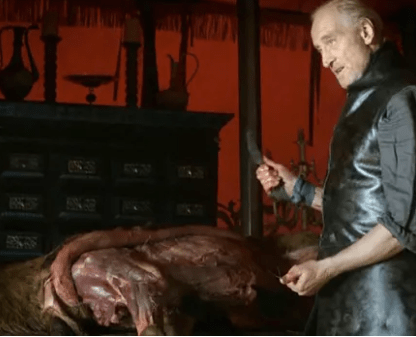
[2] The banner image is Tywin Lannister skinning a deer (Game of Thrones, Season 1 Episode 7) – symbolism made visceral.
[2] Review the post on SUEMONOGIRI and note the need for modern forensic studies because police needed to differentiate between wounds made by katana vs machete.
[3] Porkman was popularized by Michael Janich and his CQC material.
[4] I learned the basic knife dexterity drills from Master Keating. And while he has published some of his material on YouTube, the knife manipulation and retention drills are not available to the public. A proxy for those dexterity drills is this well-conceived presentation by Jeff Westfall:
_____________________
There are of course simpler training methods for counter-knife:
The combatives that came from WW2 are well worth your time to study – q.v., Fairbairn and Sykes, John Styers, and references to Bidwell.
 Protective Arts
One thought on “KNIFE WORK”